
About Gulab Singh
Lived 1792 – 1857 (aged 64). Gulab Singh was a monarch.
Early life
Gulab Singh was born on 17 October 1792 in the Hindu Dogra Rajput family which had ruled Jammu since medieval period. His father was Kishore Singh Jamwal. In 1808, following the battle of Jammu, the Dogra kingdom was annexed by Ranjit Singh. Apart from their sterling services, the family's intimate association with the region commended Kishore Singh's candidature to the Lahore court.
In 1821, Gulab Singh captured conquered Rajouri from Raja Agarullah Khan and Kishtwar from Raja Tegh Mohammad Singh (alias Saifullah Khan).
Raja of Jammu
Kishore Singh died in 1822 and Gulab Singh was confirmed as raja of Jammu by his suzerain, Ranjit Singh.
As raja of Jammu, Gulab Singh was one of the most powerful chiefs of the Sikh Empire. Under the imperial and feudal army arrangement, he was entitled to keep a personal army of 3 infantry regiments, 15 light artillery guns and 40 garrison guns.
In 1824 Gulab Singh captured the fort of Samartah, near the holy Mansar Lake. In 1827 he accompanied the Sikh general Hari Singh Nalwa, who fought and defeated a group of Pashtun rebels led by Syed Ahmad Barelvi at the battle of Shaidu. Between 1831 and 1839 Ranjit Singh bestowed on Gulab Singh the jagir of the salt mines in northern Punjab, and former confidential follower of Raja Dhyan Singh.
Intrigue at Lahore On the death of Ranjit Singh in 1839, Lahore became a center of conspiracies and intrigue in which the three Jammu brothers were involved. They succeeded in placing the administration in the hands of Prince Nau Nihal Singh with Raja Dhian Singh as prime minister. However, in 1840, during the funeral procession of his father Maharaja Kharak Singh, Nau Nihal Singh together with Udham Singh, son of Gulab Singh, died under suspicious circumstances when an old brick gate collapsed on them.
In January 1841, Sher Singh, son of Ranjit Singh tried to seize the throne of Lahore but was repulsed by the Jammu brothers. The defense of the fort was in the hands of Gulab Singh. Subsequently, Gulab Singh's youngest brother, Suchet Singh, and nephew, Hira Singh, were also murdered. As the administration collapsed the Khalsa soldiery clamored for the arrears of their pay. In 1844 the Lahore court commanded an invasion of Jammu to extract money from Gulab Singh, reputed to be the richest Raja north of the Sutlej River as he had taken most of the Lahore treasury.
However, Gulab Singh agreed to negotiate on his behalf with the Lahore court. These negotiations imposed an indemnity of 27 lakh Nanakshahee rupees on the raja.
Lacking the resources to occupy such a large region immediately after annexing portions of Punjab, the British recognised Gulab Singh as a Maharaja directly tributary to them on payment of 75 thousand Nanakshahee rupees for the war-indemnity. The angry courtiers of Lahore then incited the governor of Kashmir Imamuddin to rebel against Gulab Singh, but this rebellion was defeated, thanks in great part to the action of Herbert Edwardes, Assistant Resident at Lahore.
In the second Sikh War of 1849, he allowed his Sikh soldiers to desert and go to fight alongside their brethren in Punjab. The treaties of Chushul and Amritsar had defined the borders of the Kingdom of Jammu in the east, south, and west but the northern border was still undefined. In 1850, the fort of Chilas in the Dard country was conquered.
Maharaja Gulab Singh died on the 30th of June 1857 and was succeeded by his son, Ranbir Singh.
Gulabnama 5 Indian rupees postage stamp of Maharaja Gulab Singh released by Government of India on October 21, 2009.
Diwan Kirpa Ram of the diwan family of Eminabad wrote the first biography of Gulab Singh titled Gulabnama in the 19th century in Persian.
K. M. Panikkar describes Gulabnama as an authoritative source;
Don’t just read it —
keep it.
Full-length biographies made to live with: read them, listen on the way to work, watch them tonight.
- E-book
- Audio
- Video
Instant download · yours to keep · every purchase keeps this site free
Important facts
Family & relationships
People in Gulab Singh's life
Named in this biography and alive at the same time

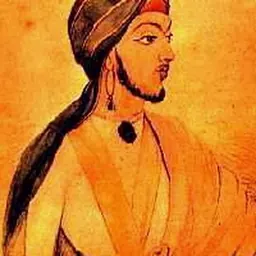
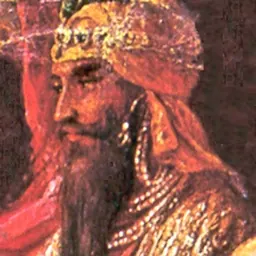
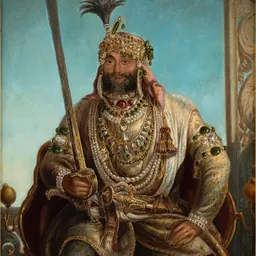


Related people
Same field, nearest in time


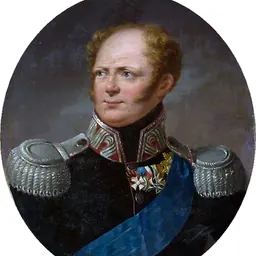

Contemporaries
People whose lives overlapped Gulab Singh's




Frequently asked questions
Who was Gulab Singh?
First maharaja of Jammu and Kashmir (1792-1857)
When was Gulab Singh born?
Gulab Singh was born on 18 October 1792 in Jammu division.
When did Gulab Singh die?
Gulab Singh died on 30 June 1857 in Jammu.
What was Gulab Singh's occupation?
Gulab Singh was a monarch.
Sources & further reading
Cite this page
APA: Biography.guide. (2026). Gulab Singh. https://biography.guide/gulab-singh/
MLA: "Gulab Singh." Biography.guide, https://biography.guide/gulab-singh/.
Chicago: "Gulab Singh." Biography.guide. https://biography.guide/gulab-singh/.
Data last updated: 2026-09-20 · Spot an error? Report a correction.
Page generated 2026-09-27 05:25 UTC