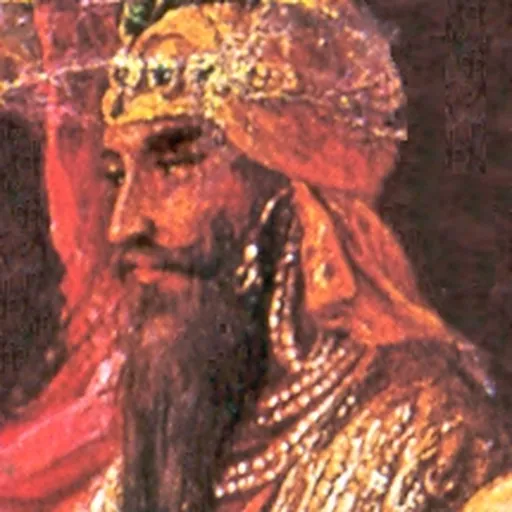
About Kharak Singh
Lived 1801 – 1840 (aged 39). Kharak Singh was a sovereign.
Kharak Singh (22 February 1801 – 5 November 1840) was the second maharaja of the Sikh Empire, ruling from June 1839 until his dethronement and imprisonment in October 1839. He was the eldest son of Maharaja Ranjit Singh, founder of the Sikh Empire, and his consort, Maharani Datar Kaur. Kharak was succeeded by his only son, Nau Nihal Singh. His mother was the daughter of Ran Singh Nakai, third ruler of the Nakai Misl.
A horoscope was commissioned for newborn prince, as was customary among the nobility of the time. Horoscopes were regarded as valuable indicators of the character and destiny of a future ruler. Astrologers suggested the prince be named according to the martial tradition of his family.
The prince was named by his father "Kharak" (ਖੜਕ) which means 'Wielder of the Sword' he was named after the unconquerable warrior mentioned in Dasam Granth. According to Gyani Sher Singh, Ranjit Singh knew the entire Dasam Granth by heart.
Ranjit Singh believed the birth of his son to be auspicious and his happiness was so great that Lahore was en fete. A full forty days were spent in alms giving, thanksgiving and celebration.
To celebrate his birth, his mother, Datar Kaur, asked her husband, Maharaja Ranjit Singh, to rebuild Gurdwara Janam Asthan of Guru Ram Das in the Chuna Mandi Bazaar at the birthplace of Guru Ram Das Ji. She felt that the ancestral home of Guru Sahib was too small, so Ranjit Singh purchased the surrounding buildings from the Qazis and had the gurdwara constructed in the architectural style of Sri Harmandir Sahib.
The following year, adorned with Tilaka, he was paraded through the streets of Lahore as Punjab's prince.
In 1816, in a formal ceremony, Kharak Singh was appointed Yuvraj Shri Tikka Kanwar by his father.
Early military campaigns and alliances
Kharak Singh was brought up in his family's martial tradition and assigned to a variety of military expeditions. While barely six years old, he was given the command of an expedition to conquer Sheikhupura the prince's mother then was gifted Sheikhupura Fort by his father.
In 1811, at the age of ten, the precocious Kharak Singh reportedly asked his father for control over the estates of the Nakai Misl—his mother’s kingdom—promising that he would render a far greater tribute than his cousin, Kahan Singh Nakai. His request was granted. Despite the revered Baba Sahib Singh Bedi's support for the Nakais the Nakai estates were obvertaken by Kharak Singh claiming he is "the grandson of the Nakais" while Kahan Singh Nakai was allowed to retain Baherwal with a jagir worth Rs. 20,000.
At a young age, he was engaged to Chand Kaur, the daughter of Jaimal Singh Kanhaiya of the Kanhaiya Misl, a match arranged by his father to ensure that the Kanhaiyas could not directly oppose the Sukerchakia heir-apparent. Following his marriage in 1812, he was placed in charge of the Kanhaiya estates. That same year, he was deputed—along with Dewan Mokham Chand and his tutor, Ram Singh—to punish the recalcitrant chiefs of Bhimber and Rajouri. Later in 1812, Kharak Singh received the principality of Jammu as his jagir. The campaign secured Sikh authority in the strategic footholds of the Kashmir region and Kharak Singh was praised for his administrative skills.
Kunwar Kharak Singh rides his horse as his mother, Maharani Datar Kaur, looks on.
Maharani Datar Kaur had a deep influence on her son and paid great attention to her son's education, as a result Kharak Singh mastered several languages and developed interests in cosmic sciences from an early age. Like his parents, Kharak Singh was deeply religious since childhood. He was a devout Sikh and admired for his piety and simplicity.
Kharak Singh shared a close relationship with his parents, particularly with his mother.
He cared for her deeply and was devoted to her throughout his life. Upon her death at Sheikhupura on June 20, 1838, he is recorded by Suri as having been inconsolable. Kharak Singh was a popular and well-regarded crown prince.
The same year, his mother, Mai Nakain took over his training for 18 months and even accompanied him to his expedition to Multan.
He was invested with the command of Siege of Multan (1818). During the battle the queen herself oversaw the steady supply of grain, horses, and ammunition being sent to Kot Kamalia, a town equally distanced between Multan and Lahore. In 1818, together with Misr Diwan Chand he commanded an expedition against the Afghan ruler of Multan Nawab Muzaffar Khan, achieving a decisive victory at the Battle of Multan.
The crown prince showed military talent hence was given a battalion to command during the Battle of Shopian, which resulted in the annexation of Srinagar and Kashmir into the Sikh Empire.
Maharaja of the Sikh Empire
On the death of his father he was proclaimed the Maharajah and installed on the throne at Lahore Fort on 1 September 1839.
Kharak Singh was a patron of the arts, and commissioned a Sanskrit astronomy manuscript – the Sarvasiddhantattvacudamani. and believed to lack his father's shrewdness and diplomatic skills. He developed a close relationship with his tutor Chet Singh Bajwa after the death of his mother, who gained such an ascendancy over him as to render him a puppet. Historians challenge the popular oriental notion of Kharak Singh being considered "imbecile", as said by Alexander Burnes and Henry Montgomery Lawrence -who had never met Kharak Singh. Burns was the first to refer to Kharak Singh as imbecile but also mentions that Kharak was extremely kind hearted and noted that the prince was the master of an impressive military and good at the administrating and handling important strategic and governing duties assigned to him.
Claude Martin Wade, who was at the Lahore Durbar for 16 years disagreed as well, stating that Kharak Singh was a man with a "mild and humane disposition, who was "loved by his dependants". Dr. Priya Atwal and Sarbpreet Singh note that Kharak Singh was politically intelligent and well versed in multiple languages, the most educated prince of Maharaja Ranjit Singh who not only led military expeditions but also diplomatic events.
Chet Singh was assassinated on 9 October 1839. Early that morning the conspirators entered the Maharaja's residence in the fort and assassinated Chet Singh in the presence of their royal master, who vainly implored them to spare the life of his friend.
In February 1840 Kharak Singh was officially deposed and imprisoned for supposed crimes. According to one account he was poisoned with white lead and mercury.
Dhian Singh had previously resisted attempts to allow Kharak training in statecraft, and on 8 October 1839 he instigated his removal from the throne with Nau Nihal Singh becoming de facto ruler.
Family
Wives According to Priya Atwal, the known wives of Kharak Singh were:
Chand Kaur Kanhaiya of the Kanhaiya Misl(1802-1842), daughter of Jaimal Singh Kanhaiya was the first wife and queen consort of Kharak Singh. They were married in 1811 when they were both only 10 years old. In 1821 she gave birth to their only son Nau Nihal Singh. Umdat-ut-Tawarikh, the chronological account of the reign of the Sukerchakia family by their historiographer Sohan Lal Suri states that she was murdered on the orders of her brother-in-law, Sher Singh and Prime Minister Dhian Singh. The account further states that Sher Singh ordered for "medicines" to be given to widows of her son to terminate their pregnancies to avoid any future claimants to the throne resulting in the death of her grandchild and daughter-in-law, Sahib Kaur Khem Kaur Dhillon from Kalalwali, daughter of Jodh Singh Kalalwala was the second wife of Kharak Singh. They were married on 3 July 1815, given a pension worth Rs. 2,400. She had a jagir worth Rs. 12,000 that was confiscated as she colluded with the Multani rebels to overthrow the British her government in Punjab. Khem Kaur later adopted her cousin's son, Bhagwan Singh. Kishan Kaur Samra (also known as Subhrawali), daughter of a Jatt zamindar from Gurdaspur was the third wife of Kharak Singh and they were also married 1815. She was the only queen to live after the fall of the Sikh Empire in 1849, had an annual pension paid by the British Raj of RS 2324 and died in Lahore in 1876 while living at the Lahore Fort. Inder Kaur Bajwa was his last wife and they were married by proxy in a "chadar dalna" ceremony in 1816. She was a relative of Chet Singh Bajwa, Kharak Singh's tutor and close confidant.
Issues The known male issues of Kharak Singh were: A haveli known as Kharak Singh's Haveli, located in Shahi Qila, Lahore, is associated with him. In 2023, a treasure-trove of historical documents was discovered at the haveli.
Don’t just read it —
keep it.
Full-length biographies made to live with: read them, listen on the way to work, watch them tonight.
- E-book
- Audio
- Video
Instant download · yours to keep · every purchase keeps this site free
Important facts
Family & relationships
People in Kharak Singh's life
Named in this biography and alive at the same time


Related people
Same field, nearest in time



Contemporaries
People whose lives overlapped Kharak Singh's





Frequently asked questions
Who was Kharak Singh?
2nd ruler of the Sikh Empire
When was Kharak Singh born?
Kharak Singh was born on 9 February 1801 in Lahore.
When did Kharak Singh die?
Kharak Singh died on 5 November 1840 in Lahore.
What was Kharak Singh's occupation?
Kharak Singh was a sovereign.
Sources & further reading
Cite this page
APA: Biography.guide. (2026). Kharak Singh. https://biography.guide/kharak-singh/
MLA: "Kharak Singh." Biography.guide, https://biography.guide/kharak-singh/.
Chicago: "Kharak Singh." Biography.guide. https://biography.guide/kharak-singh/.
Data last updated: 2026-09-20 · Spot an error? Report a correction.
Portrait: Wikimedia Commons · author & licence
Page generated 2026-09-27 04:58 UTC