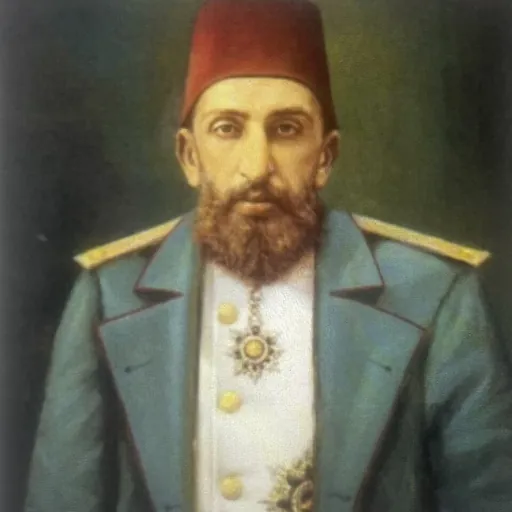
About Abdul Hamid II
Lived 1842 – 1918 (aged 75). Abdul Hamid II was a Turkish sovereign.
Early life and accession Prince Abdul Hamid at Balmoral Castle in 1867, accompanying his uncle Sultan Abdulaziz during his visit to Western Europe between 21 June 1867 – 7 August 1867.
Hamid Efendi was born on 21 September 1842 either in Çırağan Palace, Ortaköy, or at Topkapı Palace, both in Constantinople. He was the son of Sultan Abdulmejid I and Tirimüjgan Kadın (Circassia, 20 August 1819Constantinople, Feriye Palace, 2 November 1853),
Unlike many other Ottoman sultans, Abdul Hamid II visited distant countries. In the summer of 1867, nine years before he ascended the throne, he accompanied his uncle Sultan Abdul Aziz on a visit to Paris (30 June – 10 July 1867), London (12–23 July 1867), Vienna (28–30 July 1867), and capitals or cities of a number of other European countries.
The delegates to the Constantinople Conference
Abdul Hamid took stringent measures regarding his security. The memory of the deposition of Abdul Aziz was on his mind and convinced him that a constitutional government was not a good idea. Because of this, information was tightly controlled and the press rigidly censored. A secret police (Umur-u Hafiye) and a network of informants was present throughout the empire, and many leading figures of the Second Constitutional Era and Ottoman successor states were arrested or exiled. School curricula were closely inspected to prevent dissidence. Ironically, the schools that Abdul Hamid founded and tried to control became "breeding grounds of discontent" as students and teachers alike chafed at the censors' clumsy restrictions. Robert Melson noted that a distinction must be made between the policies of Abdul Hamid and of the later policies of the Young Turks during the Armenian genocide: "Sultan Abdul Hamid II had no intention of exterminating the Armenians or destroying the Armenian millet as such. The main reason why total genocide was not perpetrated by the Ottoman regime in 1894–1896 was its commitment to Islam, to the millet system, and to restoring the old order".
After the massacres, Abdul Hamid began to be called the "Bloody Sultan" or "Red Sultan" in the West. On 21 July 1905, the Armenian Revolutionary Federation attempted to assassinate him with a car bomb during a public appearance, but he was delayed for a minute, and the bomb went off too early, killing 26, wounding 58 (four of whom died during their treatment in hospital), and destroying 17 cars. This continued aggression, along with the handling of the Armenian desire for reform, led western European powers to take a more hands-on approach with the Turks. In May 1901, Herzl requested another meeting with the Sultan, facilitated by the Sultan's mediator Ármin Vámbéry, and learned that the Sultan wanted to reclaim control of the Ottoman Public Debt Administration, which was administered by European powers. As a result, Herzl aimed to free the Sultan from European financiers by consolidating Ottoman debt through a Jewish syndicate. Since the Ottomans were interested in separating financial matters from the colonization proposal, the negotiations were unsuccessful. Abdul Hamid accepted the arrival of Jews to Ottoman lands on condition that they did not gather in one place, and offered Herzl the option of settling Jews in Mesopotamia in scattered communities, but Herzl did not accept this offer.
Pan-Islamism was a considerable success. After the Greco-Ottoman war, many Muslims celebrated the Ottoman victory as their victory. Uprisings, lockouts, and objections to European colonization in newspapers were reported in Muslim regions after the war. Germany's friendship was not altruistic; it had to be fostered by railway and loan concessions. In 1899, a significant German wish, the construction of a Berlin-Baghdad railway, was granted.
Educated Muslim women resented the Salafist Hatts that mandated veils be worn outside the home and to be accompanied by men, though these decrees were mostly ignored.
Second constitutional era and downfall, 1908-09 Young Turk Revolution
The national humiliation of the Macedonian conflict, together with the resentment in the army against the palace spies and informers, at last brought matters to a crisis.
Personal life
Abdul Hamid II was a skilled carpenter and personally crafted some high-quality furniture, which can be seen at the Yıldız Palace, Şale Köşkü, and Beylerbeyi Palace in Istanbul. He was also interested in opera and personally wrote the first-ever Turkish translations of many classic operas. He also composed several operatic pieces for the Mızıka-yı Hümâyun (Ottoman Imperial Band/Orchestra, established by his grandfather Mahmud II who had appointed Donizetti Pasha as its Instructor General in 1828), and hosted the famous performers of Europe at the Opera House of Yıldız Palace, which was restored in the 1990s and featured in the 1999 film Harem Suare (it begins with a scene of Abdul Hamid watching a performance). One of his guests was the French stage actress Sarah Bernhardt, who performed for audiences. and awarded their author, Arthur Conan Doyle, the Order of the Medjidie, 2nd-Class, in 1907.
Bilgi University professor Suraiya Farooqi stated that the sultan's "tastes were distinctly Verdi" despite his political rule being "conservative".
Paranoia
It was rumored that Abdul Hamid always carried a pistol on his person at all times. In addition to locking the Ottoman Navy in the Golden Horn, he also did not allow the army to train with live ammunition.
Religion Abdul Hamid practiced traditional Islamic Sufism. He was influenced by the Libyan Shadhili Madani Sheikh, Muhammad Zafir al-Madani, whose lessons he attended in disguise in Unkapani before he became sultan. After he ascended the throne, Abdul Hamid asked al-Madani to return to Istanbul. Al-Madani initiated Shadhili gatherings of remembrance (dhikr) in the newly commissioned Yıldız Hamidiye Mosque; on Thursday evenings he accompanied Sufi masters in reciting dhikr. Nazikeda Kadın (1848 – 11 April 1895). BaşKadin (First Consort). She was an Abkhazian princess, born Mediha Hanim, lady-in-waiting to Cemile Sultan. She died prematurely after years of deep depression, due to the death of her only daughter. Safinaz Nurefsun Kadın (1850–1915). Her real name was Ayşe and she was the younger sister of the last consort of Abdülmecid I, Yıldız Hanım. When Yıldız Hanım married Abdülmecid, Ayşe was sent into the service of Şehzade Abdülaziz, where she was renamed Safinaz. According to Harun Açba, Abdülaziz was fascinated by her beauty and wanted to marry her, but she refused because she was in love with Şehzade Abdul Hamid. The feeling was mutual and the young prince asked for the help of his stepmother Rahime Perestu Kadin. She told Abdülaziz that Safinaz was ill and that she needed a change of air; later, Abdülaziz was informed of her death. Abdul Hamid then secretly married Safinaz, who was renamed Nurefsun, in October 1868. However, she could not get used to life in the harem and wanted to be Abdul Hamid's only consort. She then asked for a divorce, which was granted to her in 1879. She had no children. Bedrifelek Kadın (1851–1930). Circassian Princess who took refuge in Istanbul when Russia invaded the Caucasus. She ruled Abdul Hamid's harem when Rahime Perestu Sultan died. She left Abdul Hamid when he was deposed, perhaps disappointed that their son had not been chosen as successor. She had two sons and a daughter. Bidar Kadın (5 May 1858 – 13 January 1918). Kabartian princess, she was considered the most beautiful and charming of Abdul Hamid's consorts. She had a son and a daughter. Dilpesend Kadın (16 January 1865 – 17 June 1901). Georgian. She was educated by Tiryal Hanim, the last consort of Mahmud II, who was Abdul Hamid's grandfather. She had two daughters. Mezidemestan Kadın (3 March 1869 – 21 January 1909). She was born Kadriye Kamile Merve Hanim, she was the aunt of Emine Nazikeda Kadın, future consort of Mehmed VI. She was loved by everyone, including his other consorts and her stepchildren. She was the most influential of his consorts, but she never abused her power. She had a son, who was Abdul Hamid's favorite. Emsalinur Kadın (1866–1952). She entered the Palace with her sister Tesrid Hanım, who became a consort of Şehzade Ibrahim Tevfik. She was very beautiful. She did not follow Abdul Hamid into exile and died in poverty. She had a daughter. Destizer Müşfika Kadın (1872 – 18 July 1961). She was Abkhazian, born Ayşe Hanim. She grew up with her sister under the tutelage of Pertevniyal Sultan, the mother of Sultan Abdülaziz, uncle of Abdul Hamid. She followed Abdul Hamid into exile and was with him until his death, so much so that it is said that the sultan died in her arms. She had a daughter. Sazkar Hanım (8 May 1873 – 1945). She was a noble Abkhazian, born Fatma Zekiye Hanım. She was among the consorts who followed Abdul Hamid into exile, and later left Turkey with her one daughter. Peyveste Hanım (1873 – 1943). Abkhazian princess, born Hatice Rabia Hanim and aunt of Leyla Açba. She served Nazikeda Kadın, with her sisters, and then became the treasurer of the harem. She was highly respected. She followed her husband into exile and then her one son. Pesend Hanım (13 February 1876 – 5 November 1924). Born princess Fatma Kadriye Achba, she was one of Abdul Hamid's favorite consorts, and was known for her kindness, charity, and tolerance. She was one of the consorts who stayed with Abdul Hamid until his death; and, on his death, she cut her hair and threw it into the sea as a sign of mourning. She had a daughter. Behice Hanım (10 October 1882 – 22 October 1969). She was Sazkar Hanım's cousin, her real name was Behiye Hanim. She was arrogant and proud, initially she had to marry Şehzade Mehmed Burhaneddin, son of Abdul Hamid, but in the end the sultan decided to marry her himself, against Behice's will. She had twin sons. Saliha Naciye Kadın (1887–1923). She was born Zeliha Ankuap and was also called Atike Naciye Kadın. Known for her kindness and modesty, she was Abdul Hamid's favorite among the consorts who stayed with him until his death. She had a son and a daughter. Dürdane Hanım (1869 - January 1957). Calibös Hanım (1890 - 1955). Simperver Nazlıyar Hanım. Bergüzar Hanım. Levandit Hanım. Ebru Hanım. Sermelek Hanım. Gevherriz Hanım. Mihrimend Zelide Hanım (? - 1946). Nevcedid Hanım.
Sons Abdul Hamid had at least eight sons: In Orhan Pamuk's satirical novel Nights of Plague (2021), Abdul Hamid dispatches the Ottoman Empire's chief inspector of public health, along with a Muslim epidemiologist and his wife, the sultan's niece, to the fictitious island of Mingheria to combat the bubonic plague. Civilization V: Brave New World features Abdul Hamid II as the leader of the Ottoman Empire during the Scramble for Africa scenario.
Awards and honors
Ottoman orders
Foreign orders and decorations
Gallery Threatened by several assassination attempts, Abdul Hamid II did not travel often (though still more than many previous rulers). Photographs provided visual evidence of what took place in his realm. He commissioned thousands of photographs of his empire, including from the Constantinople studio of Jean Pascal Sébah. The sultan presented large gift albums of photographs to various governments and heads of state, including the U.S.
Don’t just read it —
keep it.
Full-length biographies made to live with: read them, listen on the way to work, watch them tonight.
- E-book
- Audio
- Video
Instant download · yours to keep · every purchase keeps this site free
Important facts
Family & relationships
People in Abdul Hamid II's life
Named in this biography and alive at the same time


Related people
Same field, nearest in time


Contemporaries
People whose lives overlapped Abdul Hamid II's
Frequently asked questions
Who was Abdul Hamid II?
34th Sultan of the Ottoman Empire (1876–1909)
When was Abdul Hamid II born?
Abdul Hamid II was born on 21 September 1842 in Istanbul.
When did Abdul Hamid II die?
Abdul Hamid II died on 10 February 1918 in Beylerbeyi Palace.
What was Abdul Hamid II's occupation?
Abdul Hamid II was a sovereign.
What nationality was Abdul Hamid II?
Abdul Hamid II was Turkish.
Sources & further reading
Cite this page
APA: Biography.guide. (2026). Abdul Hamid II. https://biography.guide/abdul-hamid-ii/
MLA: "Abdul Hamid II." Biography.guide, https://biography.guide/abdul-hamid-ii/.
Chicago: "Abdul Hamid II." Biography.guide. https://biography.guide/abdul-hamid-ii/.
Data last updated: 2026-09-20 · Spot an error? Report a correction.
Page generated 2026-09-27 05:09 UTC