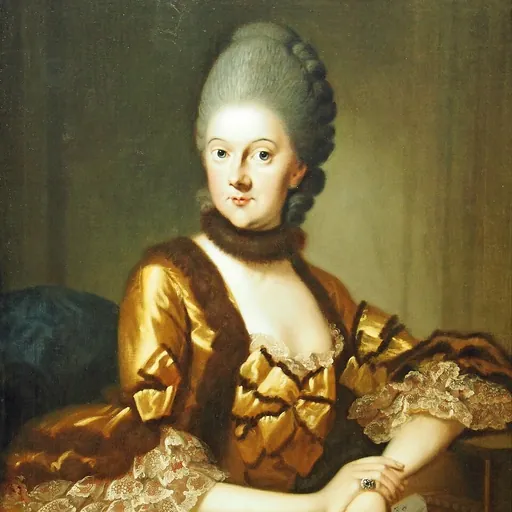
About Duchess Anna Amalia of Brunswick-Wolfenbüttel
Lived 1739 – 1807 (aged 67). Duchess Anna Amalia of Brunswick-Wolfenbüttel was a composer, salonnière and editor.
Anna Amalia of Brunswick-Wolfenbüttel (24 October 173910 April 1807), was a German princess and composer.
She became the duchess of Saxe-Weimar-Eisenach by marriage, and was also regent of the states of Saxe-Weimar and Saxe-Eisenach from 1758 to 1775. and Ernst Wilhelm Wolf. Also her mother Princess Philippine Charlotte was a composer.
Marriage and issue In Brunswick, on 16 March 1756, sixteen-year-old Anna Amalia married eighteen-year-old Ernst August II Konstantin, Duke of Saxe-Weimar-Eisenach She was pregnant with their other son Prince Constantine, born three months after the father's death.
The boy was brought up under the regency and supervision of his mother, a woman of enlightened but masterful temperament. His governor was Count Eustach von Görz, a German nobleman of the old strait-laced school; but a more humane element was introduced into his training when, in 1771, Christoph Martin Wieland was appointed his tutor. In 1774 the poet Karl Ludwig von Knebel came to Weimar as tutor to the young Prince Constantine.
Anna Amalia herself played a significant part in bringing together the poetry of 'Weimar Classicism'. Johann Adam Hiller's most successful Singspiel, Die Jagd (the score of which is dedicated to the duchess), received its first performance in Weimar in 1770, and Weimar was also the scene of the notable première on 28 May 1773 of the ‘first German opera’, Wieland's Alceste in the setting by Anton Schweitzer. Anna Amalia continued the tradition of the Singspiel in later years with performances in the amateur court theatre of her own compositions to texts by Goethe.
She also established the Duchess Anna Amalia Library, which is now home to some 1,000,000 volumes. The duchess was honored in Goethe's work under the title Zum Andenken der Fürstin Anna-Amalia. thumb Ettersburg Castle and parkAnna Amalia lacked the financial means for extensive philanthropic ambitions, as an analysis of her treasury accounts showed. Anna Amalia was 'enlightened' in that she always aimed for external impact, where she appeared informed and up-to-date – to a broad, even non-courtly, audience. As open as she was to new ideas, she remained true to the dynastic mentality in which she had been raised. Even though she was not required to observe any ceremony at her widow's court, she always observed etiquette and proper behavior. Even if court norms sometimes seemed too restrictive to her, she nevertheless mastered the court system of granting and withdrawing favors. She guided her younger son Constantin, who wanted to marry first a German noblewoman and then a French commoner, into the more appropriate paths of social standing.
Music Anna Amalia was a notable composer. The majority of her works belong stylistically to the Empfindsamkeit, in the manner of Hiller and Schweitzer, combining features of song and of arioso. In 2021–2023, further works of Anna Amalia were discovered by the academic Stephen Husarik in the collection of Archduke Rudolf of Austria.
Her compositions include:
Chamber Divertimento (clarinet, viola, violoncello, and piano) c. 1780
Harpsichord sonatas
Orchestra Oratorio (1768) boxstyle_1=background-color: #fcc; boxstyle_2=background-color: #fb9; boxstyle_3=background-color: #ffc; boxstyle_4=background-color: #bfc; 1= 1. Duchess Anna Amalia of Brunswick-Wolfenbüttel 2= 2. Charles I, Duke of Brunswick-Wolfenbüttel 3= 3. Princess Philippine Charlotte of Prussia 4= 4. Ferdinand Albert II, Duke of Brunswick-Wolfenbüttel 5= 5. Duchess Antoinette of Brunswick-Wolfenbüttel 6= 6. Frederick William I of Prussia 7= 7. Princess Sophia Dorothea of Hanover 8= 8. Ferdinand Albert I, Duke of Brunswick-Wolfenbüttel-Bevern 9= 9. Princess Christine of Hesse-Eschwege 10= 10. Louis Rudolph, Duke of Brunswick-Wolfenbüttel 11= 11. Princess Christine Louise of Oettingen-Oettingen 12= 12. Frederick I of Prussia 13= 13. Princess Sophia Charlotte of Hanover 14= 14. George I of Great Britain 15= 15. Princess Sophia Dorothea of Celle
Don’t just read it —
keep it.
Full-length biographies made to live with: read them, listen on the way to work, watch them tonight.
- E-book
- Audio
- Video
Instant download · yours to keep · every purchase keeps this site free
Important facts
more
Anna AmaliaFamily & relationships
People in Duchess Anna Amalia of Brunswick-Wolfenbüttel's life
Named in this biography and alive at the same time
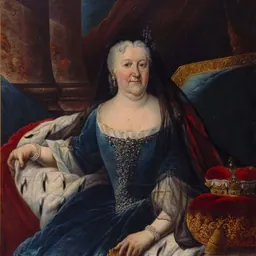
Related people
Same field, nearest in time

Contemporaries
People whose lives overlapped Duchess Anna Amalia of Brunswick-Wolfenbüttel's



Frequently asked questions
Who was Duchess Anna Amalia of Brunswick-Wolfenbüttel?
German princess, composer, editor (1739-1807)
When was Duchess Anna Amalia of Brunswick-Wolfenbüttel born?
Duchess Anna Amalia of Brunswick-Wolfenbüttel was born on 24 October 1739 in Wolfenbüttel.
When did Duchess Anna Amalia of Brunswick-Wolfenbüttel die?
Duchess Anna Amalia of Brunswick-Wolfenbüttel died on 10 April 1807 in Weimar.
What was Duchess Anna Amalia of Brunswick-Wolfenbüttel's occupation?
Duchess Anna Amalia of Brunswick-Wolfenbüttel was a composer, salonnière and editor.
What nationality was Duchess Anna Amalia of Brunswick-Wolfenbüttel?
Duchess Anna Amalia of Brunswick-Wolfenbüttel's recorded nationality: Duchy of Saxe-Weimar-Eisenach.
Sources & further reading
· Wikipedia: Duchess Anna Amalia of Brunswick-Wolfenbüttel
· DBpedia: Duchess Anna Amalia of Brunswick-Wolfenbüttel
Cite this page
APA: Biography.guide. (2026). Duchess Anna Amalia of Brunswick-Wolfenbüttel. https://biography.guide/duchess-anna-amalia-of-brunswick-wolfenbuttel/
MLA: "Duchess Anna Amalia of Brunswick-Wolfenbüttel." Biography.guide, https://biography.guide/duchess-anna-amalia-of-brunswick-wolfenbuttel/.
Chicago: "Duchess Anna Amalia of Brunswick-Wolfenbüttel." Biography.guide. https://biography.guide/duchess-anna-amalia-of-brunswick-wolfenbuttel/.
Data last updated: 2026-10-01 · Spot an error? Report a correction.
Portrait: Wikimedia Commons · author & licence
Page generated 2026-10-05 02:58 UTC