
About Dominique Mbonyumutwa
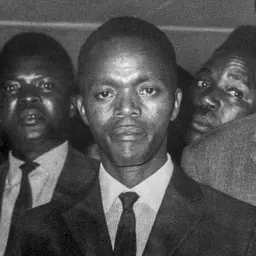
Lived 1921 – 1986 (aged 64–65). Dominique Mbonyumutwa was a Rwandan politician and traditional leader or chief.
Dominique Mbonyumutwa (January 1921 – 26 July 1986) was a Rwandan politician who served as the interim first President of Rwanda for a period of nine months in 1961, during a transitional phase between the overthrow of the Rwandan monarchy in the Rwandan Revolution and the country's independence. Following an election in October of that year, he was succeeded by Grégoire Kayibanda who became the first elected president of the country following independence.
Career Mbonyumutwa rose to prominence in the late 1950s, during a period of instability in Rwanda. At the time, Rwanda was part of the Belgian-administered United Nations trust territory of Ruanda-Urundi. Ethnic divisions between the Tutsi, who held the majority of the political power, and Hutu, who had the majority of the population, began to dominate Rwandan life. Mbonyumutwa was one of the few Hutu subchiefs in Rwanda, and a leader in the Hutu Emancipation Movement Party (Parmehutu) under Grégoire Kayibanda. He had a functioning relationship with the Rwandan King, Mutara III Rudahigwa, but after the King died in July 1959, Mbonyumutwa was in a less stable position.
On 1 November 1959, Mbonyumutwa was assaulted by a group of Tutsi political activists in Byimana in Southern Province. Rumors spread that Mbonyumutwa had died in the attack. This incident triggered the "social revolution" of November 1959. Prior to this, there had never been any systematic political violence between Hutus and Tutsis, but Hutus reacted to the attack with a wave of reprisals against Tutsis. Within a week, self-organized groups of Hutus were committing arson and even murder against their Tutsi neighbors.
On 28 January 1961, during a people's congress which abolished the Rwandan monarchy and proclaimed that Rwanda became a social republic, Mbonyumutwa was chosen as its first President. He traveled around the country for weeks to establish himself as the King's replacement and to shore up support for the new government. The United Nations condemned the new government as "one racist dictatorship [replacing] another" (with Hutus now holding power over the Tutsis), but agreed to oversee a referendum to approve the new government in September. The referendum abolished the monarchy with 80% of the vote, and a simultaneous parliamentary election led to a National Assembly dominated by Parmehutu members. Mbonyumutwa stepped down as interim president, and Grégoire Kayibanda was chosen by the assemblymembers to succeed him. until his death on 26 July 1986.
Don’t just read it —
keep it.
Full-length biographies made to live with: read them, listen on the way to work, watch them tonight.
- E-book
- Audio
- Video
Instant download · yours to keep · every purchase keeps this site free
Important facts
Family & relationships
People in Dominique Mbonyumutwa's life
Named in this biography and alive at the same time
Related people
Same field, nearest in time






Contemporaries
People whose lives overlapped Dominique Mbonyumutwa's


Frequently asked questions
Who was Dominique Mbonyumutwa?
Rwandan president (1921-1986)
When was Dominique Mbonyumutwa born?
Dominique Mbonyumutwa was born in 1921 in Mwendo, Muhanga.
When did Dominique Mbonyumutwa die?
Dominique Mbonyumutwa died on 26 July 1986 in Brussels-Capital Region.
What was Dominique Mbonyumutwa's occupation?
Dominique Mbonyumutwa was a politician and traditional leader or chief.
What nationality was Dominique Mbonyumutwa?
Dominique Mbonyumutwa was Rwandan.
Sources & further reading
· Wikipedia: Dominique Mbonyumutwa
· DBpedia: Dominique Mbonyumutwa
Cite this page
APA: Biography.guide. (2026). Dominique Mbonyumutwa. https://biography.guide/dominique-mbonyumutwa/
MLA: "Dominique Mbonyumutwa." Biography.guide, https://biography.guide/dominique-mbonyumutwa/.
Chicago: "Dominique Mbonyumutwa." Biography.guide. https://biography.guide/dominique-mbonyumutwa/.
Data last updated: 2026-09-20 · Spot an error? Report a correction.
Page generated 2026-09-27 05:20 UTC