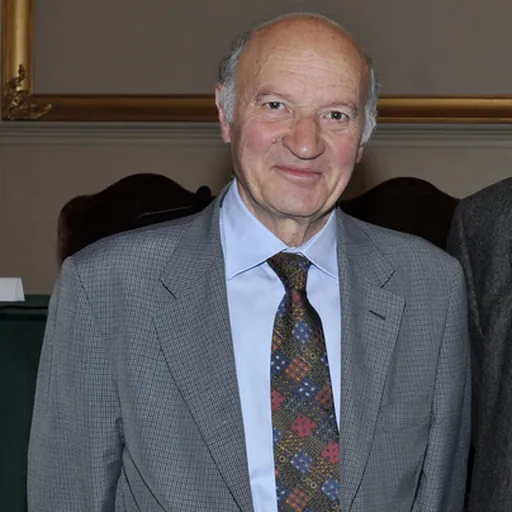
About Domenico Losurdo
Lived 1941 – 2018 (aged 76). Domenico Losurdo was an Italian philosopher, writer, university teacher, historian and translator.
Domenico Losurdo (14 November 1941 – 28 June 2018) was an Italian historian, essayist, Marxist philosopher, and communist politician.
Life and career Born in Sannicandro di Bari, Italy, Losurdo obtained his doctorate in 1963 from the University of Urbino under the guidance of with a thesis on Johann Karl Rodbertus. During the 1960s, he belonged to a small group of Italian communists that sided with the People's Republic of China in the Sino-Soviet split. Losurdo was director of the Institute of Philosophical and Pedagogical Sciences at the University of Urbino, where he taught history of philosophy as dean at the Faculty of Educational Sciences. From 1988, Losurdo was president of the Hegelian International Association Hegel-Marx for Dialectical Thought. He was also a member of the Leibniz Society of Sciences in Berlin (an association in the tradition of Gottfried Wilhelm Leibniz's Prussian Academy of Sciences), as well as director of the Marx XXI political-cultural association. Losurdo died on 28 June 2018 at the age of 76, due to brain cancer.
From communist militancy, the condemnation of American imperialism, and the study of the African-American and Native American question, Historian David Broder described Losurdo as "already among the most renowned Italian Marxists at the international level, as a richly partisan historian of philosophy ... ." and Marxist philosopher as well as historian, Losurdo was described as a noncomformist, a heterodox Marxist, and a communist militant. notes that, Losurdo read the Philosophy of Right:
His work ranged from contributions to the study of Kantian philosophy (the so-called self-censorship of Immanuel Kant and his political Nicodemism) and the reevaluation of classical German idealism, especially by G. W. F. Hegel, in an attempt to re-propose the legacy in the wake of György Lukács in particular, as well as the reaffirmation of the interpretation of German and non-German Marxism (Antonio Gramsci and the brothers Bertrando and Silvio Spaventa), with incursions into the sphere of Nietzschean thought (the reading of a radical aristocratic Friedrich Nietzsche) and Heideggerian thought, in particular the question of Martin Heidegger's adhesion to Nazism.
Losurdo's philosophical-political reflection, attentive to the contextualization of philosophical thought in his own historical time, moved in particular from the themes of radical criticism of liberalism, capitalism, and colonialism as well as the traditional conception of totalitarianism in the perspective of a defence of Marxist dialectics and historical materialism, devoting himself to the study of anti-revisionism in the Marxist–Leninist sphere.
Losurdo turned his attention to the political history of modern German philosophy from Kant to Karl Marx and the debate that developed in Germany in the second half of the 19th and in the 20th century as well as a reinterpretation of the tradition of liberalism, in particular starting from the criticism and accusations of hypocrisy addressed to John Locke for his financial participation in the Atlantic slave trade. Taking up what Arendt stated in her 1951 book The Origins of Totalitarianism, Losurdo argued that the 20th century's true original sin was the New Imperialism in the form of colonial empire of the late 19th century, where totalitarianism and internment manifested for the first time.
Ideas and research According to Losurdo, despecification is the exclusion of an individual or group from the civilian community. There are two types of despecification: Unlike many other thinkers, Losurdo thought that the Holocaust of the Jewish people is not incomparable, though he was willing to admit its tragic specificity. Losurdo stated that the comparisons he offers about this did not seek to be a relativisation or a belittlement of the Holocaust, but that to consider the Jewish Holocaust as incomparable meant to lose historical perspective and to overlook the Black Holocaust (i.e. the genocide of black people) or the American Holocaust (i.e. the genocide of Native Americans in the United States through the continued deportation to the west with the Indian removal and diffusion of smallpox), as well as other mass exterminations such as the Armenian genocide.
Losurdo was a strong critic of the equation of Nazism and communism, made by scholars like François Furet and Ernst Nolte Similarly, Losurdo criticized the concept of a Red Holocaust.
Taking up the opinion of Primo Levi (who was interned at Auschwitz, according to whom the Gulag was not morally equivalent to the Nazi concentration camps), and against Soviet dissident Aleksandr Solzhenitsyn (who was interned in Siberia and asserted the equivalence of the exterminationist intent in both the Gulag and Nazi concentration camps), Losurdo maintained that, although it was a disgrace that a socialist country, born as it is to abolish exploitation, resorted to imperialist and capitalist systems and methods, the Gulag was more analogous to many Western concentration camps (whose governments have supported and claim to be champions of freedom) which in some ways were more akin to the Nazi concentration camps as death camps and not re-educational, taking into consideration the history of the genocide of indigenous peoples. He also argued that British concentration camps and penal colonies were worse than any Gulag, accusing politicians such Winston Churchill and Harry S. Truman of being guilty of war crimes and crimes against humanity just like – if not worse than – those attributed to Joseph Stalin.
Autophobia was a concept developed by Losurdo to describe how sometimes victims tend to appropriate the point of view of their oppressors and begin to despise and hate themselves. The concept of autophobia was primarily developed within the framework of the study of Jewish history and the history of slavery. Losurdo extended this concept to social classes and political parties that have suffered defeat. Losurdo stated his belief that communists suffer from autophobia, defined as a fear of themselves and their own history, a pathological problem that must be faced, unlike healthy self-criticism.
In excerpts from a conference, organized in 2003, to re-evaluate the figure of Stalin fifty years after his death, Losurdo harshly criticized the revelations contained in Nikita Khrushchev's "Secret Speech". According to Losurdo, Stalin's bad reputation derived not from the crimes committed by the latter – which he compared to others of that time – but from the falsehoods present in the report that Khrushchev read during the 20th Congress of the Communist Party of the Soviet Union in February 1956. Losurdo gave credit to one of the main accusations that were at the base of the bloody repression against his opponents, i.e. the existence of the "full-bodied reality of the fifth column" in the Soviet Union ready to ally with the enemy. Losurdo reiterated that he did not want to rehabilitate Stalin, but only to place him in the historical context and present a more neutral analysis of the facts, implementing a revisionism of the general experience of real socialism, considered as a past to be studied for the purpose of understanding the future dynamics of socialism. Losurdo saw China's reform and opening up as a new NEP that "did not undermine its socialist values." Losurdo was also director of the Marx XXI political-cultural association.
Throughout his life, he was strongly opposed to American interventionism and its foreign policies, imperialism, and NATO.
Works Aristocratic Rebel In Aristocratic Rebel (2002), Losurdo criticized much of Nietzschean thought in the contemporary world, in particular, left-Nietzscheanism, whose influence on the left was a major problem because "it hollows out rationalist-oriented socialist thought and praxis and it often leads to an abandoning of universalism in favour of 'spiritual' interpretations of political struggle." This critique came from the application of Nietzsche by Italian leftists such as Giorgio Colli and Gianni Vattimo, although left-Nietzscheanism is beyond just that setting. Losurdo accused Furet and Nolte for their theory that the Russian Revolution started the European Civil War in 1917 so that the conflict between Bolshevism and Nazism is emphasized and only the former is blamed. In doing so, these revisionist historians omitted two main moments that for Losurdo are indispensable in understanding the Second Thirty Years' War, namely the total war as an experience shared by all those involved in the war and colonialism as a common modern European phenomenon on the other. Losurdo compared Adolf Hitler's struggle for Lebensraum in the East with the acquisition of a German India to the American frontier as part of the American conquest to the Pacific.
Echoing Traverso, who wrote that "Eastern Europe certainly represented the 'living space' that one wanted to colonize, but this conquest implied the annihilation of the USSR and Bolshevism, a state and an ideology which the Nazis saw as the product of a connection between 'Jewish intelligentsia' and Slavic 'sub-humanity.' So this total war was at the same time a war of conquest, a war of race and a colonial war", Losurdo argued that the European Jews got into this colonialist scenario as "Oriental natives", stating: "The fact that the fate of the Jews has been sealed by their double stigmatization as oriental 'natives' and as carriers of oriental Bolshevism is not at all considered."
Liberalism: A Counter-History
In Liberalism: A Counter-History (2005), first published in English in 2011, Losurdo argued that while purporting to emphasise the importance of individual liberty, liberalism has long been marked by its exclusion of people from these rights, resulting in racism, slavery, and genocide. Losurdo asserted that the origins of Nazism are to be found in what he views as colonialist and imperialist policies of the Western world. Losurdo examined the intellectual and political positions of intellectuals on modernity. In his view, Immanuel Kant and Georg Wilhelm Friedrich Hegel were the greatest thinkers of modernity, while Friedrich Nietzsche was its greatest critic.
Liberalism: A Counter-History received a number of positive reviews from both academic and popular presses.
Stalin: History and Critique of A Black Legend In Stalin: History and Critique of A Black Legend (2008), first published in English in 2023, Losurdo stimulated a debate about Joseph Stalin, about whom he claimed is built a kind of black legend intended to discredit the whole of communism. Opposed to the comparison of Nazism and Stalinism, Losurdo criticized the concept of totalitarianism, especially in the works of Hannah Arendt, François Furet, Karl Popper, and Ernst Nolte, among others. Losurdo argued that totalitarianism was a polysemic concept with origins in Christian theology and that applying it to the political sphere required an operation of abstract schematism which makes use of isolated elements of historical reality to place Nazi Germany and other fascist regimes, along with the Soviet Union and other socialist states, in the dock together, serving the anti-communism of Cold War-era intellectuals rather than reflecting intellectual research.
As a Hegelian, Losurdo aimed to bring to historical knowledge two elements that are under-represented in Marxist historiography, namely rational reflection on the role of great men and rational criticism of the original form of moral leftism, or what Losurdo referred to as the "beautiful soul", which seeks to impose "the law of the heart" and the intelligence of its inevitable authoritarian reversal. For Losurdo, the ferment of authoritarianism in the communist movement is to be found more on the libertarian side of the communist utopia than in the reformist desire to build a state. Losurdo described his work on Stalin as a history of Stalin's image and not a biography or political history of the system with which his name is commonly associated. According to Losurdo, questioning the clichés of anti-Stalinism and Stalinism, including in Communist ranks since 1956, required returning to the substance of the question of the evaluation of Soviet history from 1922 to 1953 and even beyond, since the categories of anti-Stalinism and Stalinism have been generalized to the study of other socialist states ruled by communist parties and other personalities, such as Mao Zedong in China and Fidel Castro in Cuba.
Writing for il manifesto, Guido Liguori stated that "is controversial Stalin. Storia e critica di una leggenda nera was not without its interesting elements. He proposed not so much to save Stalin (in fact he recognized many of his limits and faults)", but "he also refused to consider Stalin in merely negative terms."
The book rendered Losurdo's polarising view. O Globo summarized that Losurdo has been "raised for his criticism of liberalism by some, and accused of Stalinism by others. ... From liberals to the far left, everyone has an adjective on the tip of their tongue (or fingers) to refer to Caetano's new favourite author: Stalinist, revolutionary, farcical, anti-imperialist, revisionist. For some, the Italian was a champion of socialism who denied the farces propagated by liberalism. For others, he was a defender of the crimes of the Soviet dictator Joseph Stalin (1878-1953) and of Chinese authoritarianism." O Globo wrote that Losurdo compared the crimes of Stalin with those of liberalism (genocides sponsored by capitalist nations, concentration camps maintained by the colonial powers, and war crimes) and argued that in the end, it is the liberals who have the dirtiest or worst track record.
A review written in April 2009 by Guido Liguori in Liberazione (the official organ of the Communist Refoundation Party) of his book, in which Losurdo criticized the demonisation of Stalin carried out by the predominant historiography and tried to remove it from what he calls "the black legend about him", was at the center of a controversy within the drafting of the aforementioned review. A storm of protests ensued when around twenty editors sent a letter of protest to the editor of the newspaper in which they criticized both Losurdo's attempt at Stalin's rehabilitation in his book and Liguori's review (judged to be too positive with respect to the book) as well as with the choice of the editor of the newspaper to publish said review. The book was criticized for its claims, and the methodology used, by Valerio Evangelisti, , Niccolò Pianciola, and Andrea Romano.
Losurdo's view that purges were legitimate because of the "permanent state of exception caused by imperialist intervention and siege", with Liguori summarising Losurdo's argument that "the harshness of his leadership was due to the Western powers' intrigues and the existence of a powerful 'Fifth Column' within the USSR of the 1930s" and a continuation of the Russian Civil War, described as being imposed by imperialism, were criticized as being a defence of the Stalinist purges by Cicero Araujo and Mario Maestri. Losurdo's work has been praised by Grover Furr, who started a mutual friendship with Losurdo, whom Furr praised especially for his 2008 book on Stalin. Losurdo continued to cooperate with Furr, introducing him to an Italian publisher who published the Italian translation of Furr's book Khrushchev Lied in 2016, with Losurdo's introduction. Additionally, Losurdo wrote a blurb for the back cover of Furr's 2013 book The Murder of Sergei Kirov and an introduction to the book that remains unpublished. Losurdo outlined a split between Western Marxism and Eastern Marxism. Losurdo criticized Western Marxism for "hav[ing] 'neglected the great problems of its time', abandoning the 'class struggle and the struggle against imperialism', and embracing 'the narratives of globalization. Professor Araujo Cicero wrote that Losurdo "recognizes 'tragedy and horror' from the years when the Soviet Union was led by Stalin" but accused Losurdo's work of being a defence of "the main decisions [Stalin] made over the almost thirty years he was at the head of the country after Lenin's death." Author does not consider these accusations tenable, as Losurdo did not in any way deny the crimes during the Stalin era and described them in detail.
The publication in the communist newspaper Liberazione of a positive review by Guido Liguori on Losurdo's book about Stalin caused a crisis in the paper's editorial staff: twenty journalists wrote a letter to the editor Dino Greco, criticizing what they perceived as Losurdo's attempts at Stalin's rehabilitation, alongside Liguori's review (which they perceived as too positive) and Greco's decision to publish it. Losurdo's work was also derided by Italian liberal journalist Andrea Romano, who accused Losurdo and Luciano Canfora of "trying to create a harmless Stalinism".
About Losurdo's work on Stalin, Cicero wrote that "nlike the typical old-time Stalinist, Losurdo does not evade a series of crimes committed by the regime and its dictator, nor does it qualify them simply as 'mistakes'. Also unlike the classic Stalinist, the author is not concerned with showing the coherence of his practices with Marxism or Leninism." Cicero further stated "it is the ability and perspicacity to face realistically the great problems of your country and its time – even against the most ingrained beliefs and utopias of your former travel companions – that the book seeks to highlight. In spite of all the barbarities committed, Stalin and his regime leave their multifaceted assessment with a positive balance." Cicero argued that this was not because "they knew how to build possible socialism, the famous 'socialism in one country", but "for the simple reason that they managed to build a state and a society sufficiently vertebrate to face the chaos of the Russian 'second period of disorder' and the European 'second war of the thirties', with its most deadly by-product (Nazism), were it not for that tremendous endeavour, albeit a bloody one, it was destined to destroy the Slavic nations to the east." Cicero wrote that "Stalin and Stalinism are, in short, defended for reasons to which any admirer of State-building as a good in itself, regardless of its ideological purposes and justifications, should surrender. 'Socialism in one country' becomes, in this sense, just a formula that the dictator and his supporters improvised to fit this elementary task to the language that was understandable to them." While stating that "reading these books on Liberalism and Bonapartism is useful to historians and Marxists in general, they illustrate the history of capitalism in very convincing detail", Vargaftiq referred to Losurdo as a "neo-Stalinist chic", and criticized him for making a nationalist rather than Marxist analysis, for supporting the fifth column theory, and in general for his dismissive views of Trotskyism.
About Losurdo's work on Western Marxism, Marxist historian Mario Maestri wrote that this is "a false split and a false controversy", and accused Losurdo of replacing "the proletarian internationalism and class struggles of the 'Western Marxists' with the unified nation – that is, bourgeoisie and united proletarians – in the name of national developmentalism – as if development, as well as science and technology, were ideologically neutral and not dictated by the interests of the dominant versus the dominated classes." Maestri, who defends the thesis "we live in a historical counterrevolutionary phase", whose "milestones were the capitalist restoration in China in 1978 under the leadership of reformer Deng Xiaoping and the dissolution of the Soviet Union in 1992 – events that consolidated the globalization of capitalism", accused Losurdo of presenting "an apology for the capitalism of the Chinese Communist Party and its many business projects in Asia, Africa and Latin America", establishing this "as the only alternative for its economic development and the only way for the emancipation of European and American imperialism." According to Maestri, Losurdo defended that "the working classes of the countries on the periphery of the capital – Asia, Africa and Latin America – give up their political independence and pragmatically ally themselves with the capitalism of the Chinese CP."
Losurdo was influenced by Hegel's Philosophy of the Right, in which he saw Hegel "championing a strong interventionist state that would curb the excesses of civil society". Consequently, Losurdo formed revisionist views on withering away of the state, considering the doctrine itself "to be foolish from the outset, and that Stalin’s loyalty to it (in word, if not in deed) was a mistake."
Don’t just read it —
keep it.
Full-length biographies made to live with: read them, listen on the way to work, watch them tonight.
- E-book
- Audio
- Video
Instant download · yours to keep · every purchase keeps this site free
Important facts
People in Domenico Losurdo's life
Named in this biography and alive at the same time





Related people
Same field, nearest in time
Contemporaries
People whose lives overlapped Domenico Losurdo's

Frequently asked questions
Who was Domenico Losurdo?
Italian scholar (1941-2018)
When was Domenico Losurdo born?
Domenico Losurdo was born on 14 November 1941 in Sannicandro di Bari.
When did Domenico Losurdo die?
Domenico Losurdo died on 28 June 2018 in Ancona.
What was Domenico Losurdo's occupation?
Domenico Losurdo was a philosopher, writer, university teacher, historian and translator.
What nationality was Domenico Losurdo?
Domenico Losurdo was Italian.
Sources & further reading
Cite this page
APA: Biography.guide. (2026). Domenico Losurdo. https://biography.guide/domenico-losurdo/
MLA: "Domenico Losurdo." Biography.guide, https://biography.guide/domenico-losurdo/.
Chicago: "Domenico Losurdo." Biography.guide. https://biography.guide/domenico-losurdo/.
Data last updated: 2026-09-23 · Spot an error? Report a correction.
Portrait: Wikimedia Commons · author & licence
Page generated 2026-09-27 05:05 UTC