
About Đỗ Cao Trí
Lived 1929 – 1971 (aged 41). Đỗ Cao Trí was a Vietnamese military personnel.
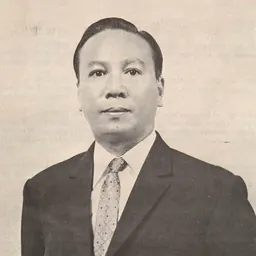
Lieutenant General Đỗ Cao Trí (20 November 1929 – 23 February 1971) was a general in the Army of the Republic of Vietnam (ARVN) known for his fighting prowess and flamboyant style. Trí started out in the French Army before transferring to the Vietnamese National Army and the ARVN. Under President Ngô Đình Diệm, Trí was the commander of I Corps where he was noted for harsh crackdowns on Buddhist civil rights demonstrations against the Diệm government. Trí later participated in the November 1963 coup which resulted in the assassination of Diệm on 2 November 1963.
Years later, Trí was exiled by Nguyễn Cao Kỳ, the most powerful member of the junta, but when Nguyễn Văn Thiệu came to power, he was called back to command III Corps. He led III Corps during the 1970 Cambodian Campaign, earning the laudatory sobriquet as "the Patton of the Parrot's Beak".
He earned his baccalaureate (Part II) from Petrus Ký High School, Saigon. After entering the French colonial forces in 1947, he graduated from Do Huu Vi Officer Class and the following year was sent to Auvour, France to attend infantry school. His first command was as a young airborne officer, and until his death he survived three attempts on his life, leading him to his belief that he had an "immunity from death on the battlefield". In Huế, demonstrations were banned and Trí's forces were ordered to arrest those who engaged in civil disobedience. At 13:00 on 3 June, some 1,500 protestors attempted to march towards the Từ Đàm Pagoda in Huế for a rally, having gathered at Bến Ngự bridge near the Perfume River. The symptoms consisted of severe blistering of the skin and respiratory ailments. The incident raised concerns among the Americans that poison gas was used, and the U.S. threatened to publicly condemn and distance itself from Saigon. Monks tried to cremate as per their custom the coffin of their colleague who had self-immolated. ARVN soldiers, firing M1 rifles, overran the pagoda and confiscated the coffin. They demolished a statue of Gautama Buddha and looted and vandalized the pagoda before detonating explosives and leveling much of the pagoda. A number of Buddhists were shot or clubbed to death.
The most determined resistance occurred outside the Diệu Đế Pagoda in Huế. As troops attempted to erect a barricade across the bridge leading to the pagoda, the crowd fought the heavily armed military personnel with rocks, sticks and their bare fists, throwing back the tear gas grenades that were aimed at them. After a five-hour battle, the military finally took the bridge at dawn by driving armored cars through the angry crowd. The defense of the bridge and Diệu Đế left an estimated 30 dead and 200 wounded. a Catholic priest and opponent of Diệm's brother Archbishop Pierre Martin Ngô Đình Thục, were also arrested. Despite his vigorous application of Diệm's military policies against Buddhists in central Vietnam, where in the words of Ellen Hammer, Trí "ruled...with an iron hand", he was still involved in plotting against the regime even before the attacks on the pagodas.
Coup against Diệm
When Trí was informed that coup was imminent, he left Huế on 29 October 1963 for Đà Nẵng, so he would be away from Ngô Đình Cẩn, Diệm's younger brother, who ruled central Vietnam from for the Ngô family. The coup took place on 1 November with Trí helping by causing diversions. He scheduled a meeting with the province chief and other pro-Diệm officials during the time that the coup was to take place. As a result, the Diệm loyalists were stuck in a meeting room and were unable to mobilize the Republican Youth and other Ngô family paramilitary and activist groups. After the coup, angry crowds surrounded the Ngô family home where Cẩn and his elderly mother lived. It was agreed they would be given safe passage out of the country by the junta. Trí told Cẩn he would be safe and would be taken out to Saigon, where it would be safer. Trí could only promise safe passage on an American plane to the capital, where embassy officials would meet Cẩn who wanted asylum in Japan. The Americans handed Cẩn over to the junta, and he was executed in 1964.
Following the arrest and assassination of Diệm in early November 1963, there was pressure on the new regime to remove Diệm supporters from power. Prime Minister Thơ's approach to removing Diệm supporters from positions of influence drew criticism. Some felt that he was not vigorous enough in removing pro-Diệm elements from authority, but pro-Diệm elements opposed the turnover, some claiming it was excessive and vengeful. One contentious non-removal was Trí, who had gained notoriety for his anti-Buddhist crackdowns in the central region around Huế. He was transferred to the II Corps in the Central Highlands directly south of the I Corps region. Kỳ's strained relations with Thiệu led the Americans to pressure Thiệu to give Kỳ more responsibility, but Thiệu refused. declaring martial law, widening conscription, Thiệu used the threat of the Việt Cộng to increase his political power, arresting, exiling or relieving senior officers who supported Kỳ.
Return to command Thiệu recalled Trí from South Korea and made him Commander of III Corps, which surrounded the capital Saigon and was crucial in blocking or orchestrating coups. Trí replaced Lieutenant General Lê Nguyên Khang, a prominent Kỳ supporter. Thiệu gave orders directly to his supporters in senior positions, bypassing Trí's own superior, Cao Văn Viên. According to Creighton Abrams, the head of U.S. forces in Vietnam at the time, "Tri has dinner with the President once or twice a week. He gets operational approval, that sort of thing, and Viên's not in on that". Although Trí and Kỳ often crossed paths at official functions thereafter, they never shook hands.
Awards and decorations
Don’t just read it —
keep it.
Full-length biographies made to live with: read them, listen on the way to work, watch them tonight.
- E-book
- Audio
- Video
Instant download · yours to keep · every purchase keeps this site free
Important facts
People in Đỗ Cao Trí's life
Named in this biography and alive at the same time



Related people
Same field, nearest in time

Contemporaries
People whose lives overlapped Đỗ Cao Trí's




Frequently asked questions
Who was Đỗ Cao Trí?
South Vietnamese commander (1929–1971)
When was Đỗ Cao Trí born?
Đỗ Cao Trí was born on 20 November 1929 in Biên Hòa.
When did Đỗ Cao Trí die?
Đỗ Cao Trí died on 23 February 1971 in Tây Ninh.
What was Đỗ Cao Trí's occupation?
Đỗ Cao Trí was a military personnel.
What nationality was Đỗ Cao Trí?
Đỗ Cao Trí was Vietnamese.
Sources & further reading
Cite this page
APA: Biography.guide. (2026). Đỗ Cao Trí. https://biography.guide/do-cao-tri/
MLA: "Đỗ Cao Trí." Biography.guide, https://biography.guide/do-cao-tri/.
Chicago: "Đỗ Cao Trí." Biography.guide. https://biography.guide/do-cao-tri/.
Data last updated: 2026-09-20 · Spot an error? Report a correction.
Page generated 2026-09-27 05:28 UTC