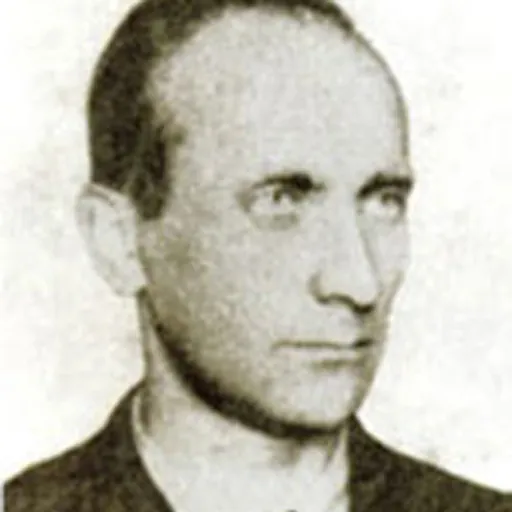
About Dmytro Klyachkivsky
Lived 1911 – 1945 (aged 33). Dmytro Klyachkivsky was an Austrian and Polish politician and military officer.
Dmytro Semenovych Klyachkivsky (; 4 November 1911 – 12 February 1945), also known by the pseudonyms Klym Savur,
Biography Klyachkivsky was born on 4 November 1911 in the city of Zbarazh, then part of Austria-Hungary (now Ukraine) as a son of a bank clerk. His father, Semen Klyahkivsky, was a member of the Sich Riflemen until 1919, when he fell ill with typhus and died. His mother, Tekla, became a washerwoman in order to provide for the family after Semen's death, and two of the family's adult children migrated to Canada to work for the family. As a child, Klyachkivsky was a devout member of the Ukrainian Greek Catholic Church and sang in a church choir.
Klyachkivsky completed his secondary studies and entered the law faculty of the Jan Kazimierz University in Lwów. From the mid- to late 1930s, Klyachkivsky began to be attracted to the Ukrainian independence movement, joining the Sokil youth group and the cooperative. He worked at the latter from 1935 to 1938. His interest in Ukrainian independence was encouraged by two former officers of the Sich Riflemen who were important in Zbarazh's community: D. Hamalai, a lawyer and leader of the Ukrainian Radical Party in Zbarazh, and V. Babiako, head of the local agricultural cooperative.
Massacres of Poles in Volhynia Klyachkivsky was the initiator of the massacres of Poles in Volhynia and Eastern Galicia in modern-day western Ukraine in the years 1943–1945. It was his directive, issued in mid-1943, that ordered the extermination of the Polish population across the province. One Ukrainian Insurgent Army commander who opposed it was threatened by Klyachkivsky with court-martial.
Evidence of his actions was found in SBU archives by Polish historian Władysław Filar and was published in 2000 in his book Before action Wisla, there was Volhynia. It was an order addressed to the commanders of the Ukrainian Insurgent Army in Volhynia. This secret directive stated:
Nevertheless, as noted by Timothy Snyder, among the tens of thousands of Poles murdered by UPA on his orders, most of the victims were women and children.
According to a Ukrainian historian Sergei Ryabenko, the "secret directive" cited by many authors is of questionable authenticity. The document signature referenced by the authors does not exist in the SBU archives, and other signatures lead to a criminal case against a deserter from Soviet army Adam Mitchik, who then joined UPA, and was later captured by the Soviets. The NKVD interrogation protocol of Mitchik from 1945 is the only archival document that contains a reference to Klyachkivsky and "secret directive", with statements similar to the above text. Based on these results Ryabenko postulated that the "secret directive" never existed and the above quote was compiled from statements attributed to Mitchik in the interrogation protocol, likely written by NKVD and signed by the defendant under torture.
Regardless of the "secret directive", other references suggest local orders to massacre the Polish population. In particular, Y. Stelmashchuk, the local commander of the UPA, stated during his NKVD interrogation :In the same June of 1943, ― the defendant submits information, ― in the Kolkiv forest, I met with Klym Savur [Klyachkivskyi], the deputy head of the stake of the main team Andriyenko. Savur gave me the order to destroy all the Poles of the Kovel district. All the leaders of the Kovel Oblast, including me, opposed this proposal, but Savur threatened me with a field trial. The situation was difficult. I had no right not to comply with the order, and personal convictions did not allow me to comply. I turned to Andrienko. Andrienko told me that these instructions are not from the center, that they are distortions on the ground, but he did not say anything specific.Ukrainian historian Volodymyr Viatrovych, uses it to support the claim that at that time the murders were not done at the order of the central leadership, but were a local initiative.
Death Klyachkivsky was killed in an ambush by the forces of the NKVD in February 1945 near the settlement of Orzhiv in the vicinity of Rivne. He was posthumously awarded the title of Colonel of the UPA and UPA Gold Cross of Military Honors First Grade.
Don’t just read it —
keep it.
Full-length biographies made to live with: read them, listen on the way to work, watch them tonight.
- E-book
- Audio
- Video
Instant download · yours to keep · every purchase keeps this site free
Important facts
People in Dmytro Klyachkivsky's life
Named in this biography and alive at the same time
Related people
Same field, nearest in time






Contemporaries
People whose lives overlapped Dmytro Klyachkivsky's





Frequently asked questions
Who was Dmytro Klyachkivsky?
Ukrainian Insurgent Army commander (1911-1945)
When was Dmytro Klyachkivsky born?
Dmytro Klyachkivsky was born on 4 November 1911 in Zbarazh.
When did Dmytro Klyachkivsky die?
Dmytro Klyachkivsky died on 12 February 1945 in Orzhiv.
What was Dmytro Klyachkivsky's occupation?
Dmytro Klyachkivsky was a politician and military officer.
What nationality was Dmytro Klyachkivsky?
Dmytro Klyachkivsky was Austrian and Polish.
Sources & further reading
· Wikipedia: Dmytro Klyachkivsky
· DBpedia: Dmytro Klyachkivsky
Cite this page
APA: Biography.guide. (2026). Dmytro Klyachkivsky. https://biography.guide/dmytro-klyachkivsky/
MLA: "Dmytro Klyachkivsky." Biography.guide, https://biography.guide/dmytro-klyachkivsky/.
Chicago: "Dmytro Klyachkivsky." Biography.guide. https://biography.guide/dmytro-klyachkivsky/.
Data last updated: 2026-09-20 · Spot an error? Report a correction.
Portrait: Wikimedia Commons · author & licence
Page generated 2026-09-27 04:57 UTC