
About Dixie Dean
Lived 1907 – 1980 (aged 73). Dixie Dean was a British association football player.
William Ralph "Dixie" Dean (22 January 1907 – 1 March 1980) was an English footballer who played as a centre forward. Dean holds the long-standing record for the most goals scored in a single season in top-flight English football, with 60 league goals in the 1927/28 season alone. He is regarded as one of the greatest centre-forwards of all time and was inducted into the English Football Hall of Fame in 2002.
Born in Birkenhead, he began his career at his hometown club Tranmere Rovers, before moving on to Everton, the club he had supported as a child. A prolific goalscorer, he was particularly known for having a penchant for scoring goals with his head, courtesy of his elevation and athleticism, as well as his powerful and accurate heading ability, which has led pundits to describe him as one of the greatest aerial specialists of all time. Dean played the majority of his career at Everton, before injuries caught up with him and he moved on to new challenges at Notts County, and eventually Sligo Rovers.
In Everton's league championship-winning season of 1927–28, Dean scored a record 60 league goals (out of the team's 102), having played in 39 of Everton's 42 games. That season, he also made his debut for England: he went on to score eighteen goals in sixteen appearances for his country.
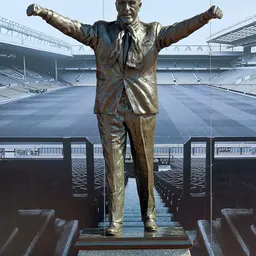
A statue of Dean was unveiled outside Goodison Park in May 2001. A year later, he became one of 22 players inducted into the inaugural English Football Hall of Fame.
Early years Dean was born at 313 Laird Street in Birkenhead, Cheshire, across the River Mersey from Liverpool. Dean's family on both sides hailed from Chester. He was the grandson of Ralph Brett, a train driver who drove the royal train during the reign of George V. Dean grew up as a supporter of Everton thanks to the efforts of his father, also named William, who took him to a match during the 1914–15 title-winning season.
Dean's childhood coincided with the First World War, and between the ages of seven and eleven he delivered cow's milk to local families as part of the war effort: "Well, it was war time you see, so you were grafting all the time. I used to take milk out. I'd be up at half-past four in the morning and go down and get the ponies and the milk floats, then I'd come out to this place in Upton, between Upton and Arrowe Park, and Burgess' Farm was there. We used to collect the milk in the big urns and take it out to people's houses, serving it out of the ladle. And not only that, you had an allotment, and that was in school time. And there was no such thing as pinching and stealing and all that bloody caper. In those days, you were growing all that stuff and you needed it for the war time."
Dean attended Laird Street School but felt he received no formal education: "My only lesson was football ... I used to give the pens out on Friday afternoons ... the ink, and the chalks. That was the only job I had in school ... I never had any lessons."
He left school at fourteen and worked for Wirral Railway as an apprentice fitter; his father also worked there and had been working since he was eleven years old In Dean's obituary in The Times, Geoffrey Green suggested that the nickname was taken from a "Dixie" song that was popular during Dean's childhood; there was "something of the Uncle Tom about his features".
Alternatively, Tranmere Rovers club historian Gilbert Upton uncovered evidence, verified by Dean's godmother, that the name "Dixie" was a corruption of his childhood nickname, Digsy (acquired from his approach to the children's game of tag, where Dean would dig his fist into a girl's back, hence "Digsy").
Club career
Tranmere Rovers He played football for Laird Street School, Moreton Bible Class, Heswall and Pensby United. He then joined the professional ranks with his local club, Tranmere Rovers in November 1923. He was sixteen at the time.
Whilst at Tranmere, he was on the receiving end of a tough challenge which resulted in him losing a testicle in a reserve game against Altrincham. Immediately following the challenge, a teammate rubbed the area to ease the pain. Dean shouted, "Don't rub 'em, count 'em!"
In his sixteen months at Tranmere, spanning the 1923–24 and 1924–25 seasons, he scored 27 goals in 30 league appearances. All 27 were in the second of those two seasons, in which he averaged exactly a goal per game. His exploits attracted the interest of many clubs across England, including Arsenal and Newcastle United. He made his debut away to Arsenal, and scored his first Everton goal later that month, at home to Aston Villa. By then, Dean was captain of the side. However, the harsh physical demands of the game (as it was played then) took their toll and he was dropped from the first team in 1937.
Dean's 310 First Division goals for Everton remain as the record for most goals for a single club in English football's top tier.
Later career Dean went on to play for Notts County for one season, in which he scored three goals in nine games. At age 32, Dean signed for Irish club Sligo Rovers in January 1939 to help the club in their FAI Cup campaign. On his arrival, the railway station in Sligo was said to be filled with locals trying to catch a glimpse of him. Dean scored ten goals in seven games for the club, including five in a 7–1 win over Waterford (which remains a club record for the most goals scored in a single game). He also played in four Cup matches, scoring once (in the 1–1 final against Shelbourne, who won the replay 1–0). Dean's runner-up medal was later stolen from his hotel room; on a return trip to Ireland to watch Rovers 39 years later in the 1978 FAI Cup final, a package was delivered to his hotel room with the medal inside. He is considered a legend at The Showgrounds and is featured in the club's outdoor museum.
Dean ended his professional playing days with Cheshire County League club Hurst (now Ashton United) in the 1939–40 season, managing two games and one goal before the outbreak of war ended his career. He made his debut in a 4–0 loss to Stalybridge Celtic; 5,600 people attended the game, paying sixpence, earning the club gate receipts of £140.
International career Dean made his debut for the England national football team against British rivals Wales at the Racecourse Ground in Wrexham in February 1927, less than a month after his 20th birthday. His final game for England came in a 1–0 victory over Ireland in October 1932 at Blackpool's Bloomfield Road, when Dean was 25 years old.
Dean was involved in the 1927 and 1929 editions of the British Home Championship. During the 1927 edition, Dean scored four goals in his two games for England and scored twice against Scotland at Hampden Park. Despite the loss, the Scots won the competition overall and applauded Dean (who finished the tournament as top scorer). In the 1929 edition, he scored in his only outing against Ireland at Goodison Park.
The only international competitions outside the British Home Championship during Dean's international career were the 1928 and 1936 Olympic Games and the inaugural FIFA World Cup, which took place in 1930; however, neither Great Britain nor England participated. Dean represented England sixteen times, scoring eighteen goals in nine games (including hat-tricks against Belgium and Luxembourg).
Later life and death Dean became a Freemason in 1931 while playing for Everton and England. He was initiated in Randle Holme Lodge, No. 3261, in Birkenhead on 18 February 1931. After retiring, he went on to run the Dublin Packet pub in Chester (Everton and the Dublin Packet commemorate this with memorabilia) and work at Littlewoods football pools as a porter at their Walton Hall Avenue offices, where he was remembered by fellow workers as a quiet, unassuming man.
In January 1972, Dean was admitted to St Catherine's hospital in Birkenhead suffering from the effects of influenza and was released a month later. In November 1976, he had his right leg amputated due to a blood clot; his health was declining, and he became increasingly housebound. Dean died on 1 March 1980 at age 73, after suffering a heart attack at Everton's home ground Goodison Park, whilst watching a match against their closest rivals, Liverpool. It was the first time that he had visited Goodison Park in several years, due to ill health. "He belongs to the company of the supremely great, like Beethoven, Shakespeare and Rembrandt", said Bill Shankly. His funeral took place at St James' Church on Laird Street (the street where he was born) in Birkenhead. He was survived by his four children: William, Geoffrey, Ralph and Barbara; he outlived his wife Ethel, who died of a heart attack in 1974 after 43 years of marriage.
Legacy
Dean was an internationally known figure. Military records show that during the Second World War, an Italian prisoner of war was captured by British troops in the Western Desert and told his captors "fuck your Winston Churchill and fuck your Dixie Dean". One of the soldiers present was Liverpool-born Patrick Connelly, who later went into show business using the pseudonym "Bill Dean".
Everton arranged a testimonial for Dean on 7 April 1964. Over 34,000 people saw teams from Scotland and England, composed of players from Everton and Liverpool, compete; The "Scots", with one Englishman and one Welshman, won 3–1.
The match raised £7,000 for Dean.
+Testimonial team squadsEnglandScotland Rankin Lawrence Byrne Brown Moran Thompson (Eng) Harris Gabriel Labone Yeats Kay Stevenson Callaghan Scott Stevens St. John Pickering Young Temple Vernon (Wal) Morrissey Wallace
Dean's 1933 FA Cup winner's medal sold for £18,213 at auction in March 2001. In May 2001 local sculptor Tom Murphy created a statue of Dean, which was erected outside the Park End of Goodison Park at a cost of £75,000 with the inscription "Footballer, Gentleman, Evertonian". In 2002, Dean was an inaugural inductee to the English Football Hall of Fame. There is an annual Dixie Dean award, which is given to the Merseyside player of the year; it has been won by players from his former clubs (Tranmere and Everton) and Liverpool.
When asked if he thought his record of scoring 60 goals in a season would be broken, Dean said: "I think it will. But there's only one man who'll do it. That's the fellow that walks on the water. I think he's about the only one." He was known as a sporting player, never booked or sent off during his career despite rough treatment and provocation from opponents. Only Arthur Rowley has scored more English-league career goals; however, while Rowley made 619 appearances and scored 433 goals (0.70 goals per game), Dean scored 379 goals in 438 games (0.87 goals per game).
In December 1930 and again in October 1931, Dean became the first Everton player to score two hat-tricks in one month of competitive play. His record would not be equalled for nearly ninety years (Dominic Calvert-Lewin did so in September 2020).
Division!!Apps!!Goals!!Apps!!Goals!!Apps!!Goals!!Apps!!Goals
1923–24 Third Division
1924–25 Third Division
30!!27!!3!!0!!0!!0!!33!!27
1924–25 First Division
1925–26 First Division
1926–27 First Division
1927–28 First Division
1928–29 First Division
1929–30 First Division
1930–31 Second Division
1931–32 First Division
1932–33 First Division
1933–34 First Division
1934–35 First Division
1935–36 First Division
1936–37 First Division
1937–38 First Division
399!!349!!32!!28!!2!!6!!433!!383
1937–38 Third Division
1938–39 Third Division
9!!3!!0!!0!!0!!0!!9!!3 Sligo Rovers 1938–39 League of Ireland
Hurst National team!!Year!!Apps!!Goals
Scores and results list England's goal tally first, score column indicates score after each Dean goal.
+ List of international goals scored by Dixie DeanNo.DateVenueOpponentScoreResultCompetition1 12 February 1927 Racecourse Ground, Wrexham, Wales 1–0 3–3 1926–27 Home Championship 2 3–33 2 April 1927 Hampden Park, Glasgow, Scotland 1–1 2–1 1926–27 Home Championship 4 2–15 11 May 1927 Stade du Daring Club de Bruxelles, Molenbeek, Belgium 5–0 9–1 Friendly 6 6–07 9–08 21 May 1927 Stade de la Frontière, Esch-sur-Alzette, Luxembourg 1–2 5–2 Friendly 9 3–210 4–211 26 May 1927 Stade Olympique Yves-du-Manoir, Colombes, France 2–0 6–0 Friendly 12 5–013 17 May 1928 Stade Olympique Yves-du-Manoir, Colombes, France 3–1 5–1 Friendly 14 4–115 19 May 1928 Olympisch Stadion, Antwerp, Belgium 1–1 3–1 Friendly 16 2–117 22 October 1928 Goodison Park, Liverpool, England 2–1 2–1 1928–29 Home Championship 18 Arsenal Stadium, London, England 5–0 7–1 Friendly
Honours Everton Football League First Division: 1927–28, 1931–32 Football League Second Division: 1930–31 FA Cup: 1932–33 FA Charity Shield: 1928, 1932
Sligo Rovers League of Ireland runner-up: 1938–39 FAI Cup runner-up: 1938–39
England British Home Championship: 1926–27 (shared), 1931–32 (shared) English Top Division Golden Boot: 1927–28, 1931–32 Second Division Championship: Top Goalscorer, 1930–31 Sunday Pictorial Trophy (60 league goals in 1927–28) Lewis's Medal (Commemorate 200 league goals in 199 appearances) Hall of Fame Trophy (1971) Football Writers' Association inscribed silver salver (1976) English Football Hall of Fame (Inaugural inductee, 2002) Most goals in an English top-flight season: 60 (1927–28) Seasonwise World Top Scorer: 1927–28 (60 goals)
Don’t just read it —
keep it.
Full-length biographies made to live with: read them, listen on the way to work, watch them tonight.
- E-book
- Audio
- Video
Instant download · yours to keep · every purchase keeps this site free
Important facts
People in Dixie Dean's life
Named in this biography and alive at the same time


Related people
Same field, nearest in time



Contemporaries
People whose lives overlapped Dixie Dean's



Frequently asked questions
Who was Dixie Dean?
English footballer (1907–1980)
When was Dixie Dean born?
Dixie Dean was born on 22 January 1907 in Birkenhead.
When did Dixie Dean die?
Dixie Dean died on 1 March 1980 in Liverpool.
What was Dixie Dean's occupation?
Dixie Dean was an association football player.
What nationality was Dixie Dean?
Dixie Dean was British.
Sources & further reading
Cite this page
APA: Biography.guide. (2026). Dixie Dean. https://biography.guide/dixie-dean/
MLA: "Dixie Dean." Biography.guide, https://biography.guide/dixie-dean/.
Chicago: "Dixie Dean." Biography.guide. https://biography.guide/dixie-dean/.
Data last updated: 2026-09-27 · Spot an error? Report a correction.
Page generated 2026-09-27 05:17 UTC