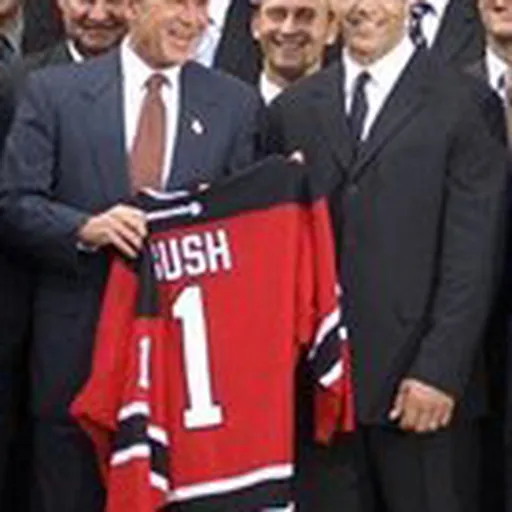
About Scott Stevens
Born 1964. Scott Stevens is a Canadian ice hockey player and ice hockey coach.
Ronald Scott Stevens (born April 1, 1964) is a Canadian professional ice hockey coach and former player. As a defenseman, Stevens played 22 seasons in the National Hockey League (NHL) for the Washington Capitals, St. Louis Blues and New Jersey Devils, serving as captain of the Devils from 1992 to 2004. Although offensively capable, his defensive play and his heavy body checking on opponents were crucial to his success.
Stevens started his career with the Capitals, where he helped the team make the Stanley Cup playoffs for the first time. After spending a season with the Blues, he was acquired by the Devils through arbitration. Personifying the team's defence-first mentality, he captained the Devils to four Stanley Cup Final appearances in nine years, winning three of them. In 2000, he won the Conn Smythe Trophy as the most valuable player of the 2000 Stanley Cup playoffs. Despite his team success with the Devils, he never won the James Norris Memorial Trophy as the league's best defenceman.
Stevens was later inducted into the Hockey Hall of Fame in 2007, his first year of eligibility. Stevens retired with the most games played by an NHL defenceman (1,635 games), later passed by Chris Chelios and Zdeno Chara. Stevens was also the youngest player in league history to reach 1,500 games played, playing in his 1,500th game at age 37 years, 346 days. He did not have a negative plus/minus in any of his 22 NHL seasons and had the most penalty minutes of any player enshrined in the Hall of Fame until Chris Chelios was inducted in 2013. In 2017, Stevens was named one of the "100 Greatest NHL Players" in history.
Early life Stevens was born in Kitchener, Ontario, to Larry and Mary Stevens, the middle child of three brothers. Larry owned a paper products company and was also a semi-professional Canadian football player. Growing up near Toronto, he was a fan of the Toronto Maple Leafs and idolized Leafs defenceman Börje Salming. Stevens attended Eastwood Collegiate Institute, where he played middle linebacker on the school's Canadian football team. However, hockey was Stevens' true passion. He and his brothers often played hockey in the house, ruining the furniture repeatedly. His play impressed scouts and he was taken ninth overall by his hometown Kitchener Rangers in the 1981 Ontario Hockey League (OHL) draft. Stevens and Shaw were an integral part of the Rangers' defence, playing in every game of the season en route to the team's Memorial Cup victory. In addition, both played in the OHL All-Star Game. Rangers head coach Joe Crozier said of Stevens, "He's come a long way this year ... He's strong, tough, handles the puck well and has tremendous hockey sense." He made an immediate impact, scoring on his first shot in his first NHL game.
The following year, he would nearly double his point total from the previous year, finishing with 13 goals and 32 assists for 45 points. Only teammate Larry Murphy had more points among defencemen. His 201 penalty minutes would lead the team; he would ultimately lead the Capitals in the category five times during his tenure with the team, and eventually set the team record for most career penalty minutes by a defenceman. Head coach Bryan Murray also helped calm the fiery young Stevens, who would learn to fight less and play harder. and earned the team's Fan Favorite Award. However, the Capitals continued their playoff woes; after defeating the Islanders in the first round, they lost to the New York Rangers in the division finals.
The 1986–87 season saw Stevens return to his old ways, as he spent a career-high 283 minutes in the penalty box. The total set a Capitals record (since broken) for penalty minutes in a season.
During the 1987–88 season, Stevens set Capitals records for most assists and most points by a defenceman in a game, with five assists against the Los Angeles Kings on December 6, 1987. He ended up finishing second behind Boston Bruins defenceman Ray Bourque in the voting for the James Norris Memorial Trophy. In addition, he was named as an NHL first team All-Star. the Capitals fell four games to three. He was named to his second All-Star game, and added an assist as the Wales Conference lost to the Campbell Conference 9–5. However, the Caps could not translate their regular-season success into the playoffs, as they lost in the first round to the Flyers. Despite his lowered stats, the Capitals made their furthest inroads in the playoffs ever. After defeating the Devils in the first round and the Rangers in the second round, the Capitals were in the Conference Final for the first time in team history where they were swept by the Bruins. He also made the Campbell Conference All-Star team. The Blues were eliminated in the second round of the playoffs by the Minnesota North Stars.
New Jersey Devils (1991–2004) Stevens' time with the Blues would only last one season. In the offseason following the 1990–91 NHL season, the Blues signed Brendan Shanahan from the New Jersey Devils,
1991–1995 Initially, Stevens refused to report to the Devils for training camp, and would not report until September 26, 1991, 22 days after the arbitration ruling. The Devils were already worried after captain Kirk Muller walked out of camp. Stevens and his wife had made plans to settle in St. Louis, and he wanted to end his career with the Blues.
Stevens finished his first season in New Jersey fifth on the team in scoring, first among defencemen and good enough for a spot on the second All-Star team.
Although he would miss part of the following season with a concussion, The Devils were eliminated in the first round of the playoffs again, losing to the Pittsburgh Penguins in five games. Stevens finished as a runner-up to Ray Bourque for the Norris Trophy; the four-vote difference was the closest in Norris Trophy voting history. Five days later, the Devils matched the offer, and thus Stevens remained in New Jersey. However, the Devils later found out Stevens had heard from St. Louis management before the free agency period began, which was illegal under NHL policy. After a five-year investigation, the league fined the Blues $1.5 million and awarded the Devils two of St. Louis' first-round draft picks. Despite the reduced schedule, Stevens managed 2 goals and 20 assists, once again leading defencemen in scoring. The Devils finished fifth in the conference, and advanced to the Stanley Cup Final, where they swept the heavily favoured Detroit Red Wings to win the franchise's first championship. It was determined that Kozlov suffered a concussion. Stevens then turned to Wings forward and former Washington teammate Dino Ciccarelli, who was upset about the check, and said, "You're next!"
1996–1999 The Devils expected to defend their Stanley Cup title the following season. However, they became the first team in 26 years to miss the playoffs following a championship. Stevens voiced the team's disappointment, saying, "After winning the Cup, you expect to definitely be in the playoffs the next year ... Maybe it was just a wakeup call to get back on track."
Stevens started the 1996–97 season with a one-game suspension due to high-sticking penalty against Igor Larionov, which drew blood. Stevens finished second on the team among defencemen in scoring behind Scott Niedermayer.
For the most part, it seems to go with the guy who's got a lot of points... I don't think about it as much as I used to. I've been asked to play a certain role here, which doesn't help in that area. But I feel that gives the team a chance to win every night. That's the satisfaction I get. — —Scott Stevens, on not winning the Norris Trophy Stevens was especially important to the Devils' defensive corps, as longtime Devil Ken Daneyko was undergoing rehabilitation for alcoholism. The Devils finished as the top seed in the Eastern Conference but were eliminated in the first round by the Ottawa Senators.
The Devils made several changes before the 1998–99 season, including the hiring of Robbie Ftorek as head coach to replace Jacques Lemaire. The team continued its focus on defence, as the solid corps of Stevens, Daneyko and Niedermayer finished with plus-minuses of +29, +27 and +26 respectively. Unfortunately, the team was once again eliminated in the first round of the playoffs, this time by the Pittsburgh Penguins. With four players scoring over 50 points, including rookie Scott Gomez's team-leading 51 assists, Stevens' 29 points were only good enough for tenth on the team and third among defencemen, behind Niedermayer and Brian Rafalski. Stevens also set an NHL record after becoming the first player to play in 600 games with two teams. The Devils then met their bitter rivals, the Philadelphia Flyers, in the Eastern Conference Final. After getting behind in the series three games to one, the Devils managed to win games five and six, setting the stage for game seven in Philadelphia. Stevens and Lindros had numerous on-ice feuds in recent seasons; this was only Lindros' second game since returning from a concussion suffered in March against the Boston Bruins. Stevens had previously taken Flyers centre Daymond Langkow out with a concussion after game two. The Devils completed the comeback against the Flyers with a 2–1 victory to win the Eastern Conference Final. The Devils faced off against the defending Stanley Cup champion Dallas Stars in the Stanley Cup Final. Stevens and Rafalski were tasked with the responsibility of shutting down Dallas' scoring line of Mike Modano, Brett Hull and Joe Nieuwendyk. Stevens scored the game-winner in the first game of the series en route to a 7–3 Devils victory; the goal was his third of the playoffs. The Devils went on to win the Finals in six games after game five went to three overtimes and game six was decided in double overtime. Stevens earned an assist on Jason Arnott's Cup-winning goal, and he won the Conn Smythe Trophy for his leadership role on the team. However, the playoffs proved tough, as the underdog Carolina pushed the Devils to six games, then Toronto took a 3-2 series lead before New Jersey won the last two games to advance. New Jersey did manage to stifle Pittsburgh's Mario Lemieux (who made his comeback after retiring in 1997) and Jaromír Jágr in five games during the Eastern Conference Final. In the Stanley Cup Final, this time against the Colorado Avalanche, despite being up three games to two, the Devils could not finish off the Avalanche and lost the series in seven games. Stevens finished third in the voting for the Norris Trophy. though he did become the youngest player ever to play in 1,500 games.
Stevens and the Devils once again had success in 2002–03, finishing first in the division. In addition, he was named as captain of the Eastern Conference All-Star team for the first time, and finished the season with the fewest penalty minutes over a full season in his career. Stevens added to his list of playoff hits when he blindside hit Mighty Ducks forward Paul Kariya to the head in game six. However, Kariya came back shortly thereafter and led the Ducks to a victory, forcing a game seven. Despite the play of Stevens, Martin Brodeur, Jamie Langenbrunner and Jeff Friesen, the Conn Smythe Trophy went to Ducks goaltender Jean-Sébastien Giguère. Some speculated that there were too many worthy Devils candidates for the trophy, resulting in a split vote among sportswriters.
The 2003–04 NHL season would be the last for Stevens. Before ending the season, he surpassed former teammate Larry Murphy as the NHL's all-time leader in games played by a defenceman when he appeared in his 1,616th game in November. In the off-season, Stevens recovered and continued to work out and expected to return to the Devils for the 2004–05 NHL season. However, the lockout canceled the entire season and Stevens announced his retirement on September 6, 2005, after 1,635 NHL games, fourth at the time (and now eleventh) all-time in games played, the leader in games played by a defenceman (since passed by Chris Chelios and Zdeno Chára), and 14th all-time in career penalty minutes. After two seasons of failing to make the playoffs, Stevens stepped down as assistant coach in September 2014. His role as the assistant coach for the defenseman was filled by another former Devil, Tommy Albelin. However, three months later, Stevens returned to the Devils along with former assistant coach Adam Oates, relieving Peter DeBoer of his coaching duties. In a unique move, both Stevens and Oates were named as "interim" co-head coaches, with Stevens focusing on defencemen and Oates on forwards.
Minnesota Wild On June 7, 2016, the Minnesota Wild hired Stevens as an assistant to head coach Bruce Boudreau. Less than a year later, on May 30, 2017, Stevens resigned to "spend more time with his family".
International play In addition to his NHL career, Stevens represented Canada in several international ice hockey competitions.
He attended summer camp with Team Canada before the 1983 World Junior Championships, but because of his commitment to the Capitals, he was unable to join the team.
NHL players were first allowed to participate in the Olympic ice hockey tournament at the 1998 games. Stevens was selected to Team Canada, although New Jersey teammate Scott Niedermayer was controversially omitted. Stevens went scoreless in the tournament for the only time in his international career. Canada would finish fourth after losing their semi-final match-up against the Czech Republic in a shootout, followed by a 3-2 loss to Finland in the bronze medal match. Stevens would be part of Canada's orientation camp for the 2002 Games, but he would not make the final roster.
Legacy Stevens was the first Devils player to have his number retired; he was honoured at a ceremony at Continental Airlines Arena on February 3, 2006. alt=A large white banner with the number 4 is suspended in air above an ice hockey rink, as the crowd cheers. The longest-serving captain in Devils history, Stevens mentored the younger Devils defencemen like Colin White and Brian Rafalski, who was Stevens' defensive linemate. Long-time teammate Scott Niedermayer said Stevens was "not the most vocal guy around", but he would talk to players when it was necessary. Former NHL defencemen Dion Phaneuf and François Beauchemin are often compared to Stevens, and Phaneuf says he has idolized Stevens' style of play. Among the victims of Stevens' body checks were Slava Kozlov, Eric Lindros, Paul Kariya, Shane Willis and Ron Francis, the last of whom was inducted with Stevens into the Hockey Hall of Fame in 2007.
One of the more notable victims of Stevens' hits was young Shane Willis, who endured a concussion and was knocked out for the rest of the series. Carolina Hurricanes goaltender Artūrs Irbe said Stevens was "trying to kill [Willis] or put him out of the playoffs". Stevens responded: earning him the nickname "Captain Crunch".
Others counter that Stevens' hits were legal for the era in which he played. Despite being a devastating open-ice hitter, being accused by some of deliberately attempting to injure opponents, he was not considered a dirty player. In Stevens' entire career, he was suspended only twice for a total of four games, and received no suspensions for any of his hits (by contrast, New Jersey teammate Scott Niedermayer received a ten game suspension for hitting an opposite player in the head with his stick, while another contemporary, Chris Pronger has been suspended eight times). Out of Stevens' 2,785 career penalty minutes, only eight minutes were for elbowing penalties. It wasn't until later that the league changed its rules to protect defenseless players from head trauma, and with the NHL establishing a department of player safety, leading to postulation that Stevens would have been penalized more severely under the new rules.
Personal life Stevens met his wife Donna while he was playing junior hockey with Kitchener. He is a fan of the outdoors, and spent his summers away from hockey at Lake Catchacoma. Stevens joined the NHL Network as a commentator in December 2017.
Sexual assault allegation In May 1990, while playing for the Capitals, Stevens was accused of raping a 17-year-old girl outside a bar, alongside teammates Dino Ciccarelli, Geoff Courtnall, and Neil Sheehy. The court case fell apart, though a spokesperson for the Metropolitan police at the timewith no supporting evidence available for use at trialstated that the police "have sufficient grounds to believe that a criminal offense did occur."
Career statistics Regular season and playoffs Regular season Playoffs Season Team League GP G A Pts PIM GP G A Pts PIM 1980–81 Kitchener Ranger B's MWJHL 39 7 33 40 82 — — — — — 1980–81 Kitchener Rangers OHL 1 0 0 0 0 — — — — — 1981–82 Kitchener Rangers OHL 68 6 36 42 158 15 1 10 11 21 1982–83 Washington Capitals NHL 77 9 16 25 195 4 1 0 1 26 1983–84 Washington Capitals NHL 78 13 32 45 201 8 1 8 9 21 1984–85 Washington Capitals NHL 80 21 44 65 221 5 0 1 1 11 1985–86 Washington Capitals NHL 73 15 38 53 165 9 3 8 11 12 1986–87 Washington Capitals NHL 77 10 51 61 283 7 0 5 5 19 1987–88 Washington Capitals NHL 80 12 60 72 184 13 1 11 12 46 1988–89 Washington Capitals NHL 80 7 61 68 225 6 1 4 5 11 1989–90 Washington Capitals NHL 56 11 29 40 154 15 2 7 9 25 1990–91 St. Louis Blues NHL 78 5 44 49 150 13 0 3 3 36 1991–92 New Jersey Devils NHL 68 17 42 59 124 7 2 1 3 29 1992–93 New Jersey Devils NHL 81 12 45 57 120 5 2 2 4 10 1993–94 New Jersey Devils NHL 83 18 60 78 112 20 2 9 11 42 1994–95 New Jersey Devils NHL 48 2 20 22 56 20 1 7 8 24 1995–96 New Jersey Devils NHL 82 5 23 28 100 — — — — — 1996–97 New Jersey Devils NHL 79 5 19 24 70 10 0 4 4 2 1997–98 New Jersey Devils NHL 80 4 22 26 80 6 1 0 1 8 1998–99 New Jersey Devils NHL 75 5 22 27 64 7 2 1 3 10 1999–2000 New Jersey Devils NHL 78 8 21 29 103 23 3 8 11 6 2000–01 New Jersey Devils NHL 81 9 22 31 71 25 1 7 8 37 2001–02 New Jersey Devils NHL 82 1 16 17 44 6 0 0 0 4 2002–03 New Jersey Devils NHL 81 4 16 20 41 24 3 6 9 14 2003–04 New Jersey Devils NHL 38 3 9 12 22 — — — — —NHL totals 1,635 196 712 908 2,785 233 26 92 118 378
International play Year Team Event Result GP G A Pts PIM 1983 Canada WC 10 0 2 2 8 1985 Canada WC 8 1 2 3 6 1987 Canada WC 4th 2 0 1 1 2 1989 Canada WC 7 2 1 3 2 1991 Canada CC 8 1 0 1 4 1996 Canada WCH 8 0 2 2 4 1998 Canada OG 4th 6 0 0 0 2 Senior totals 49 4 8 12 28
All-Star Games Year Location G A P PIM 1985 Calgary 0 0 0 0 1989 Edmonton 0 1 1 0 1991 Chicago 0 0 0 0 1992 Philadelphia 1 0 1 0 1993 Montreal 0 2 2 0 1994 New York City 1 1 2 0 1996 Boston 0 0 0 0 1997 San Jose 0 2 2 0 1998 Vancouver 0 0 0 0 1999 Tampa Bay 0 0 0 0 2000 Toronto 0 0 0 0 2001 Colorado 0 2 2 0 2003 Florida 0 0 0 0 All-Star totals 2 8 10 0
Awards NHL Award Year(s) NHL All-Rookie Team 1983 NHL All-Star Game 1985, 1989, 1991, 1992, 1993, 1994, 1996, 1997, 1998, 1999, 2000, 2001, 2003 Conn Smythe Trophy 2000 NHL first All-Star team 1988, 1994 NHL Plus-Minus Award 1994 NHL second All-Star team 1992, 1997, 2001 Stanley Cup 1995, 2000, 2003
Don’t just read it —
keep it.
Full-length biographies made to live with: read them, listen on the way to work, watch them tonight.
- E-book
- Audio
- Video
Instant download · yours to keep · every purchase keeps this site free
Important facts
People in Scott Stevens's life
Named in this biography and alive at the same time






Related people
Same field, nearest in time



Contemporaries
People whose lives overlapped Scott Stevens's

Frequently asked questions
Who is Scott Stevens?
Canadian ice hockey player
When was Scott Stevens born?
Scott Stevens was born on 1 April 1964 in Kitchener.
What is Scott Stevens's occupation?
Scott Stevens is an ice hockey player and ice hockey coach.
What nationality is Scott Stevens?
Scott Stevens is Canadian.
Sources & further reading
Cite this page
APA: Biography.guide. (2026). Scott Stevens. https://biography.guide/scott-stevens-ice-hockey-player/
MLA: "Scott Stevens." Biography.guide, https://biography.guide/scott-stevens-ice-hockey-player/.
Chicago: "Scott Stevens." Biography.guide. https://biography.guide/scott-stevens-ice-hockey-player/.
Data last updated: 2026-09-22 · Spot an error? Report a correction.
Portrait: Wikimedia Commons · author & licence
Page generated 2026-09-27 05:03 UTC