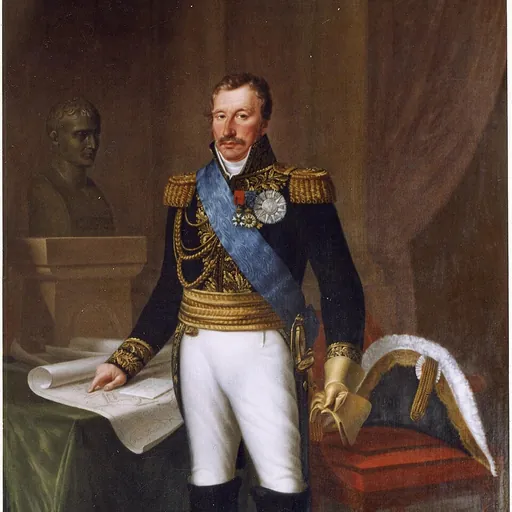
About Dirk van Hogendorp
Lived 1761 – 1822 (aged 61). Dirk van Hogendorp was a Dutch civil servant, military officer, diplomat, politician and writer.
Dirk van Hogendorp (13 October 1761 – 29 October 1822) was a Dutch military officer, politician, colonial administrator and diplomat. In 1812 he was governor of Vilnius, in 1813 he was appointed as the governor of Hamburg. He was an early critic of the Dutch colonial system as implemented under the VOC. His ideas about reforms in the Dutch East Indies were to a large extent realized by the Commissioners-General of the Dutch East Indies, through the behind the scenes influence of his friend Herman Warner Muntinghe, first as adviser of Stamford Raffles, and later as adviser of the Commissioners-General.
Life Personal life
Van Hogendorp was the eldest son of Willem van Hogendorp and his wife, Carolina Wilhelmina van Haren. He was a brother of Gijsbert Karel van Hogendorp. He married Margaretha Elisabeth Bartlo in 1785 in Batavia. They had a son, Carel Sirardus Willem van Hogendorp. After his first wife's death he married Princess Augusta Eleonora Carolina von Hohenlohe-Langenburg in 1803. The children from this marriage all died before 1813.
In the Dutch East Indies Hogendorp in 1786 joined the VOC as an onderkoopman (assistant merchant). Soon after he became the assistant-resident at Patna in Dutch Bengal. This city was a trade center where both the VOC and the British East India Company had trading posts. He became a friend of the British Governor-General of Bengal lord Cornwallis, and studied the reforms the British implemented around that time. In particular the treatment of the local peasants, who were freed from their status of serfs and became free labor, aroused his admiration. This would inspire the ideas that he would later try to introduce on Java.
Back in Patria the Asiatic Council of the Uitvoerend Bewind made an attempt to have him indicted, to which Hogendorp wrote an apologia, entitled Verdediging aan het Committé tot den O.I. handel en bezittingen, and the fiscaal of the council, Herman Warner Muntinghe, refused to indict.
The draft report, which bears some similarity to the ideas of Abbé Raynal, was rejected by Nederburgh and the old VOC officials who believed it too radical, and who realized that the Dutch depended on the very indigenous rulers, or Regents that the plan would essentially undermine. Furthermore, they held firm to the belief that the colonies existed as mercantile assets, to be exploited for the benefit of the chartered company it was, and rejected any alternatives that would give more rights to either the natives or competitors from other nations. However, the report was influential enough that Hogendorp was able to attain a seat on the committee for drafting a "Charter" to rule Java and other Asiatic possessions, commissioned by the Asiatic Council, that was then (1803) dominated by progressive politicians like Samuel Wiselius and Johannes Neethling. The commission used many of the ideas Hogendorp had first proposed. Its report, that also contained a draft "Charter" for the East Indies was, however, received with much opposition from the vested interests in the Batavian Republic, and the Staatsbewind prevailed on the Asiatic Council to accommodate those interests. Later the council was purged of its progressive members and the clique around Hogendorps nemesis Nederburgh came to dominate it.
Diplomatic career After the adoption of the watered-down "Charter" a vacancy appeared to open up in the government of the Indies: Governor-General Johannes Siberg's position had become untenable and the Staatsbewind looked for a replacement. To many Hogendorp seemed to be the obvious choice, but the Staatsbewind prevaricated and meanwhile another vacancy, this time that of envoy to the Russian court opened up, which Hogendorp accepted in 1803. His sojourn in Saint Petersburg was personally successful: he had a good rapport with Czar Alexander I, who even offered to be a godfather to one of Hogendorp's children, but professionally he had less success: a trade treaty, to which the previous czar, Paul I, had been amenable, did not materialize. Hogendorp did succeed in opening up the navigation through the Dardanelles to the Black Sea for Batavian shipping, but a project to have Russia guarantee the sovereignty of the Republic (in view of the threat of Imperial France), remained unsuccessful. So Hogendorp asked in 1805 for his recall. His sojourn was shortened by the invasion of Austria by Napoleon in the course of the War of the Fifth Coalition, which led to the flight of the Austrian Emperor Francis I from Vienna in November 1809, which prompted Hogendorp to return home post-haste.
Napoleon's invasion of Russia
When Napoleon invaded Russia in 1812, he appointed Hogendorp in several military governorships, first of Königsberg, later of Vilna in what was then a part of Russia, as Lithuania had been annexed by that country. He had to rule with an iron fist to be able to supply the French army, and to organize an auxiliary Lithuanian corps for the Grande Armée.
When Napoleon escaped from Elba, beginning the Hundred Days, Hogendorp made the mistake of immediately traveling to France to offer his services. Napoleon made him governor of Nantes. After Napoleon lost the Battle of Waterloo Hogendorp's role was of course ended. He was no longer welcome in the new Kingdom of the United Netherlands, just like that other admirer of Napoleon, Carel Hendrik Ver Huell. Ver Huell thrived, but Hogendorp had to find refuge with the family of his daughter-in-law near Calais. There he wrote Du système colonial de la France sous les rapports de la politique et du commerce which was published in 1817, but did not have the success Hogendorp hoped. When Napoleon died in 1821 it turned out that he had bequeathed 100,000 francs to Hogendorp. This news arrived just as Hogendorp himself, after his death on 29 October 1822, was buried in Rio de Janeiro in the Brazil, then part of the United Kingdom of Portugal, Brazil and the Algarves. Van Hogendorp lived his last years on a small plantation, named Novo Sion operated by slaves owned by van Hogendorp, growing coffee and oranges.
Publications Brief van Dirk van Hogendorp aan alle vrijheid- en vaderlandlievende Bataven in Nederlandsch Oost-Indië enz. Bombay, 9 January 1799. Berigt van den tegenwoordigen toestand der Batavische bezittingen in Oost-Indië en den handel op dezelve. Delft, December 1799, 2nd ed. Delft 1800. Ontwerp om de Oost-Indische Compagnie te herstellen tot een handeldrijvend ligchaam, 's-Gravenhage 1801. Antwoord op het onderzoek der gronden van het stelsel an D. van Hogendorp, 's-Gravenhage 1802. Nadere uitlegging en ontwikkeling van het stelsel van Dirk van Hogendorp, en antwoord op het werk van S.C. Nederburgh, getiteld: Verhandeling over de Vragen enz. 1802. Aanmerkingen op het adres van participanten der Nederlandsche O.I. Compagnie aan het Staatsbewind der Bataafsche Republiek, 's-Gravebhage 1802. Brief van Sir George Dallas aan Sir William Pulteney, beide leden van het Engelsche parlement, over het verschil tusschen de Oost-Indische Compaynie en den vrijen handel in Engeland, 's-Gravenhage 1802. Ontwerp om de O.I. Compagnie dezer landen in haren vorigen bloei te herstellen, 's-Gravednhage and Amsterdam 1802. Memorie ter wederlegging van de nadeelige geruchten en lasteringen, welke tegen hem uitgestrooid zijn gedurende hij gouverneur was van Hamburg, 's-Gravenhage and Amsterdam 1814. Staat- en handelkundige beschouwing van het Koloniaal systema in Frankrijk, uit het Fransch. Amsterdam 1817.
Playwright: Kraspoekol As a curiosity: Van Hogendorp published a play entitled "Kraspoekol, of de slavernij, een tafereel der zeden van Nederlandsch Indië", Delft 1800. And "... six months after the publication of this play, with his name to it, he attempted to have it represented on the stage at The Hague, on 20 March 1801; but the East Indies Gentry, not thinking it proper to exhibit the most illustrious actions of themselves and their noble ancestors upon a stage to vulgar European spectators, went to the play provided with little half-penny whistles and trumpets, and kept up such a tremendous whistling and trumpeting from the very moment the curtain began to be drawn up, that not a syllable of the play could be heard – and, if these Gentlemen could, they would also have extinguished the candles, to keep in darkness what themselves and their ancestors never intended for the light. In short, the play, after being thus interrupted the whole of the first act, was broken off before the second, when the manager was obliged to give up the entertainment. The next day the ignorant part of the audience was so curious to know the secrets which these East India Gentlemen had been thus industrious to conceal, that the bookseller (as he told me himself) sold infinitely more copies of the play that day than all he had sold the whole of the preceding six months, and had he ten times more, they would not have answered the numerous demands."
Don’t just read it —
keep it.
Full-length biographies made to live with: read them, listen on the way to work, watch them tonight.
- E-book
- Audio
- Video
Instant download · yours to keep · every purchase keeps this site free
Important facts
People in Dirk van Hogendorp's life
Named in this biography and alive at the same time



Related people
Same field, nearest in time


Contemporaries
People whose lives overlapped Dirk van Hogendorp's




Frequently asked questions
Who was Dirk van Hogendorp?
Dutch general and politician (1761-1822)
When was Dirk van Hogendorp born?
Dirk van Hogendorp was born on 3 October 1761 in Heenvliet.
When did Dirk van Hogendorp die?
Dirk van Hogendorp died on 29 October 1822 in Rio de Janeiro.
What was Dirk van Hogendorp's occupation?
Dirk van Hogendorp was a civil servant, military officer, diplomat, politician and writer.
What nationality was Dirk van Hogendorp?
Dirk van Hogendorp was Dutch.
Sources & further reading
· Wikipedia: Dirk van Hogendorp
Cite this page
APA: Biography.guide. (2026). Dirk van Hogendorp. https://biography.guide/dirk-van-hogendorp-civil-servant/
MLA: "Dirk van Hogendorp." Biography.guide, https://biography.guide/dirk-van-hogendorp-civil-servant/.
Chicago: "Dirk van Hogendorp." Biography.guide. https://biography.guide/dirk-van-hogendorp-civil-servant/.
Data last updated: 2026-09-23 · Spot an error? Report a correction.
Portrait: Wikimedia Commons · author & licence
Page generated 2026-09-27 05:05 UTC