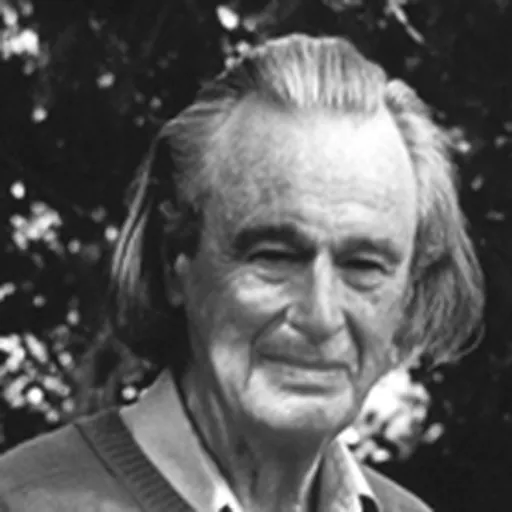
About Derek Freeman
Lived 1916 – 2001 (aged 84). Derek Freeman was a New Zealand anthropologist.
John Derek Freeman (15 August 1916 – 6 July 2001) was a New Zealand anthropologist known for his criticism of Margaret Mead's work on Samoan society, as described in her 1928 ethnography Coming of Age in Samoa. His attack "ignited controversy of a scale, visibility, and ferocity never before seen in anthropology." He also studied education and was issued a teacher's certificate in 1937. In 1938 he attended a graduate seminar taught by Ernest Beaglehole, who in turn had been a student of Edward Sapir. Beaglehole encouraged Freeman's interest in Mead's groundbreaking 1928 work, and this sparked his interest in visiting Samoa.
During his undergraduate studies in psychology he studied the socialization of children aged 6 to 9 in Wellington. This research led him to take a strong cultural determinist stance, even publishing an article in the student publication "Salient" stating that "the aims and desire which determine behavior are all constituted by the social environment". Also during this period he met Jiddu Krishnamurti who instilled in Freeman an interest in free will and choice as a counterpoint to the forces of social and cultural conditioning. during which time he learned to speak the Samoan language fluently, being qualified by a government examination. And he was adopted into a Samoan family of the community of Sa'anapu, and received the chiefly title of Logona-i-Taga. Freeman returned to England in 1951 and was accepted into King's College at the University of Cambridge, where he completed his doctoral thesis on the Iban in 1953.
His thesis about Iban agriculture has been described as "a superb piece of research" and "one of the best and most complete accounts of swidden agriculture that has yet been made" It was pioneering in using quantitative data to illuminate aspects of swidden economy as well as social organization. He also described the Iban kinship system which was remarkable in being neither patrilineal or matrilineal, but allowing either kind of filiation (but not both) for any individual. Freeman described this system as "utrolineal", and personal choice inherent in the system underpinned much of Freeman's later work.
Conversion and breakdown in Kuching The Old Sarawak Museum in Kuching, where Freeman destroyed an Iban carved statue. An important event in Freeman's life and career took place in 1961 when Freeman was sent to Borneo to attend to a graduate student, one Brian de Martinoir, who had run into trouble with locals while studying in central Borneo. The student (who was later described by Freeman as an impostor with fake credentials) had been subject to verbal abuse and humiliation by Tom Harrisson, Government Ethnologist and Curator of the Sarawak Museum, and this event had threatened his relationship with the Kajang people that he was studying. Freeman knew Harrisson, from his earlier work in Borneo in 1957 when Freeman had himself once been subject to Harrisson's fiery temper - the two men both had strong personalities and they were both strongly territorial about their research subjects.
During the stay in Kuching, Freeman developed an intense antagonism towards Harrisson, whom he believed to be a corrupting influence on the local indigenous people, and in spite of his orders from the Australian National University to leave Harrisson be, he worked intensely to put him in a bad light with the local government, and to have him forcibly removed from Borneo. Freeman seems to have believed that through erotic statues elaborated by the local Iban and working in concert with agents of the Soviet Union to subvert the British rule of Malaysia, Harrisson was exerting a form of mind control over Freeman himself as well as over the officials of Borneo. The conflict culminated when Freeman broke into Harrisson's house while he was out, and smashed a carved wooden sculpture at the Sarawak museum. He also changed the name under which he published; until that point he had published as J. D. Freeman, but from then on he published as Derek Freeman. In November 1964 Mead visited the Australian National University and she and Freeman had their only meeting. Freeman privately presented Mead with most of the critique of her work that he would later publish after her death, and at a public meeting they had a heated discussion about the importance of female virginity in Samoan culture. During this meeting Freeman made a peculiar faux pas. When Mead asked why he had not brought his undergraduate thesis on Samoan social structure to her residence the night before, he replied "because I was afraid you might ask me to stay the night". Mead was by then more than 60 years old and walked with a cane, and the suggestion that Freeman thought Mead might seduce him caused hilarity in the auditorium. Freeman later commented that he had no idea why he said what he did, and that he was himself mortified at hearing his own words. This slip and subsequent events in Samoa, have been used to argue that Freeman's academic relationship with Margaret Mead was complicated by Freeman's emotions. Freeman later admitted that he did feel intimidated by Mead even as he was administering his harsh verbal critique of her work, and he described her as a "castrator of men" to whose power he did not want to succumb.
Back to Samoa In December 1965, Freeman returned to Samoa, staying there the next two years. Originally his research was supposed to focus on social change, especially interactions between demographic and environmental processes, and he intended to base his research in ethological and psychoanalytic theory. However, traveling to Samoa Freeman decided that his objective should rather be to refute Mead's studies of Samoan sexuality. After working for a while in Western Samoa where he had most of his connections, he traveled to Ta‘ū in American Samoa, the location of Mead's fieldwork in the 1920s, hoping to find some of her original informants. He did not find any, but he did interview several Chiefs who had known Mead and who were highly critical of her depictions of Samoan society. He was also told that Mead had had an affair with a Samoan man, and the men he interviewed expressed outrage at her sexual licentiousness. This information deeply affected Freeman, who later described the discovery as deeply upsetting. He concluded that when Mead described Young Samoan women as sexually liberated she was in fact projecting onto them "her own sexual experiences as a young woman in the faraway, romantic south seas". Shortly after uncovering this information Freeman suffered another breakdown, his Samoan hosts found him wandering the beach in an agitated state. Due to his "verbally violent" behavior, the coast guard was dispatched to bring him to observation at the local hospital. Samoan witnesses ascribed the incident to spirit possession, some Americans thought of it as evidence of psychological problems, but Freeman himself dismissed those speculations attributing it to fatigue from research and possible symptoms of dengue fever.
The beginnings of controversy Back from Samoa in 1968 Freeman gave a paper criticizing Mead to the Australian Association of Social Anthropology. The paper contained many of the arguments later to be published in "Margaret Mead and Samoa": Freeman argued that Mead had been influenced by her strongly held belief in the power of culture as a determinant of human behavior, and that this belief had caused her to mischaracterize Samoa as a sexually liberated society when in fact it was characterized by sexual repression and violence and adolescent delinquency. In 1972 he published a note in the Journal of the Polynesian Society criticizing Mead's spelling of Polynesian words suggesting that her non-standard orthography betrayed a general lack of skills in the Samoan language. Completing his manuscript of Margaret Mead and Samoa in 1977 he wrote Mead offering her to read it before publication, but Mead was by then seriously ill with cancer and was unable to respond - she died the next year. Freeman sent the manuscript first to the University of Oxford Press for publication, but the editor requested several revisions which Freeman rejected. In 1982 the manuscript was accepted for publication by the Australian National University Press, which issued the work in 1983.
In 1979 Freeman also sparked a public controversy in Canberra when he protested against the Mexican government's gift of a copy of the Aztec calendar stone to the Australian National University. Freeman believed the stone to have been an altar used for human sacrifice, and therefore saw it as being inappropriate. Freeman stated that the Aztecs were "the most barbaric culture in all of human history". The event caused public debate, with commentators accusing Freeman of exhibiting a double standard as he did not speak out against a model of the Roman Colosseum in the Classics Museum at the Australian National University, and that he had never spoken similarly out against practices of human sacrifice and cannibalism amongst the Bornean and Samoan people he had studied. The controversy created an urban legend in Australia that Freeman had either doused the stone with blood in a display of protest, or that he had planned to do so - these stories are however incorrect, and Freeman in fact calmly attended the inauguration of the stone. consequently, his refutation was published only after Mead's death in 1978. Freeman says that he informed Mead of his continuing work in refuting her research when he met her in person in November 1964 nevertheless, he has come under fire for not publishing his work at a time when Mead could reply to his accusations. However, when Freeman died in 2001, his obituary in The New York Times pointed out that Freeman tried to publish his criticism of Mead as early as 1971, but American publishers had rejected his manuscript. In 1978, Freeman sent a revised manuscript to Mead, but she was ill and died a few months later without responding.
The publication of Margaret Mead in Samoa: the Making and Unmaking of an Anthropological Myth sparked an intense controversy both within anthropology and in the general public. The debate which has been characterized as being "of a scale, visibility, and ferocity never before seen in anthropology,"
Freeman's 1983 critique asserts that Mead was tricked by native informants who were lying to her and that these misconceptions reinforced Mead's doctrine of "absolute cultural determinism" that entirely neglects the role of biology and evolution in human behavior, concentrating instead on the cultural influences. Freeman also argues that "Mead ignored violence in Samoan life, did not have a sufficient background in—or give enough emphasis to—the influence of biology on behavior, did not spend enough time in Samoa, and was not familiar enough with the Samoan language."
Freeman's refutation was initially met by some with accusations of "circumstantial evidence, selective quotation, omission of inconvenient evidence, spurious historical tracking and other critical observations,"
Freeman's obituary in The New York Times stated that "His challenge was initially greeted with disbelief or anger, but gradually won wide -- although not complete -- acceptance," but further said that "many anthropologists have agreed to disagree over the findings of one of the science's founding mothers, acknowledging both Mead's pioneering research and the fact that she may have been mistaken on details."
Soon after, The New York Times published the following response from Professor Louise Lamphere, president of the American Anthropological Association,
Your 5 Aug. obituary of the anthropologist Derek Freeman leaves the impression that the two books he wrote attacking Margaret Mead's work have permanently damaged her reputation. The Freeman debate has been the subject of a number of books and scholarly articles that support her views on the importance of culture for the adolescent experience, while criticizing some details of her research.
I have taught about the controversy for the last 18 years and am still impressed by the fact that a 24-year-old woman could produce a study so far ahead of its time. Dr. Freeman studied a different island 20 years after Mead's research, and his notion that biology is more determinative than culture is oversimplified. Most serious scholarship casts grave doubt on his data and theory.
A detailed review of the controversy by Paul Shankman, published by the University of Wisconsin Press in 2009, supports the contention that Mead's research was essentially correct, and concludes that Freeman cherry-picked his data and misrepresented both Mead and Samoan culture.
Death Freeman died of congestive heart failure in 2001 at the age of eighty-four. His private book collection, which has been described as one of a number of "major Canberra personal libraries", was dispersed after his death.
Selected works
Books and theses 1953 Family and Kin among the Iban of Sarawak. University of Cambridge. 1955 Iban agriculture; a report on the shifting cultivation of hill rice by the Iban of Sarawak, Colonial Office Research Study No. 19 (London: Her Majesty's Stationery Office) 1970. Report on the Iban. LSE Monographs in Social Anthropology No. 41. London: Athlone Press (first published in 1955) 1983. Margaret Mead and Samoa: The making and unmaking of an anthropological myth. Cambridge: Harvard University Press. 1998. The fateful hoaxing of Margaret Mead: A historical analysis of her Samoan research. Boulder: Westview Press.
Articles and chapters 1957. Iban pottery. Sarawak Museum Journal 8 1957 The family system of the Iban of Borneo. In Jack Goody (ed.) The developmental cycle in domestic groups (Cambridge Papers in Social Anthropology, No. 1), pp. 15–52. Cambridge: Cambridge University Press. 1960 The Iban of Western Borneo. In G.P. Murdock (ed.) Social structure in Southeast Asia, pp. 65–87. Chicago: Quadrangle Books. 1961. [review of] Social Stratification in Polynesia. by Marshall D. Sahlins, Man, Vol. 61, (Aug. 1961), pp. 146–148 1961. On the Concept of the Kindred. The Journal of the Royal Anthropological Institute of Great Britain and Ireland Vol. 91, No. 2, 1961. pp. 192–220 1964. Some Observations on Kinship and Political Authority in Samoa. American Anthropologist, 66: 553–568 1965. Samoa: A Matter of Emphasis. American Anthropologist, 67: 1534–1537. 1966. Social anthropology and the scientific study of human behaviour. Man. New Series, Vol. 1, No. 3 (Sep. 1966), pp. 330–342 1968. Thunder, Blood, and the Nicknaming of God's Creatures. Psychoanalytic Quarterly, 37:353-399 1969. The Sea Dayaks of Borneo before White Rajah Rule. The Journal of Asian Studies 1970. Human nature and culture. In Man and the New Biology. Australian National University Press, Canberra 1971. Aggression: instinct or symptom? Australian and New Zealand Journal of Psychiatry. Jun;5(2):66-77. 1973. Darwinian Psychological Anthropology: A Biosocial Approach [with Comments and Reply] Current Anthropology Vol. 14, No. 4, pp. 373–387 1974. The Evolutionary Theories of Charles Darwin and Herbert Spencer [with Comments and Replies] Current Anthropology. Vol. 15, No. 3 (Sep. 1974), pp. 211–237 1977. Studies in Borneo Societies: Social Process and Anthropological Explanation. Man. 1980. Sociobiology: The 'antidiscipline' of anthropology. In Montagu, A. (ed.), Sociobiology Examined. Oxford University Press, New York. 1981 Some reflections on the nature of Iban society. Canberra: Department of Anthropology, Research School of Pacific (and Asian) Studies, The Australian National University. 1981. The anthropology of choice: An ANZAAS presidential address given in Auckland, New Zealand, on 24 January 1979. Canberra Anthropology 4(1): 82–100. 1983. Inductivism and the test of truth: A rejoinder to Lowell D. Holmes and others. Canberra Anthropology 6(2): 96–192. Special Volume: Fact and Context in Ethnography: The Samoa Controversy 1984. "O Rose thou art sick!" A Rejoinder to Weiner, Schwartz, Holmes, Shore, and Silverman. American Anthropologist, 86: 400–40 1984. Response [to Ala'ilima, Wendt and McDowell]. Pacific Studies 7(2): 140–196. 1985. A reply to Ember's reflections on the Freeman-Mead controversy. American Anthropologist 87(4): 910–917. 1985. Response to Reyman and Hammond. American Anthropologist 87(2): 394–395. 1986. Rejoinder to Patience and Smith. American Anthropologist 88(1): 162-167 1987. Comment on Holmes's "Quest for the real Samoa". American Anthropologist 89(4): 930–935. 1987. Review of Quest for the real Samoa: The Mead/Freeman controversy and beyond, by Lowell D. Holmes. Journal of the Polynesian Society 96(3): 392–395. 1989. Fa’apua’a and Margaret Mead. American Anthropologist 91:1017–22. 1989. Holmes, Mead and Samoa. American Anthropologist 91(3): 758–762. 1991. There's tricks i' th' world: An historical analysis of the Samoan researches of Margaret Mead. Visual Anthropology Review 7(1): 103–128. 1991. On Franz Boas and the Samoan researches of Margaret Mead. Current Anthropology 32(3): 322–330. 1992. Paradigms in collision: The far-reaching controversy over the Samoan researches of Margaret Mead and its significance for the human sciences. Academic Questions Summer: 23–33. 1996. Derek Freeman: Reflections of a heretic. The Evolutionist (an internet-only magazine), London School of Economics, 1997. Paradigms in collision: Margaret Mead's mistake and what it has done to anthropology. Skeptic 5: 66–73. 2001. "Words have no words for words that are not true": A rejoinder to Serge Tcherkézoff. Journal of the Polynesian Society, 110(3):301-11 2001. Paradigms in collision, in Dilthey's dream. Canberra, Australia: Pandanus
Don’t just read it —
keep it.
Full-length biographies made to live with: read them, listen on the way to work, watch them tonight.
- E-book
- Audio
- Video
Instant download · yours to keep · every purchase keeps this site free
Important facts
People in Derek Freeman's life
Named in this biography and alive at the same time




Related people
Same field, nearest in time



Contemporaries
People whose lives overlapped Derek Freeman's



Frequently asked questions
Who was Derek Freeman?
New Zealand anthropologist (1916-2001)
When was Derek Freeman born?
Derek Freeman was born on 15 August 1916 in Wellington.
When did Derek Freeman die?
Derek Freeman died on 6 July 2001 in Canberra.
What was Derek Freeman's occupation?
Derek Freeman was an anthropologist.
What nationality was Derek Freeman?
Derek Freeman was New Zealand.
Sources & further reading
Cite this page
APA: Biography.guide. (2026). Derek Freeman. https://biography.guide/derek-freeman-anthropologist/
MLA: "Derek Freeman." Biography.guide, https://biography.guide/derek-freeman-anthropologist/.
Chicago: "Derek Freeman." Biography.guide. https://biography.guide/derek-freeman-anthropologist/.
Data last updated: 2026-09-22 · Spot an error? Report a correction.
Portrait: Wikimedia Commons · author & licence
Page generated 2026-09-27 05:01 UTC