
About Deng Ken
Lived 1911 – 2017 (aged 105–106). Deng Ken was a Chinese politician.
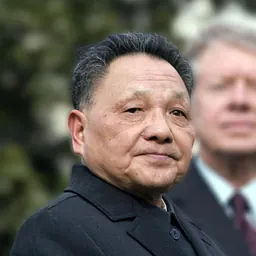
Deng Ken (; November 1911 – 15 October 2017) was a Chinese politician who served as Vice Governor of Hubei. During a political career spanning more than five decades, he held a number of senior Party and government positions. A member of the Chinese Communist Party from 1937, Deng participated in the Communist movement before the establishment of the People's Republic of China, working in Shanghai, Yan'an and Northeast China during the Second Sino-Japanese War and the Chinese Civil War. He was the younger brother of former Chinese paramount leader Deng Xiaoping and although their careers occasionally intersected, he spent most of his political life serving in regional administrative roles rather than in the central government.
Early life Originally named Deng Xianxiu, Deng was born in Guang'an, Sichuan, in November 1911, to Deng Wenming and a mother surnamed Dan. In 1920, his elder brother, Deng Xiaoping, left China to participate in the Diligent Work–Frugal Study Movement in France. While abroad, Deng Xiaoping sent political publications, including Chiguang ("Red Light"), to Sichuan. Deng Ken later recalled that reading these magazines during his school years had a lasting influence on his political outlook. As a student at Guang'an Junior Middle School and later Jialing High School in Nanchong, Deng participated in student protests against the Nationalist government. His political activities forced him to interrupt his studies on several occasions, during which he returned to his hometown to teach at Beishan Primary School, a school co-founded by his father. After continuing his education in Chengdu, he again became involved in revolutionary activities before deciding to pursue further studies in Shanghai in 1931. Before his departure, his father encouraged him to look for Deng Xiaoping, who was believed to be carrying out underground Communist work in the city following his return from abroad.
In April 1931, Deng enrolled at Jinan University in Shanghai. Unable to locate his brother through personal contacts, he published a notice in the Shishi Xinbao ("Current Affairs Daily") on 3 May requesting to find him. Because of his clandestine work for the Chinese Communist Party, Deng Xiaoping initially suspected the notice might be a trap by Nationalist Chinese intelligence agents and only established contact after verifying its authenticity through Party channels.
Following Deng Xiaoping's rehabilitation in 1973, Deng Ken was also restored to public office. During the following decade, he served as Director of the Office of Culture and Education of the Wuhan Revolutionary Committee, Deputy Director of the Wuhan Revolutionary Committee, Deputy Secretary of the Wuhan Municipal Committee of the Chinese Communist Party, Vice Mayor of Wuhan, Party Secretary of Wuhan and Chairman of the Wuhan Municipal Committee of the Chinese People's Political Consultative Conference. In December 1981, he was appointed Vice Governor of Hubei. After leaving that post in 1982, he served as counsellor to the People's Government of Hubei, a member of the Advisory Commission of the Hubei Provincial Committee of the Chinese Communist Party and President of the Hubei People's Association for Friendship with Foreign Countries before retiring from public office in December 1986.
Personal and later life Deng and his wife Ding Hua had a son, Deng Ye, who worked as a researcher at the Institute of Modern History of the Chinese Academy of Social Sciences.
In 2005, on the 100th birth anniversary of Deng Xiaoping, Deng Ken visited his hometown of Guang'an. Upon entering the Deng family's ancestral residence, he remarked, "[Deng] Xiaoping devoted his entire life to the revolution and never returned home."
In August 2015, with the approval of the central authorities, Deng was granted provincial governor-level treatment, an honorary administrative rank accorded to certain retired senior officials.
Don’t just read it —
keep it.
Full-length biographies made to live with: read them, listen on the way to work, watch them tonight.
- E-book
- Audio
- Video
Instant download · yours to keep · every purchase keeps this site free
Important facts
People in Deng Ken's life
Named in this biography and alive at the same time

Related people
Same field, nearest in time






Contemporaries
People whose lives overlapped Deng Ken's





Frequently asked questions
Who was Deng Ken?
Chinese politician (1911–2017)
When was Deng Ken born?
Deng Ken was born in 1911.
When did Deng Ken die?
Deng Ken died on 15 October 2017.
What was Deng Ken's occupation?
Deng Ken was a politician.
What nationality was Deng Ken?
Deng Ken was Chinese.
Sources & further reading
Cite this page
APA: Biography.guide. (2026). Deng Ken. https://biography.guide/deng-ken/
MLA: "Deng Ken." Biography.guide, https://biography.guide/deng-ken/.
Chicago: "Deng Ken." Biography.guide. https://biography.guide/deng-ken/.
Data last updated: 2026-09-20 · Spot an error? Report a correction.
Page generated 2026-09-27 05:03 UTC