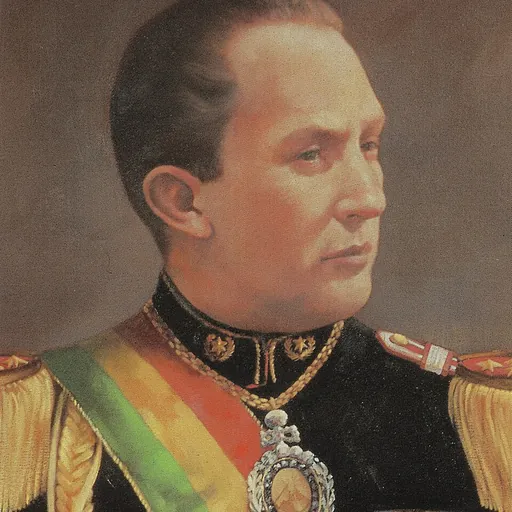
About David Toro
Lived 1898 – 1977 (aged 79). David Toro was a Bolivian politician.
José David Toro Ruilova (24 June 1898 – 25 July 1977) was a Bolivian military officer and politician who served as the 35th president of Bolivia from 1936 to 1937. He previously served as minister of development and minister of government in 1930.
Toro pursued military service in the Armed Forces and stood out for both his tactical skill and shrewd political instincts. He served as minister under Hernando Siles and led the cabinet as the sole executive authority after Siles resigned in a bid to extend his term. Toro and the other ministers were overthrown shortly thereafter in the 1930 coup. He was forced into exile. He spent a stint as military attaché in Argentina but returned to the general staff during the Chaco War. Toro's decision-making during the conflict, which Bolivia lost, generated controversy.
In 1936, a coup d'état in La Paz installed Toro as president of a government junta. He presided over an experimental period of in Bolivia that introduced moderate socialist reforms. The Ministry of Labor was established, a new labor code implemented, and the rights of women expanded. Toro instituted YPFB as the state-owned petroleum enterprise, established a state monopoly on the sale of hydrocarbons, and nationalized the holdings of Standard Oil in 1937.
Toro's regime drew support from members of the veterans' movement. In 1937, dissatisfied with the slow pace of reforms, Toro was forced to resign in a soft coup. He was succeeded as president by his protégé and comrade-in-arms, Germán Busch. Toro made one final attempt at power in 1938 but was unsuccessful and he slipped into obscurity. Exiled to Chile, he died in Santiago in 1977.
Early life He became major in 1925. A decree of September 1936 specified 16 days as holidays. Marriages performed by clerics were legalized, the expulsion of colonos was prohibited if (as noted by one study) “they had worked on the haciendas for two consecutive or three discontinuous years,” and the organization of peasant sindicatos on church and municipal properties was authorized. In addition, a “free school” for the Checa ayllu in Loyaza Province was authorized.
In the end, Toro was caught between the cross currents of reformers from the left, and the interests of a mining magnate. On 13 July 1937, Toro resigned the presidency and Lieutenant Colonel Germán Busch assumed the presidency. Toro attempted to dislodge Busch from power a year after his ouster, but his coup attempt failed and he sought exile in Chile, where he died on 25 July 1977, at the age of 79.
Publications
Don’t just read it —
keep it.
Full-length biographies made to live with: read them, listen on the way to work, watch them tonight.
- E-book
- Audio
- Video
Instant download · yours to keep · every purchase keeps this site free
Important facts
People in David Toro's life
Named in this biography and alive at the same time


Related people
Same field, nearest in time





Contemporaries
People whose lives overlapped David Toro's


Frequently asked questions
Who was David Toro?
President of Bolivia (1898-1977)
When was David Toro born?
David Toro was born on 24 June 1898 in Sucre.
When did David Toro die?
David Toro died on 25 July 1977 in Santiago.
What was David Toro's occupation?
David Toro was a politician.
What nationality was David Toro?
David Toro was Bolivian.
Sources & further reading
Cite this page
APA: Biography.guide. (2026). David Toro. https://biography.guide/david-toro/
MLA: "David Toro." Biography.guide, https://biography.guide/david-toro/.
Chicago: "David Toro." Biography.guide. https://biography.guide/david-toro/.
Data last updated: 2026-09-21 · Spot an error? Report a correction.
Portrait: Wikimedia Commons · author & licence
Page generated 2026-09-27 04:59 UTC