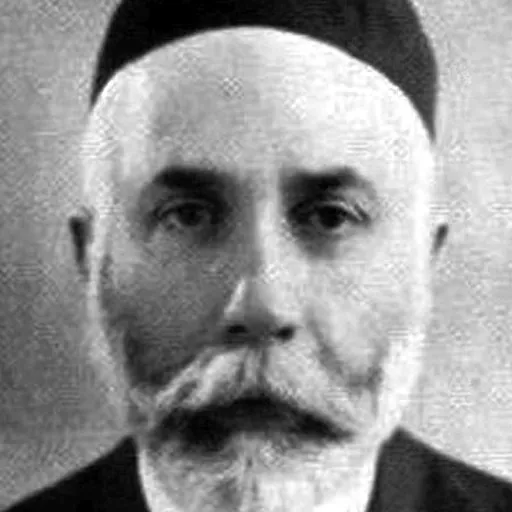
David Solomon Sassoon
Jewish bibliophile
About David Solomon Sassoon
Lived 1880 – 1942 (aged 61–62). David Solomon Sassoon was a British book collector and antiquarian seller, known for Bibliophilia.
David Solomon Sassoon (; 8 December 1880 – 10 August 1942) (also known as "David Suleiman Sassoon"), was a bibliophile and grandson of 19th century Baghdadi Jewish community leader David Sassoon.
Family Sassoon was born in Bombay to Solomon and Flora Sassoon. He and his mother Flora moved to London in 1902, after Solomon's death in 1894.
Manuscript collector Sassoon travelled extensively with the sole intent of collecting Hebrew books and manuscripts which he later catalogued in a two-volume book, entitled, Ohel David. The importance of his private collection of books and manuscripts cannot be overestimated, since it affords scholars the opportunity to examine some twenty-four distinct liturgical rites used by the different Jewish communities of the nineteenth century: Aleppo, Ashkenazi, Egyptian, Italian, North African (Morocco), Tunis, Tlemcen, Karaite, Sefardi (Spanish), Bene Israel, Cochin, Turkish, Yemen, among others.
Sassoon originally owned some 412 manuscripts and twenty incunables, the rarest of which he retrieved from Baghdad. By 1914, the Sassoon collection numbered 500 manuscripts. Between 1914 and 1932, when the Catalogue was published, the manuscripts grew to 1,220, of which 1,153 are fully described in the Catalogue. When David and his mother visited the Holy Land in 1925, he acquired the Decisions of Rabbi Isaiah ben Mali di Trani the Elder (thirteenth century) on Hullin (MS No. 702, Cat. p. 697). One of the more important manuscripts obtained by him is Sefer Halakhot Pesuḳot of Rabbi Yehudai Gaon, a work that he obtained from a Jew in Yemen in 1911, but written in Babylon or Persia in the ninth or tenth century. Sassoon also obtained in Yemen a hand-written copy of Maimonides' Guide for the Perplexed, written in Spain in the fourteenth century (1397). Of the sixteen liturgical works (siddurim) that Sassoon obtained in Yemen, the earliest dates back to the early 16th-century (1531 CE). A study of these manuscripts reveal that the liturgy used by the Jews of Yemen underwent changes after Western influences penetrated into the Peninsula.
Perhaps the most prized of Sassoon's acquisitions is the Farhi Bible, a codex with more than 359 illustrations which he purchased in Aleppo. It is said to have been written by Elisha Crescas in Provence between the years 1366 and 1383. It is now kept in a bank vault in Switzerland. Another treasure retrieved by Sassoon is the Damascus Pentateuch, a codex which he bought in Damascus in 1915, and which was acquired by the Jewish National and University Library in Jerusalem in 1975. A particularly significant acquisition in September 1923 was the Diwan of Samuel Hanagid (MS No. 589, Cat. pp. 451–460), which the Oxford University Press published with an introduction by Sassoon in 1924. Today, most of what remains of David Solomon Sassoon's private collection of Hebrew manuscripts is stored at the University of Toronto, in Canada, although a small cluster of manuscripts from his estate are now at the British Library, which were either offered to the library in lieu of tax, or were purchased at Sotheby's auction sales in the 1970s.
His son, Solomon David Sassoon (1915–1985), was an educator, Rabbi, philanthropist and fundraiser, and also a collector of Jewish manuscripts.
Published works (reprinted by Makor Publishers Ltd., Jerusalem 1972)
Don’t just read it —
keep it.
Full-length biographies made to live with: read them, listen on the way to work, watch them tonight.
- E-book
- Audio
- Video
Instant download · yours to keep · every purchase keeps this site free
Important facts
Family & relationships
People in David Solomon Sassoon's life
Named in this biography and alive at the same time

Related people
Same field, nearest in time




Contemporaries
People whose lives overlapped David Solomon Sassoon's

Frequently asked questions
Who was David Solomon Sassoon?
Jewish bibliophile
When was David Solomon Sassoon born?
David Solomon Sassoon was born in 1880 in Mumbai.
When did David Solomon Sassoon die?
David Solomon Sassoon died on 10 August 1942.
What was David Solomon Sassoon's occupation?
David Solomon Sassoon was a book collector and antiquarian seller.
What was David Solomon Sassoon known for?
David Solomon Sassoon was known for Bibliophilia.
What nationality was David Solomon Sassoon?
David Solomon Sassoon was British.
Sources & further reading
· Wikipedia: David Solomon Sassoon
· DBpedia: David Solomon Sassoon
Cite this page
APA: Biography.guide. (2026). David Solomon Sassoon. https://biography.guide/david-solomon-sassoon/
MLA: "David Solomon Sassoon." Biography.guide, https://biography.guide/david-solomon-sassoon/.
Chicago: "David Solomon Sassoon." Biography.guide. https://biography.guide/david-solomon-sassoon/.
Data last updated: 2026-09-23 · Spot an error? Report a correction.
Portrait: Wikimedia Commons · author & licence
Page generated 2026-09-27 05:08 UTC