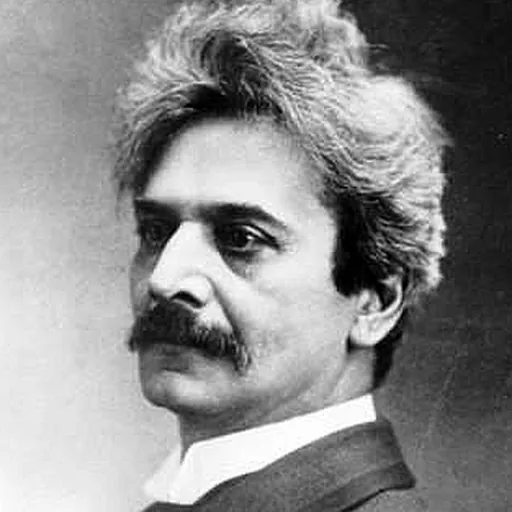
About David Popper
Lived 1843 – 1913 (aged 70). David Popper was an Austrian and Hungarian composer, academic musician, music educator, cellist and musician.
David Popper (June 18, 1843 – August 7, 1913) was a Bohemian cellist and composer.
Life Popper was born in Prague, and studied music at the Prague Conservatory. His family was Jewish. He studied the cello under Julius Goltermann (1825–1876) and soon attracted attention. He made his first tour in 1863; in Germany he was praised by Hans von Bülow, son-in-law of Franz Liszt, who recommended him as Chamber Virtuoso in the court of Prince von Hohenzollern-Hechingen in Löwenberg. In 1864, he premiered Robert Volkmann's Cello Concerto in A minor, Op. 33, with Hans von Bülow conducting the Berlin Philharmonic. He lost this job a couple of years later due to the prince's death.
In 1866, after a successful season in London, he was invited by the court of Württemberg to stay at Friedrichshafen for two weeks. The invitation included the pianist Anna Mehlig as well. The two of them were expected to perform regularly for the royal couple, which they seemed to have fulfilled satisfactorily, as Anna Mehlig was awarded the honorary title of court pianist shortly afterwards. Popper composed a "Romance" for piano and cello during his stay which he dedicated to Mehlig.
He made his debut in Vienna in 1867, and was made principal cellist at the Hofoper. From 1868 to 1870 he was also a member of the Hellmesberger Quartet. In 1872, he married pianist Sophie Menter, He and Hubay performed chamber music on more than one occasion with Johannes Brahms, including the premiere of Brahms's Piano Trio No. 3 in Budapest, on December 20, 1886.
Popper died in Baden, near Vienna. An old edition of the Grove Dictionary of Music and Musicians described him thus: "His tone is large and full of sentiment; his execution highly finished, and his style classical."
Works
Popper was a prolific composer of cello music, writing four concertos under his own name (the so-called fifth cello concerto of Joseph Haydn, supposedly realized by Popper from the older composer's sketches, is almost certainly another original composition ), a Requiem for three cellos and orchestra (1891) and a number of smaller pieces which are still played today, including the solo piece Tarantella. His shorter showpieces were written to highlight the unique sound and style of the cello, extending the instrument's range with pieces such as Spinnlied (Spinning Song), Elfentanz (Dance of the Elves), or the Ungarische Rhapsodie (Hungarian Rhapsody), which was published by the Friedrich Hofmeister Musikverlag. He also wrote instructional pieces. Popper is also known for his High School of Cello Playing (Op. 73), a book of cello études that is widely used by advanced cello students. Op. 2, Five Songs for Soprano Op. 3, Scenes From a Masked Ball, cello and piano No. 1, Arlequin (Harlequin) in F Major No. 2, Warum? (Why?) in A Major No. 3, Erzählung (Story) in E Major No. 4, Papillon (Butterfly) in D Major No. 5, Begegnung (Meeting) in F Major No. 6, Lied (Song) in G Major Op. 5, Romance, cello and piano Op. 8, Concerto No. 1 in D minor, cello and orchestra Op. 10, Pieces for cello and piano No. 1, Sarabande No. 2, Gavotte, in D minor No. 3, Trio-Pastoral Op. 11, Pieces for cello and piano No. 1, Widmung No. 2, Humoreske No. 3, Mazurka in G minor Op. 12, Mazurka in D minor, cello and piano Op. 14, Polonaise de concert, cello and piano Chanson d'autrefois, cello and piano Op. 16, Suite for two cellos March for two cellos Op. 18, Sérénade orientale, cello and piano Op. 22, Nocturne in G major, cello and piano Op. 23, Pieces for cello and piano No. 1, [n. d.] No. 2, Gavotte in D major Op. 24, Concerto No. 2 in E minor, for cello and orchestra Op. 27, Preludes for cello solo No. 1, Andante serioso; [n. d.] Op. 28, Concert-Polonaise No. 2 in F major, cello and piano Op. 32, Pieces for cello and piano No. 1, Nocturne No. 2, Mazurka in A major Op. 33, Tarantella, cello and piano Op. 35, Four Mazurkas, cello and piano Op. 38, Barcarolle in G major, cello and piano Op. 39, Dance of the Elves, cello and piano Op. 40, Three Songs (for Soprano or Tenor) Op. 41, Nocturne, cello and piano Op. 42, Three Nocturnes, cello and piano Op. 43, Fantasy on Little Russian Songs, cello and piano Op. 46, 2 Transcriptions for Cello and Piano No. 1, Schlummerlied aus der “Mainacht" by Rimsky-Korsakov No. 2, Träurmerei aus den “Kinderszenen” by Schumann Op. 47, Nocturne No.4 in B Minor for cello and piano Op. 48, Menuetto in D major, cello and piano Op. 49, Kaiser-Marsch zur Krönung Seiner Majestät Kaiser Alexander III. for Orchestra Op. 50, Im Walde, Suite for cello and orchestra No. 1, Eintritt (Entrance) No. 2, Gnomentanz (Gnomes Dance) No. 3, Andacht (Devotion) No. 4, Reigen (Round Dance) No. 5, Herbstblume (Autumn Flower) No. 6, Heimkehr (Homecoming) Op. 51, Six Mazurkas, cello and piano Op. 54, Spanish Dances, cello and piano No. 1, Zur Gitarre No. 2, Serenade No. 3, Spanische Tänze No. 4, L'Andalouse No. 5, Vito Op. 55, Pieces for cello and piano No. 1, Spinning Song No. 2, Hunting Piece Op. 59, Concerto No. 3 in G major, cello and orchestra Op. 60, Walzer Suite, cello and piano Op. 62, Pieces for cello and piano No. 1, La Mémoire No. 2, La Chanson villageoise (Village Song) No. 3, La Berceuse Op. 64, Pieces for cello and piano No. 1, Wie einst in schöner’n tagen (Once in Fairer Days) No. 2, Tarantelle, in A major No. 3, Wiegenlied (Lullaby) Op. 65, Pieces for cello and piano No. 1, Adagio No. 2, Menuetto No. 3, Polonaise Op. 66, Requiem, for three cellos and piano (originally for three cellos and orchestra) Op. 67, Pieces for cello and piano No. 1, Largo No. 2, Gavotte in D minor No. 3, [n. d.] No. 4, Gavotte in D minor Op. 68, Hungarian Rhapsody, cello and piano Op. 69, Suite for cello and piano Largo à l'ancienne mode Op. 71, Scottish Fantasy, cello and piano Op. 72, Concerto No. 4 in B minor, cello and orchestra Op. 73, High School of Cello Playing (Hohe Schule des Violoncellospiels): Forty Études for Cello Solo Op. 74, String Quartet in C minor Op. 75, Serenade, cello and piano Op. 76, Zehn mittelschwere große Etüden [a/k/a Studies (Preparatory to Op. 73)] Op. 76a, Fünfzehn leichte melodisch-rhythmische Etüden Op. 81, Gavotte in A Major for Cello and Piano
Works with unknown or no opus number Joseph Haydn: Cello Concerto No. 5 in C-Major, Hob. VIIb:5 (see above; almost certainly an original composition by Popper) Cadenzas for cello Joseph Haydn: Cello Concerto in D major Camille Saint-Saëns: Concerto in A minor, Op. 33 Robert Volkmann: Cello Concerto in A minor Robert Schumann: Cello Concerto in A minor, Op. 129 Molique, B.: Cello Concerto in D major Romance in G major for cello and piano, originally for violin and piano Chant du soir, cello and piano
Arrangements and transcriptions for cello and piano Bach, J.S., Arie aus der D-dur Suite Chopin, Nocturne, Op. 9, No. 2 Campioni, Minuet Pastoral Cherubini, Ave Maria Giordani, Caro mio ben Handel, Largo; Sarabande Jámbor, Nocturne, Op. 8, No. 1 Jensen, Murmelndes Lüftchen, Op. 21, No. 4 Mendelssohn, Auf Flügeln des Gesanges; Reiselied, Op. 19, No. 6 Pergolesi, Nina (Tre giorni) Purcell, Aria Rubinstein, Mélodie, Op. 3, No. 1 Schubert, Du bist die Ruh’; Ave Maria, Op. 52, No. 4; Der Neugierige; Sei mir gegrüsst; Litanei auf das Fest "Allerseelen"; An die Musik Schumann, Träumerei, Op. 15, No. 7; Abendlied, Op. 85, No. 12; Schlummerlied, Op. 124, No. 16 Svendsen, Romance in G-major, op. 26 Tchaikovsky, Song Without Words, Op 2, No. 3; Chanson triste, Op. 40, No. 2; Barcarolle, Op. 37, No. 6; Perce-Niegre, Op. 37, No. 4; Chant d’automne, Op. 37, No. 10
Don’t just read it —
keep it.
Full-length biographies made to live with: read them, listen on the way to work, watch them tonight.
- E-book
- Audio
- Video
Instant download · yours to keep · every purchase keeps this site free
Important facts
People in David Popper's life
Named in this biography and alive at the same time



Related people
Same field, nearest in time


Contemporaries
People whose lives overlapped David Popper's
Frequently asked questions
Who was David Popper?
Bohemian cellist and composer (1843–1913)
When was David Popper born?
David Popper was born on 16 June 1843 in Prague.
When did David Popper die?
David Popper died on 7 August 1913 in Baden.
What was David Popper's occupation?
David Popper was a composer, academic musician, music educator, cellist and musician.
What nationality was David Popper?
David Popper was Austrian and Hungarian.
Sources & further reading
Cite this page
APA: Biography.guide. (2026). David Popper. https://biography.guide/david-popper/
MLA: "David Popper." Biography.guide, https://biography.guide/david-popper/.
Chicago: "David Popper." Biography.guide. https://biography.guide/david-popper/.
Data last updated: 2026-09-22 · Spot an error? Report a correction.
Portrait: Wikimedia Commons · author & licence
Page generated 2026-09-27 05:03 UTC