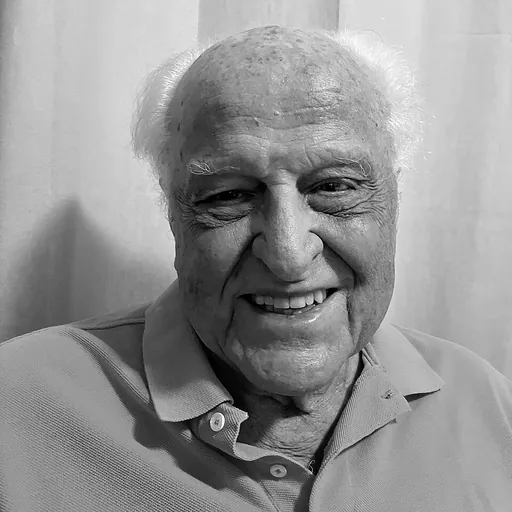
About David LaBerge
Born 1929. David LaBerge is a neuroscientist, psychologist and university teacher.
David LaBerge (born 1929) is a neuropsychologist specializing in the attention process and the role of apical dendrites in cognition and consciousness.
Early life and education David LaBerge was born in St. Louis, Missouri and received his undergraduate degree from the College of Wooster, his MA degree from Claremont University and his PhD degree Stanford University.
Career Dr. LaBerge has taught at Indiana University, Bloomington, University of Minnesota, and University of California at Irvine from 1955 until 1997. He was also a member of the adjunct faculty in psychology and biology at Bard College at Simon's Rock from 1997 to 2007 and was a visiting scholar at the University of Washington, Seattle from 2009 - 2011.
Honors Distinguished Teaching Award, College of Liberal Arts, University of Minnesota; University of Minnesota Students Association Distinguished Service Award. Fellow, Society of Experimental Psychologists. Fellow AAAS. Fellow American Psychological Association. Fellow, American Psychological Society. Member Society for Neuroscience.
Research 1. Mathematical models of choice behavior: A model for neutral elements (1959a, b) provided a way to represent noise elements in the Estes and Burke (1953) choice theory. A recruitment model for choice behavior (1962, 1994) assumes that processing a stimulus involves the recruiting (or accumulation) of elements by alternative response counters until a criterion number is reached and the corresponding response is evoked. Predictive comparisons of two mathematical models of choice: the Counting Model (Accumulator Model) and the Random Walk Model. LaBerge, Journal of Mathematical Psychology (1994). 2. Early experiments of attention in response time experiments: Stimulus processing is biased by relative frequency of presentation (1964), by incentive value (1967), and by inserting an informative cue into a trial (1970).
LaBerge conducted a study regarding attention and the measurement of perceptual learning. In the primary trial, participants were shown a letter and therefore had to press a key on their keyboard when they saw it in a pattern of letters. The secondary trial did not provide a cue and instead had participants respond when they saw a set of matching letters in the pattern. When unfamiliar letters were presented, participants were evaluating the letters' features and organizing the letters into a schema. LaBerge's study supported automaticity of reading and provided a basis for how perceptual learning is achieved. Perceptual learning requires participants to focus on the actual stimuli as a whole and not just the features so they can be quickly organized and understood.3. Studies of automaticity: Measurement of automatic processing (1973a). A theory of automaticity in reading (1974) with S.J. Samuels. A theory of automaticity in perception (1975).
The theory of automaticity involves unitization of perceptual patterns. LaBerge's research categorizes attention and information processing through processing within vs. between systems. Simply put, stimuli are broken down and put into a box, which is then further separated into another box to understand the stimuli's meaning. Within processing involves the unitization of information, which is consolidated into long-term memory overtime, automatically processing familiar patterns. Unitization further achieves perceptual learning. The apical dendrite's primary function is to receive feedback information from cortical areas, integrate, and thus send an electrical current through the axon. The action potentials elicited from the apical dendrites, however, are smaller but last longer at the cell body, modulating inputs. LaBerge additionally hypothesized that apical dendrites sustain attention through feedback information, which involves top-down processing, being amplified. The strength of the activity by apical dendrites is linked to a Hebbian cell assembly. The Hebbian cell assembly form involves strong excitatory connections on the inside and weaker neuron connections on the outside. The assembly then self-sustains excitatory activity from the neurons to prolong the consolidation of information to memory. Additionally, attention can be automatic or controlled. A controlled expression will contain a feedback loop, which maintains a neural expression, or feedforward component, which amplifies the expression. The attention module is further controlled by instruction, which directs attention to specific and straightforward features. Controlling attention thus involves a modular mode, which is automatic, fixed, brief, and routinized, or a preamble mode, which is controlled, flexible, prolonged, and voluntary. He was the director of the 50-voice South Sound Classical Choir in the Tacoma, WA area until May 2019.
He resides in Tacoma, Washington with his wife Janice Lawry.
Don’t just read it —
keep it.
Full-length biographies made to live with: read them, listen on the way to work, watch them tonight.
- E-book
- Audio
- Video
Instant download · yours to keep · every purchase keeps this site free
Important facts
People in David LaBerge's life
Named in this biography and alive at the same time

Related people
Same field, nearest in time



Contemporaries
People whose lives overlapped David LaBerge's
Frequently asked questions
Who is David LaBerge?
American neuropsychologist
When was David LaBerge born?
David LaBerge was born in 1929.
What is David LaBerge's occupation?
David LaBerge is a neuroscientist, psychologist and university teacher.
Sources & further reading
Cite this page
APA: Biography.guide. (2026). David LaBerge. https://biography.guide/david-laberge/
MLA: "David LaBerge." Biography.guide, https://biography.guide/david-laberge/.
Chicago: "David LaBerge." Biography.guide. https://biography.guide/david-laberge/.
Data last updated: 2026-09-20 · Spot an error? Report a correction.
Portrait: Wikimedia Commons · author & licence
Page generated 2026-09-27 04:58 UTC