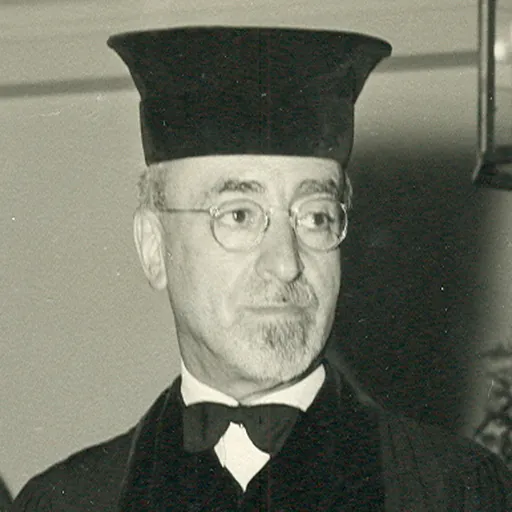
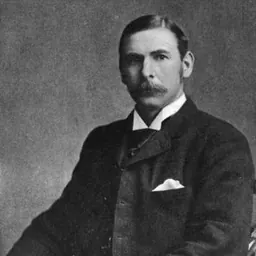
About David de Sola Pool
Lived 1885 – 1970 (aged 84–85). David de Sola Pool was an American rabbi and translator.
Biography Early life and education Born in London, England, de Sola Pool was descended from an old and renowned family of rabbis and scholars, de Sola, which traces its origins to medieval Spain. His great-grandparents were Rabbi (R.) David Aaron de Sola and Rebecca Meldola, his great-great-grandfather was Haham Raphael Meldola, a prominent English rabbi. He was also related to R. Abraham de Sola, R. Henry Pereira Mendes and Frederick de Sola Mendes.
He studied at the University of London. He held a doctorate in ancient languages, summa cum laude, from the University of Heidelberg.
Career In 1907, de Sola Pool was invited to become the assistant rabbi of Congregation Shearith Israel — often called the Spanish and Portuguese Synagogue — located in New York City, the oldest Jewish congregation in the United States. He served as its assistant rabbi, under H. Pereira Mendes, until 1919. He left to work in Mandatory Palestine, but returned to become senior rabbi in 1921, when the synagogue was unable to find a replacement for Mendes after his 1920 retirement.
In his detailed history of the congregation, An Old Faith in the New World, Pool highlighted with satisfaction its noteworthy diversity: "Probably in no other congregation in the world is there so wide an ingathering of Jews from the four corners of the earth as is to be found in Shearith Israel [...] Throughout the congregation's three centuries, its history has been marked by the integration of the elements which have come to it from the sixty or more countries of the earth. Within the compass of the congregation the motto of the country, E pluribus unum, has happy fulfillment."
On D-Day during World War II, Pool delivered these broadcast remarks in support of the brave troops fighting overseas.
He served as rabbi until 1955, and was an involved Rabbi Emeritus for the rest of his life.
Zionism
Following in the footsteps of his cousin and predecessor, H. Pereira Mendes, Pool ardently advocated for Jewish nationhood. He and his wife, Tamar, were leaders in Hadassah's Young Judaea youth movement, and Tamar went on to become National President of Hadassah, striving there to support for the Zionist cause. In 1919, Pool took leave of his position and went with his wife to Palestine to do relief work, assuming charge of post-war relief and reconstruction for the World Zionist Organization and the American Jewish Joint Distribution Committee. Pool and his wife stayed three years until before returning to his rabbinical position in New York. Then, as Nazism rose in the 1930s, Pool spoke out increasingly of the need for a Jewish homeland, calling on American Jewry to action. After Israel's founding, he and his wife Tamar were continuously active in support of the new nation.
Publications De Sola Pool translated and edited the Sephardic prayer book for the Union of Sephardic Congregations in 1954, and the Ashkenazic prayer book for the Rabbinical Council of America. These prayerbooks are still in use in congregations around the world.
His book The Kaddish (1909, third printing 1964), based on his dissertation, remains a definitive and well-regarded work on the origins of the Kaddish prayer.
De Sola Pool wrote several important books about Jewish history in Colonial America including Portraits Etched In Stone — Early Jewish Settlers, 1682–1831 (1952) and together with his wife, Tamar de Sola Pool, An Old Faith in the New World — Portrait of Shearith Israel, 1654–1954 (1955). He co-authored with his wife, Tamar de Sola Pool, Is There An Answer: An Inquiry into Some Human Dilemmas (1966). They also co-edited the Parenzo Haggadah for Passover (1951, 1975). De Sola Pool edited the prayerbooks used for the United States Armed Forces. He also wrote a book, Why I am a Jew (1957), part of a series written by leading clerical figures, which remains a supremely well-written introduction to Judaism.
Honors De Sola Pool held honorary degrees of Doctor of Divinity, Doctor of Hebrew Letters, Doctor of Humane Letters, and Doctor of Sacred Theology.
In 2012, the American Sephardi Federation mounted a small exhibition of de Sola Pool's correspondence.
Other positions First President of the Union of Sephardic Congregations (1928). President of the New York Board of Rabbis (1916–1917). Member of Herbert Hoover's food conservation staff (1917). Field organizer and director of army camp work of the Jewish Welfare Board during World War I (1917–1918). U.S. representative to the Zionist Commission in Jerusalem, charged with helping to implement the Balfour Declaration (1919–1921). Regional director for Palestine and Syria of the Joint Distribution Committee (1920–1921). Founder and director (1922) of the Jewish Education Committee of New York. President of the Union of Sephardic Congregations from 1928. President of the Synagogue Council of America (1938–1940). Chairman of the Committee of Army and Navy Religious Activities of the National Jewish Welfare Board (1940–1947). Vice-president (1951–55) and President (1955–1956) of the American Jewish Historical Society. U.S. delegate to the NATO Atlantic Congress in London (1959).
Family His wife, Tamar de Sola Pool, was the daughter of R. Chaim Hirschensohn. She was a National President of Hadassah Women's Zionist Organization of America and a prominent leader in her own right.
His son, Ithiel de Sola Pool, was a pioneer in the development of social science and founder of the political-science department at the Massachusetts Institute of Technology.
Don’t just read it —
keep it.
Full-length biographies made to live with: read them, listen on the way to work, watch them tonight.
- E-book
- Audio
- Video
Instant download · yours to keep · every purchase keeps this site free
Important facts
Family & relationships
People in David de Sola Pool's life
Named in this biography and alive at the same time




Related people
Same field, nearest in time



Contemporaries
People whose lives overlapped David de Sola Pool's




Frequently asked questions
Who was David de Sola Pool?
Rabbi, writer
When was David de Sola Pool born?
David de Sola Pool was born on 16 May 1885 in London.
When did David de Sola Pool die?
David de Sola Pool died in 1970 in New York City.
What was David de Sola Pool's occupation?
David de Sola Pool was a rabbi and translator.
What nationality was David de Sola Pool?
David de Sola Pool was American.
Sources & further reading
· Wikipedia: David de Sola Pool
Cite this page
APA: Biography.guide. (2026). David de Sola Pool. https://biography.guide/david-de-sola-pool/
MLA: "David de Sola Pool." Biography.guide, https://biography.guide/david-de-sola-pool/.
Chicago: "David de Sola Pool." Biography.guide. https://biography.guide/david-de-sola-pool/.
Data last updated: 2026-09-20 · Spot an error? Report a correction.
Portrait: Wikimedia Commons · author & licence
Page generated 2026-09-27 04:57 UTC