About David Davies
Lived 1812 – 1874 (aged 61–62). David Davies was a poet.
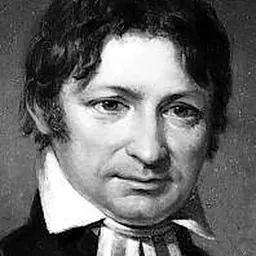
David Davies, also known as Dai'r Cantwr (David the singer) (c. 1812–1874), was a Welsh poet and lay-preacher. He was convicted and sentenced to transportation to Australia for his actions during the Rebecca Riots.
Early life Davies was born in the parish of Llancarfan in about 1812 to John and Mary Davies, his father is believed to have been a tenant of the Duke of Beaufort. Although little of his early personal life is known, in later police records Davies is recorded as a "farm labourer, can plough", Davies was nicknamed "Dai'r Cantwr", David the Singer, because he "taught them to sing at church". By 26 May, the first phase of the Rebecca Riots ended with the destruction of the Water Street gate in Carmarthen. widely accepted to be Thomas Rees. At some point during the riots, until their end in late 1843, Davies became heavily involved, and like fellow rioter Shoni Sguborfawr, was paid to take a prominent role in the toll-gate attacks.
Although there are multiple theories of how the two men met, Davies and 'Shoni' became associated in several acts of incendiarism and gate-breaking. The riots were initially supported by the public, and very few rioters were arrested and convicted, but some of those taking part used the guise of 'Rebecca' to exact revenge on individuals and extort money; and Davies and 'Shoni' both undertook these actions. Eventually people turned on both men and on 24 September 1843, warrants were issued for their arrest. The following day Davies was arrested at the Plough and Harrow a public house in Pum Heol near Llanelli. Shoni Sguborfawr was arrested in London on 26 September. Davies was placed in custody in Carmarthen Goal to await sentence.
Transportation to Australia and later life On 22 December 1843, Davies was tried at Carmarthen assizes under the charge of demolishing the turnpike at Spudder's Bridge near Kidwelly. Davies was found guilty and was sentenced to transportation for 20 years; 'Shoni' was given a life sentence for attempted murder after shooting a man in Pontyberem.
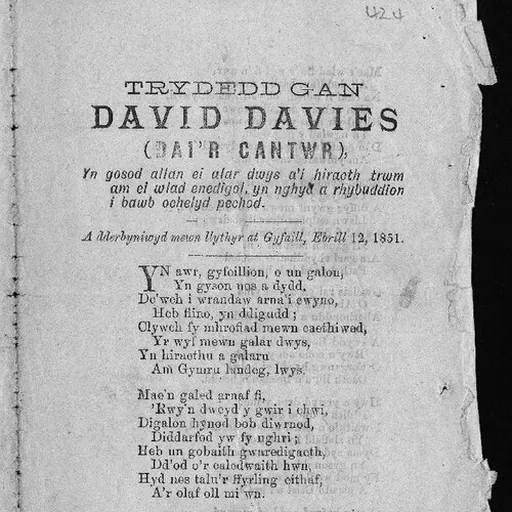
After sentencing, Davies was held at Carmarthen, and while awaiting transportation he wrote the poem now known as the Threnody of Dai'r Cantwr, described by Professor David Williams as 'not without literary merits'. On 5 February 1844, he was moved to the Millbank Penitentiary and remained there until 12 March when he was transported on the London to Van Diemen's Land, modern-day Tasmania. He landed on 10 July and was set to work on Maria Island, just off the country's east coast. After completing his work on the Island, he was placed in the employment of various people, but was unable to stay out of trouble, receiving brief sentences for minor offences, such as insolence, drunkenness and using indecent language.
Davies received his ticket of leave in April 1854, and was conditionally pardoned on 31 October of the same year. Although some claimed he returned to Wales, he seems to have remained in Tasmania, and died there in an outhouse of the Ross Hotel in August 1874, from smoke inhalation after his pipe accidentally set fire to grass, whilst Davies was asleep and intoxicated.
Threnody of Dai'r Cantwr
One of the verses of Threnody of Dai'r Cantwr, translated from the original Welsh:
Though wounding were the wicked blows The cruel world hath struck at me I have a strength they cannot break My human pride my dignity They bound my hands with prison chains And yet my soul they could not bind Now far across the sundering sea I drag my solely troubled mind My father's home, its tender care I know I shall not see again I'll rot for twenty searing years Among corrupt unfeeling men Farewell to you a hundredfold Fair county, sweet untroubled Wales Still I remember in my pain Your streams, your hills, your gentle vales You are the garden of the world The Eden where all beauty lies My heart breaks as with flaming sword They drive me now from paradise
An edited version of the whole poem in the original Welsh is in E. Wyn James, ‘Baled hiraethon Dai’r Cantwr o Lancarfan’, (Colofn ‘Llys a Llan’), Y Dinesydd, 494 (Chwefror 2025), 14-15. An electronic version of the article is to be found here: http://dinesydd.cymru/teithiau/
Don’t just read it —
keep it.
Full-length biographies made to live with: read them, listen on the way to work, watch them tonight.
- E-book
- Audio
- Video
Instant download · yours to keep · every purchase keeps this site free
Important facts
People in David Davies's life
Named in this biography and alive at the same time




Related people
Same field, nearest in time

Contemporaries
People whose lives overlapped David Davies's





Frequently asked questions
Who was David Davies?
Welsh poet and lay-preacher
When was David Davies born?
David Davies was born in 1812 in Llancarfan.
When did David Davies die?
David Davies died on 10 August 1874.
What was David Davies's occupation?
David Davies was a poet.
Sources & further reading
· DBpedia: David Davies (Dai'r Cantwr)
Cite this page
APA: Biography.guide. (2026). David Davies. https://biography.guide/david-davies-poet/
MLA: "David Davies." Biography.guide, https://biography.guide/david-davies-poet/.
Chicago: "David Davies." Biography.guide. https://biography.guide/david-davies-poet/.
Data last updated: 2026-09-20 · Spot an error? Report a correction.
Portrait: Wikimedia Commons · author & licence
Page generated 2026-09-27 04:57 UTC