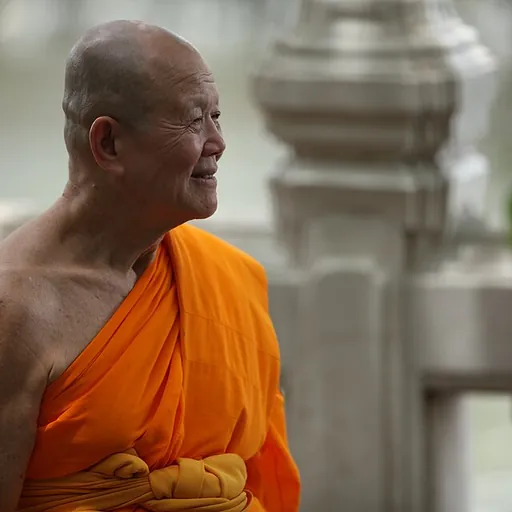
About Dattajīvo
Born 1941. Dattajīvo is a Thai buddhist monk.
Early life
Born Phadet Phongsawat in 1940 in Kanchanaburi, he had Vietnamese-Thai parents.
Phadet became involved in Thai black magic at the age of seventeen. In his student years at Kasetsart University, he would often hold organized public demonstrations of black magic for his fellow students. In the biographies of Wat Phra Dhammakaya it is described that every time a junior student, Chaiyabun (who later became known as Luang Por Dhammajayo), came to watch one of Phadet's demonstrations, the magic would not work. Phadet therefore become curious about Chaiyabun's mental powers, and decided to test Chaiyabun by bringing him to his black magic teacher. But even the teacher could not use his powers in Chaiyabun's presence. Phadet therefore wanted to learn more about Chaiyabun and the meditation he practiced. He felt inspired by Chaiyabun's sincerity in meditation and his adherence to the Buddhist five precepts. This was a turning point in his life, and from that moment on he has always been Chaiyabun's student and assistant, and they developed a solid friendship. He trained in meditation with Mae Chi Chandra for years.
In 1971, Phadet was ordained and became known as Luang Por Dattajivo, which means "He who gives his soul [to Buddhism]". By that time, Chaiyabun had already ordained as Luang Por Dhammajayo. In the opinion of a newspaper editor who wrote about the two monks, in the 1960s and 1970s, a university degree in Thailand was a guarantee someone would get a good position in society. Their decision to become ordained instead of pursuing a career therefore stood out.
Life as a deputy abbot
When Wat Phra Dhammakaya was built in the 1970s and 1980s, Luang Por Dattajivo was in charge of the construction work. Furthermore, he helped develop the friendly relationships with the people living in the neighborhood of the temple, and was responsible for receiving guests at the temple. As a teacher, Luang por Dattajivo has spoken regularly before international audiences. For example, as a panelist at the United Nations General Assembly Special Session "World Summit for Social Development" in 2000 in Geneva, he highlighted the importance of spirituality in addressing social development and overcoming poverty. A prolific author, he has written many books published in Thai language, many of which have been translated into other languages than Thai. His books are often about contemporary problems, A topic that he is known for is economics from a Buddhist philosophical point of view.
In Wat Phra Dhammakaya, he is the person with the second most authority in the temple, next to Luang Por Dhammajayo. His character and organizational style complement Luang Por Dhammajayo in many ways. Mae Chi Chandra once stated that without Luang Por Dhammajayo and Luang Por Dattajivo, the founding of Wat Phra Dhammakaya would not have been possible. He is also responsible for the management of international centers of Wat Phra Dhammakaya. He was also observing abbot of Wat Phra Dhammakaya from 1999 to 2006, and again from 2011 to 2016. In December 2016, however, Phravitetbhavanacharn was appointed as observing abbot instead, and considered part of the campaigns by the junta to remove any traces of the influence of former Prime President Thaksin Shinawatra, also known as the "de-Thaksinization" of Thailand.
Following the end of the lockdown of the temple, the junta stated authorities will look for Luang Por Dhammajayo elsewhere. However investigations against the temple continued. Just days after the end of the lockdown, additional charges were filed against Wat Phra Dhammakaya, this time against Luang Por Dattajivo, for allegedly using illegally obtained money to buy stocks and illegal land, something the temple dubbed "fake news". Some Thai news outlets, such as Khao Sod, became critical of the new charges, stating that weeks after the accusations were made neither the justice system nor DSI had produced any form of evidence supporting the allegations, describing the accusations as "a new invention" and improbable, because the temple would have no need for such money. Nevertheless, Luang Por Dattajivo has cooperated with the authorities, and the lawsuits were still running, Luang Por fighting the charges.
Despite the charges, Luang Por still continued his duties, and led ceremonies for preparing construction for the Minnesota and Seoul branch temples.
Recognition
Luang Por Dattajivo's work in Buddhist teaching was recognized when he received the ecclesiastical title "Phrabhavanaviriyakhun" in 1992, and later in 2013 "Phrarajbhavanajahn" from King Rama IX. However, in March 2017, King Rama X removed his title after he failed to acknowledge charges filed against him by the Thai police. Luang Por Dattajivo received the Dhammacakra Sema-Pillar award from Princess Sirindhorn in 1993. Furthermore, he received an honorary degree from the Mahachulalongkornrajavidyalaya University in 1994. In the 2010s, a stupa was built in his honor by Luang Por Dhammajayo, called the Phra Maha Cetiya Dattajivo.
Publications in English
Buddhist Ways to Overcome Obstacles (1992), translated by Pensri Kiengsiri. Khumson Books: Bangkok, Blueprint for a Global Being (Buddhism in Plain English Series 1) (2000). Dhammakaya Foundation: Bangkok The Buddha's First Teaching (Buddhism in Plain English Series 3) (2002). Dhammakaya Foundation: Bangkok Reforming Society means Reforming Human Nature (Buddhism in Plain English Series 1) (2003). Dhammakaya Foundation: Bangkok The Fruits of True Monkhood (Buddhism in Plain English Series 4) (2003). Dhammakaya Foundation: Bangkok Vanijja Sutta: Cause of Over-target Benefit (2003). Thinkers and Writers for World Peace: Bangkok The Ordination (2004). Thinkers and Writers for World Peace: Bangkok Man's Personal Transformation (2005). Dhammakaya Foundation: Bangkok How to Raise the Children to be Good People for the Nation (2005), compiled by Phra Treetep Chinungkuro. Thinkers and Writers for World Peace: Bangkok Dhamma Talk by Phrabhavanaviriyakhun (2007). Rung Silp Printing: Bangkok Pages to Happiness (2007), compiled by S. Phongsawasdi. Thinkers and Writers for World Peace: Bangkok Buddhist Economics (Buddhism in Plain English Series 2) (2010). Dhammakaya Foundation: Patumthani Training the Trainers, part 1 (2012). Rung Silp Printing: Bangkok. Archived from the original on 12 March 2017.
Don’t just read it —
keep it.
Full-length biographies made to live with: read them, listen on the way to work, watch them tonight.
- E-book
- Audio
- Video
Instant download · yours to keep · every purchase keeps this site free
Important facts
People in Dattajīvo's life
Named in this biography and alive at the same time


Related people
Same field, nearest in time


Contemporaries
People whose lives overlapped Dattajīvo's


Frequently asked questions
Who is Dattajīvo?
Thai Buddhist monk
When was Dattajīvo born?
Dattajīvo was born on 21 December 1941 in Kanchanaburi.
What is Dattajīvo's occupation?
Dattajīvo is a buddhist monk.
What nationality is Dattajīvo?
Dattajīvo is Thai.
Sources & further reading
· DBpedia: Luang Por Dattajivo
Cite this page
APA: Biography.guide. (2026). Dattajīvo. https://biography.guide/dattajivo/
MLA: "Dattajīvo." Biography.guide, https://biography.guide/dattajivo/.
Chicago: "Dattajīvo." Biography.guide. https://biography.guide/dattajivo/.
Data last updated: 2026-09-22 · Spot an error? Report a correction.
Portrait: Wikimedia Commons · author & licence
Page generated 2026-09-27 05:04 UTC