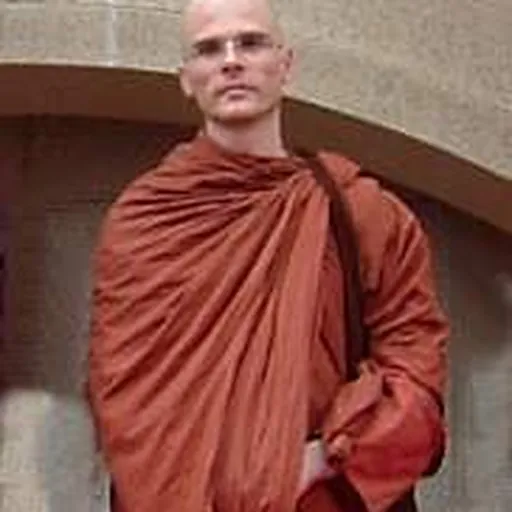
Bhikkhu Anālayo
German Buddhist monk, scholar, and meditation teacher (born 1962)
About Bhikkhu Anālayo
Born 1962. Bhikkhu Anālayo is a Sri Lankan and German buddhist monk, śrāmaṇera, buddhologist and monk.
Bhikkhu Anālayo is a bhikkhu (Buddhist monk), scholar, and meditation teacher. He was born in Germany in 1962, and went forth in 1995 in the Theravādin monastic tradition of Sri Lanka. He is best known for his comparative studies of Early Buddhist Texts as preserved by the various early Buddhist traditions.
Monastic life Bhikkhu Anālayo temporarily ordained in 1990 in Thailand, after a meditation retreat at Wat Suan Mokkh, the monastery established by the influential 20th-century Thai monk Ajahn Buddhadasa. In 1994 he went to Sri Lanka, looking to meet Nyanaponika Thera after having read his book The Heart of Buddhist Meditation. He received his upasampada in 2007 in the Sri Lankan Shwegyin Nikaya (belonging to the main Amarapura Nikaya), with Pemasiri Thera of Sumathipala Aranya as his ordination acariya. Bhikkhu Bodhi has been Bhikkhu Anālayo's main mentor in the study of the Pāli discourses. The late Bhikkhu Kaṭukurunde Ñāṇananda has also been an important influence in his understanding of the Dhamma, whereas Godwin Samararatne has been the most influential meditation teacher in his early practice life.
Scholarly career and activity Bhikkhu Anālayo completed a PhD thesis on the Satipaṭṭhāna Sutta at the University of Peradeniya in 2000, which was later published as Satipaṭṭhāna, the Direct Path to Realization. During the course of that study, he had come to notice the interesting differences between the Pāli and Chinese Buddhist canon versions of this early Buddhist discourse. This led to his undertaking a habilitation research at the University of Marburg, completed in 2007, in which he compared the Majjhima Nikāya discourses with their Chinese, Buddhist Hybrid Sanskrit and Tibetan Buddhist canon counterparts. In 2013 Anālayo then published Perspectives on Satipaṭṭhāna, where he builds on his earlier work by comparing the parallel versions of the Satipaṭṭhāna-sutta and exploring the meditative perspective that emerges when emphasis is given to those instructions that are common ground among the extant canonical versions and thus can reasonably well be expected to be early.
Bhikkhu Anālayo has published extensively on early Buddhism. The textual study of early Buddhist discourses in comparative perspective is the basis of his ongoing interests and academic research. At present he is the chief editor and one of the translators of the first English translation of the Chinese Madhyama-āgama (Taishō 26), and has undertaken a partial English translation of the Chinese Saṃyukta-āgama (Taishō 99), parallel to the Pali Saṃyutta Nikāya collection.
Central to Anālayo's academic activity remain theoretical and practical aspects of meditation. He has published several articles on insight and absorption meditation and related contemporary meditation traditions to their textual sources.
His comparative studies of early Buddhist texts have also led Anālayo to focus on historical developments of Buddhist thought, and to research the early roots and genesis of the bodhisattva ideal and the beginning of Abhidharma thought.
Bhikkhu Anālayo was a presenter at the International Congress on Buddhist Women's Role in the Sangha. Exploring attitudes towards bhikkhunis (female monastics) in early Buddhist texts and the story of the foundation of the bhikkhuni order has allowed him to be a supporter of bhikkhuni ordination, which is a matter of controversy in the Theravada and Tibetan traditions. He has presented his overall assessment in book form, which combines the original English text with a Sinhala translation: Bhikkhunī Ordination from Ancient India to Contemporary Sri Lanka. Consequently, a ruling of the supreme court of Sri Lanka in 2025 implicitly recognized the validity of the revival of bhikkhunī ordination.
Bhikkhu Anālayo has retired from being a professor of the Numata Centre for Buddhist Studies at the University of Hamburg. He is the co-founder of the Āgama Research Group and a resident scholar at the Barre Center for Buddhist Studies.
Analayo has published critiques of several contemporary Western teachers and movements, at least in part based on what he perceives to be inaccurate representation of Pali discourses, including Daniel Ingram, Rob Burbea, and Stephen Batchelor and secular Buddhism broadly.
Selected published work co-editor (reprinted as a booklet together with translations into Sinhala, Thai and Burmese: West Malaysia: Selangor Buddhist Vipassanā Meditation Society, 2013; and New York: Buddhist Association of the United States, 2014). PDF
Don’t just read it —
keep it.
Full-length biographies made to live with: read them, listen on the way to work, watch them tonight.
- E-book
- Audio
- Video
Instant download · yours to keep · every purchase keeps this site free
Important facts
People in Bhikkhu Anālayo's life
Named in this biography and alive at the same time



Related people
Same field, nearest in time


Contemporaries
People whose lives overlapped Bhikkhu Anālayo's


Frequently asked questions
Who is Bhikkhu Anālayo?
German Buddhist monk, scholar, and meditation teacher (born 1962)
When was Bhikkhu Anālayo born?
Bhikkhu Anālayo was born in 1962 in Germany.
What is Bhikkhu Anālayo's occupation?
Bhikkhu Anālayo is a buddhist monk, śrāmaṇera, buddhologist and monk.
What nationality is Bhikkhu Anālayo?
Bhikkhu Anālayo is Sri Lankan and German.
Sources & further reading
Cite this page
APA: Biography.guide. (2026). Bhikkhu Anālayo. https://biography.guide/bhikkhu-analayo/
MLA: "Bhikkhu Anālayo." Biography.guide, https://biography.guide/bhikkhu-analayo/.
Chicago: "Bhikkhu Anālayo." Biography.guide. https://biography.guide/bhikkhu-analayo/.
Data last updated: 2026-09-21 · Spot an error? Report a correction.
Portrait: Wikimedia Commons · author & licence
Page generated 2026-09-27 05:00 UTC