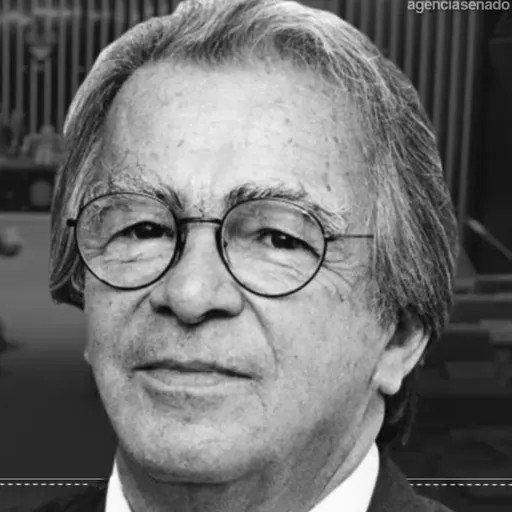
About Darcy Ribeiro
Lived 1922 – 1997 (aged 74). Darcy Ribeiro was a Brazilian anthropologist, politician, writer, sociologist, novelist and pedagogue.
Darcy Ribeiro (October 26, 1922 – February 17, 1997) was a Brazilian anthropologist, historian, sociologist, author and politician. His ideas have influenced several scholars of Brazilian and Latin American studies. As Minister of Education of Brazil he carried out profound reforms which led him to be invited to participate in university reforms in Chile, Peru, Venezuela, Mexico and Uruguay after leaving Brazil due to the 1964 coup d'état.
Biography Darcy Ribeiro was born in Montes Claros, in the state of Minas Gerais, the son of Reginaldo Ribeiro dos Santos and of Josefina Augusta da Silveira. He completed his primary and secondary education in his native town, at the Grupo Escolar Gonçalves Chaves and at the Ginásio Episcopal de Montes Claros.
He is best known for development work in the areas of education, sociology and anthropology and for being, along with his friend and colleague Anísio Teixeira, one of the founders of the University of Brasília in the early 1960s. He also served as the first rector of that university. In April 1964, after the military coup that deposed Goulart, Ribeiro went into exile in Uruguay, where he worked as a professor of anthropology and planning advisor at the University of the Republic and met Argentine Manuel Sadosky, recognised as one of the pioneers in introducing computers for academic training and research in Latin America. In September 1968, Ribeiro returned to Brazil, but was arrested and spent nine months in preventive detention. After being tried by a military court and declared a person of maximum danger, he was acquitted due to lack of evidence. However, he was forced into exile, this time in Caracas in 1969, where he worked as a consultant for the university reform of the Central University of Venezuela. At the end of 1970, he was invited by President Salvador Allende to advise the Chilean government and, at the same time, served as a research professor and advisor at the University of Chile. During those years, Ribeiro published important books such as El proceso civilizatorio (The Civilising Process), Las Américas y la civilización (The Americas and Civilisation), El dilema de América Latina (The Dilemma of Latin America), Fronteras indígenas de la civilización (Indigenous Frontiers of Civilisation) and La universidad necesaria (The Necessary University). His last stage was in Peru, during the Revolutionary Government of the Armed Forces, where Ribeiro was head and international co-director of the Centre for the Study of Popular Participation (CENTRO), a project co-financed by the ILO and Sinamos (1972-1976) . With the support of mathematician Oscar Varsavsky, he developed a global computational model of Peruvian society and economy at CENTRO, which in turn could feed into a database .
Thought
Darcy Ribeiro's ideas belonged to the evolutionist school of sociology and anthropology, and his main influences were Neoevolutionists Leslie White and Julian Steward, and the Marxist archeologist V. Gordon Childe. He believed that people went through a "civilizatory process" beginning as hunter-gatherers. This "civilizatory process" was according to him marked by technological revolutions, and among these he stress the eight more important as the following: the agricultural revolution the urban revolution the irrigation revolution the metallurgic revolution the livestock revolution the mercantile revolution the Industrial Revolution the thermonuclear revolution
Ribeiro proposed also a classification scheme for the world peoples, emphasizing the American countries, where he identified "New Peoples" (Chile, Colombia, Paraguay, Venezuela etc.), that merged from the mix of several cultures; "Witness Peoples" (Peru, Mexico, Ecuador, Guatemala etc), remnants of ancient civilizations; and "Transplanted Peoples" (USA, Canada, Argentina and Uruguay), European diasporas without significative other people influences.
Selected works
Ethnology Culturas e línguas indígenas do Brasil – 1957 Arte plumária dos índios Kaapo – 1957 A política indigenista brasileira – 1962 Os índios e a civilização – 1970 Uira sai, à procura de Deus – 1974 Configurações histórico-culturais dos povos americanos – 1975 Suma etnológica brasileira – 1986 (colaboração; três volumes). Diários índios – os urubus-kaapor – 1996
Anthropology O processo civilizatório – etapas da evolução sócio-cultural – 1968 As Américas e a civilização – processo de formação e causas do desenvolvimento cultural desigual dos povos americanos – 1970 Os índios e a civilização – a integração das populações indígenas no Brasil moderno – 1970 The culture – historical configurations of the American peoples – 1970 Os brasileiros – teoria do Brasil – 1972 O dilema da América Latina – estruturas do poder e forças insurgentes – 1978 O povo brasileiro – a formação e o sentido do Brasil – 1995
Romances Maíra – 1976 O mulo – 1981 Utopia selvagem – 1982 Migo – 1988
Essays Kadiwéu – ensaios etnológicos sobre o saber, o azar e a beleza – 1950 Configurações histórico-culturais dos povos americanos – 1975 Sobre o óbvio - ensaios insólitos – 1979 Aos trancos e barrancos – como o Brasil deu no que deu – 1985 América Latina: a pátria grande – 1986 Testemunho – 1990 A fundação do Brasil – 1500/1700 – 1992 (colaboração) O Brasil como problema – 1995 Noções de coisas – 1995
Education Plano orientador da Universidade de Brasília – 1962 A universidade necessária – 1969 Propuestas – acerca da la renovación – 1970 Université des Sciences Humaines d'Alger – 1972 La universidad peruana – 1974 UnB – invenção e descaminho – 1978 Nossa escola é uma calamidade – 1984 Universidade do terceiro milênio – plano orientador da Universidade Estadual do Norte Fluminense – 1993
Don’t just read it —
keep it.
Full-length biographies made to live with: read them, listen on the way to work, watch them tonight.
- E-book
- Audio
- Video
Instant download · yours to keep · every purchase keeps this site free
Important facts
People in Darcy Ribeiro's life
Named in this biography and alive at the same time

Related people
Same field, nearest in time



Contemporaries
People whose lives overlapped Darcy Ribeiro's
Frequently asked questions
Who was Darcy Ribeiro?
Brazilian politician and academic (1922-1997)
When was Darcy Ribeiro born?
Darcy Ribeiro was born on 26 October 1922 in Salinas.
When did Darcy Ribeiro die?
Darcy Ribeiro died on 17 February 1997 in Brasília.
What was Darcy Ribeiro's occupation?
Darcy Ribeiro was an anthropologist, politician, writer, sociologist, novelist and pedagogue.
What nationality was Darcy Ribeiro?
Darcy Ribeiro was Brazilian.
Sources & further reading
Cite this page
APA: Biography.guide. (2026). Darcy Ribeiro. https://biography.guide/darcy-ribeiro/
MLA: "Darcy Ribeiro." Biography.guide, https://biography.guide/darcy-ribeiro/.
Chicago: "Darcy Ribeiro." Biography.guide. https://biography.guide/darcy-ribeiro/.
Data last updated: 2026-09-22 · Spot an error? Report a correction.
Portrait: Wikimedia Commons · author & licence
Page generated 2026-09-27 05:03 UTC