
About Daniel Murray
Lived 1768 – 1852 (aged 83). Daniel Murray was a catholic priest and catholic bishop.
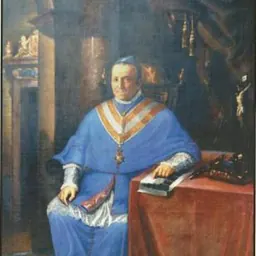
Daniel Murray (1768, at Sheepwalk, near Arklow, Ireland – Dublin, 1852) was an Irish Catholic prelate who served as Archbishop of Dublin from 1832 until his death.
Life He was born on 18 April 1768 at Sheepwalk, near Arklow, County Wicklow, the son of Thomas and Judith Murray. His parents were farmers. At the age of eight he went to Thomas Betagh's school at Saul's Court, near Christchurch Cathedral. At sixteen, Archbishop John Carpenter sent him to the Irish College at Salamanca, completing his studies at the University of Salamanca. He was ordained priest in 1792 at the age of twenty-four.
After some years as curate at St. Paul's Church in Dublin he was transferred to Arklow, and was there in 1798 when the rebellion broke out. The yeomanry shot the parish priest in bed and Murray, to escape a similar fate, fled to the city where for two years he served as curate at St. Andrew's Chapel on Hawkins Street. As a preacher, Murray is said to have been particularly effective, especially in appeals for charitable causes, such as the schools. He was then assigned to the Chapel of St. Mary in Liffey Street Upper where Archbishop John Troy was the Parish Priest.
Murray became Archbishop of Dublin in 1825 and on 14 November 1825 celebrated the completion of St Mary's Pro-Cathedral. He enjoyed the confidence of successive popes and was held in high respect by the British government. His life was mainly devoted to ecclesiastical affairs, and the establishment and organisation of religious associations for the education and relief of the poor. With the outbreak of cholera in the 1830s, in 1834 he and Mother Aikenhead founded St. Vincent's Hospital. Murray persuaded Edmund Rice to send members of the Christian Brothers to Dublin to start a school for boys. The first was opened in a lumber yard on the City Quay. He assisted Catherine McAuley in founding the Sisters of Mercy, and in 1831 professed the first three members.
Edward Bouverie Pusey had an interview with him in 1841, and bore testimony to his moderation, and John Henry Newman had some correspondence with him prior to Newman's conversion from the Anglican Church to the Roman Catholic Church in 1845. A seat in the privy council at Dublin, officially offered to him in 1846, was not accepted. Murray took part in the synod of the Roman Catholic clergy at Thurles in 1850.
Towards the end of his life, Murray's eyesight was impaired, and he read and wrote with difficulty. Among his last priestly functions was a funeral service for Richard Lalor Sheil who had died in Italy, and whose body had been brought back to Ireland for burial. Daniel Murray died in Dublin on 26 February 1852, at the age of eighty-four. He was interred in the pro-cathedral, Dublin, where a marble statue of him has been erected in connection with a monument to his memory, executed by James Farrell, president of the Royal Hibernian Academy of Fine Arts.
Views He was a strong supporter of Daniel O'Connell's Catholic Association, and gave testimony before the Parliamentary Commission on Catholic emancipation, but remained aloof from the Repeal Association.
Murray was later a strong opponent of the Ecclesiastical Titles Act 1851. the Catholic Church had refrained from using the ancient titles of the existing Anglican sees, and had created new titles for their bishoprics. In Ireland, the Catholic hierarchy continued to use the titles of the ancient sees. In 1850, in response to the Catholic emancipation legislation, Pope Pius IX set up a Roman Catholic hierarchy of dioceses in England and Wales in Universalis Ecclesiae. The Ecclesiastical Titles Act 1851 was passed in response, making it a criminal offence for anyone outside the Church of England to use any episcopal title "of any city, town or place, or of any territory or district (under any designation or description whatsoever), in the United Kingdom". The Roman Catholic community unofficially used the territorial titles, although the bishops themselves carefully stayed within the letter of the law. No one was ever prosecuted.
He supported Stanley's National Education scheme and among the first Education Commissioners, wished to tolerate the Queen's Colleges, as opposed to the views of Archbishop John MacHale of Tuam. He had hesitation, however, in accepting the adverse decision of Rome, and was present at the Synod of Thurles where the Queen's Colleges were formally condemned.
Don’t just read it —
keep it.
Full-length biographies made to live with: read them, listen on the way to work, watch them tonight.
- E-book
- Audio
- Video
Instant download · yours to keep · every purchase keeps this site free
Important facts
People in Daniel Murray's life
Named in this biography and alive at the same time


Related people
Same field, nearest in time


Contemporaries
People whose lives overlapped Daniel Murray's



Frequently asked questions
Who was Daniel Murray?
Irish archbishop
When was Daniel Murray born?
Daniel Murray was born on 18 April 1768 in Arklow.
When did Daniel Murray die?
Daniel Murray died on 26 February 1852 in Dublin.
What was Daniel Murray's occupation?
Daniel Murray was a catholic priest and catholic bishop.
Sources & further reading
· DBpedia: Daniel Murray (bishop)
Cite this page
APA: Biography.guide. (2026). Daniel Murray. https://biography.guide/daniel-murray/
MLA: "Daniel Murray." Biography.guide, https://biography.guide/daniel-murray/.
Chicago: "Daniel Murray." Biography.guide. https://biography.guide/daniel-murray/.
Data last updated: 2026-09-20 · Spot an error? Report a correction.
Page generated 2026-09-27 05:18 UTC