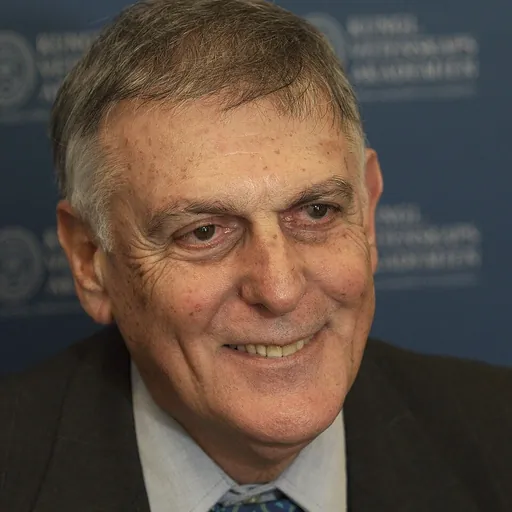
About Dan Shechtman
Born 1941. Dan Shechtman is an Israeli and American physicist, chemist, engineer, pedagogue, university teacher and crystallographer, known for Quasicrystal.
Dan Shechtman (; born January 24, 1941) is an Israeli chemist, the Philip Tobias Professor of Materials Science at the Technion – Israel Institute of Technology, an Associate of the US Department of Energy's Ames National Laboratory, and Professor of Materials Science at Iowa State University. On April 8, 1982, while on sabbatical at the U.S. National Bureau of Standards in Washington, D.C., Shechtman discovered the icosahedral phase, which opened the new field of quasiperiodic crystals, also referred to as "quasicrystals." For this discovery, he was awarded the 2011 Nobel Prize in Chemistry, making him one of six Israelis who have won the Nobel Prize in Chemistry.
Biography
Early life Dan Shechtman was born in 1941 in Tel Aviv, in what was then Mandatory Palestine; the city became part of the new state of Israel in 1948. He grew up in Petah Tikva and Ramat Gan in a Jewish family. His grandparents had immigrated to Palestine during the Second Aliyah (1904–1914) and founded a printing house. As a child, Shechtman was fascinated by Jules Verne's The Mysterious Island (1874), which he read many times. His childhood dream was to become an engineer like the main protagonist, Cyrus Smith.
Spouse and children Shechtman is married to Prof. Tzipora Shechtman, Head of the Department of Counseling and Human Development at Haifa University, and author of two books on psychotherapy. They have a son Yoav Shechtman (a former postdoctoral researcher in the lab of W. E. Moerner and now professor at the Technion – Israel Institute of Technology) and three daughters: Tamar Finkelstein (an organizational psychologist at the Israeli police leadership center), Ella Shechtman-Cory (a PhD in clinical psychology), and Ruth Dougoud-Nevo (also a PhD in clinical psychology).
Academic career
After receiving his Ph.D. in Materials Engineering from the Technion in 1972, where he also obtained his B.Sc. in Mechanical Engineering in 1966 and M.Sc. in Materials Engineering in 1968,
Since 2014 he has been the head of the International Scientific Council of Tomsk Polytechnic University.
Work on quasicrystals and controversy Shechtman's Nobel Prize–winning work was in the area of quasicrystals, ordered crystalline materials lacking repeating structures, such as this Al-Pd-Mn alloy.
A quasiperiodic crystal, or, in short, quasicrystal, is a structure that is ordered but not periodic. A quasicrystalline pattern can continuously fill all available space, but it lacks translational symmetry. "Aperiodic mosaics, such as those found in the medieval Islamic mosaics of the Alhambra palace in Spain and the Darb-i Imam shrine in Iran, have helped scientists understand what quasicrystals look like at the atomic level. In those mosaics, as in quasicrystals, the patterns are regular – they follow mathematical rules – but they never repeat themselves." Quasicrystals have also been found naturally.
From the day Shechtman published his findings on quasicrystals in 1984 to the day Linus Pauling died in 1994, Shechtman experienced hostility from Pauling toward the non-periodic interpretation. "For a long time it was me against the world," Shechtman said. "I was a subject of ridicule and lectures about the basics of crystallography. The leader of the opposition to my findings was the two-time Nobel Laureate Linus Pauling, the idol of the American Chemical Society and one of the most famous scientists in the world. For years, 'til his last day, he fought against quasi-periodicity in crystals. He was wrong, and after a while, I enjoyed every moment of this scientific battle, knowing that he was wrong." Pauling is noted saying "There is no such thing as quasicrystals, only quasi-scientists." Pauling was apparently unaware of a paper in 1981 by H. Kleinert and K. Maki which had pointed out the possibility of a non-periodic Icosahedral Phase in quasicrystals (see the historical notes). The head of Shechtman's research group told him to "go back and read the textbook" and a couple of days later "asked him to leave for 'bringing disgrace' on the team." Shechtman felt rejected.
Quasicrystalline materials could be used in a large number of applications, including the formation of durable steel used for fine instrumentation, and non-stick insulation for electrical wires and cooking equipment., but presently have no technological applications.
The Nobel prize was 10 million Swedish krona (approximately ). Shechtman received the endorsement of the ten Members of Knesset required to run. In the elections, held on June 10, 2014, he was awarded only one vote. This led Israeli press and Israeli humorists to qualify Shechtman as "quasi-president" in reference to the "quasi-scientist" quote.
Awards
2019 Honorary John von Neumann Professor title 2014 Fray International Sustainability Award, SIPS 2014 2013 Honorary doctorate from Bar-Ilan University 2011 Nobel Prize in Chemistry for the discovery of quasicrystals 2008 European Materials Research Society (E-MRS) 25th Anniversary Award 2002 EMET Prize in Chemistry 2000 Muriel & David Jacknow Technion Award for Excellence in Teaching 2000 Gregori Aminoff Prize of the Royal Swedish Academy of Sciences 1999 Wolf Prize in Physics 1998 Israel Prize, for Physics 1993 Weizmann Science Award 1990 Rothschild Prize in Engineering 1988 New England Academic Award of the Technion 1988 International Award for New Materials of the American Physical Society 1986 Physics Award of the Friedenberg Fund for the Advancement of Science and Education
Published works
Don’t just read it —
keep it.
Full-length biographies made to live with: read them, listen on the way to work, watch them tonight.
- E-book
- Audio
- Video
Instant download · yours to keep · every purchase keeps this site free
Important facts
People in Dan Shechtman's life
Named in this biography and alive at the same time



Related people
Same field, nearest in time


Contemporaries
People whose lives overlapped Dan Shechtman's

Frequently asked questions
Who is Dan Shechtman?
Israeli scientist
When was Dan Shechtman born?
Dan Shechtman was born on 24 January 1941 in Tel Aviv.
What is Dan Shechtman's occupation?
Dan Shechtman is a physicist, chemist, engineer, pedagogue, university teacher and crystallographer.
What is Dan Shechtman known for?
Dan Shechtman is known for Quasicrystal.
What nationality is Dan Shechtman?
Dan Shechtman is Israeli and American.
Sources & further reading
Cite this page
APA: Biography.guide. (2026). Dan Shechtman. https://biography.guide/dan-shechtman/
MLA: "Dan Shechtman." Biography.guide, https://biography.guide/dan-shechtman/.
Chicago: "Dan Shechtman." Biography.guide. https://biography.guide/dan-shechtman/.
Data last updated: 2026-09-22 · Spot an error? Report a correction.
Portrait: Wikimedia Commons · author & licence
Page generated 2026-09-27 05:01 UTC