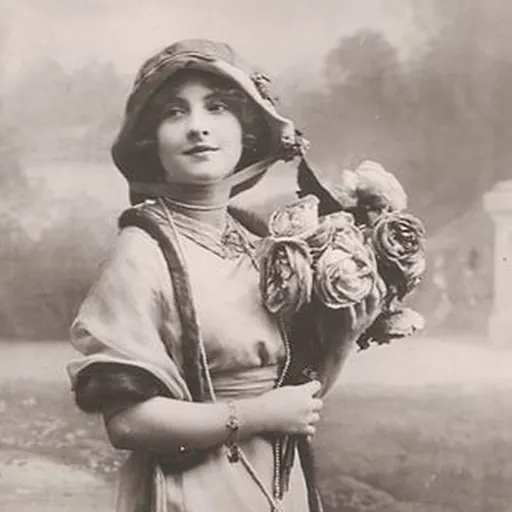
About Daisy Burrell
Lived 1892 – 1982 (aged 89). Daisy Burrell was a British singer and film actor.
Daisy Burrell (born Daisy Isobel Eaglesfield Ratton; 16 June 1892 – 10 June 1982) was a British stage actress and Edwardian musical comedy performer who also appeared as a leading lady in silent films and in pantomime.
In 1951 she appeared in The Golden Year, the first musical comedy produced for television.
Background Daisy Ratton was born in Wandsworth in 1892, although according to Who Was Who in the Theatre 1912–1976 she was born in Singapore in 1893. and they lived at Stoke Newington, but he died in 1873, aged 35, leaving a young son and daughter. His widow, Daisy's grandmother, married Hassan Fareed the next year and died in 1890, aged 42. In 1891, Daisy's father, Charles Morris Ratton, married Ethel Eaglesfield Griffith, the daughter of another stockbroker, but by the end of 1892 he disappears from the records. Her grandfather, E. J. Griffith, died in 1895 as a hospital clerk at Guy’s Hospital, leaving a modest £365. His widow, Matilda Catherine Lovibond Griffith, the youngest child of Dr Edward Long MRCS, died in October 1898 at Lavender Hill.
Daisy Burrell’s mother, Ethel Ratton, was by 1898 the partner of Henry S. Burrell, licensee of the Clarence Hotel, Stoke Newington. Their son, John Griffith Burrell, was born in March 1899, and christened in August 1907; their daughter Edwina Ethel was born in September 1908. In 1900, H. S. Burrell had the Old Star in Wapping. He also had a career as a singer, using the stage name of Harry Saunders, and at the time of the 1901 census the Burrell family was in Willesden, using the name Saunders, apart from Daisy, whose name was given as Ratton. In 1911, the family was in Stoke Newington, and was again called Burrell. Later it lived mostly in Kent, at Hythe and Folkestone. In 1939, Henry and Ethel Burrell were living at 77, Castle Road, Hythe, with their daughter Edwina. Ethel Burrell died in 1944, and Henry Burrell in 1955, leaving an estate valued at £5,166.
Charles M. Ratton had a sister, Laura Theresa Ratton, Daisy Burrell’s aunt, who lived in Worthing and died unmarried in 1944.
Early career
Taking her step-father's surname, at least as a performer, Burrell first appeared on stage at the London Hippodrome in July 1903, playing the part of Kitty in The Redskins, a water spectacular by Alicia Ramsey. She went on to study at the Guildhall School of Music, and in 1909 played the part of Youth in Give Heed, a modern morality play by Blanche G. Vulliamy, performed by students of the Guildhall School at the Court Theatre.
On leaving, Burrell went into pantomime at the Theatre Royal, Drury Lane, and in 1910 The Illustrated London News noted her appearing as Cinderella at the new Palladium. She first came to wide attention the same year, appearing at the Vaudeville Theatre in The Girl in the Train. After closing in London this production, starring Burrell in the title role, went on tour until 1911, with the Gloucestershire Echo reporting that "Miss Daisy Burrell acts and sings delightfully Gonda Van der Loo".
After that, Burrell was with George Edwardes's touring company for six years, appearing in the hit Edwardian musical comedies The Marriage Market, Peggy, The Sunshine Girl and others. In The Marriage Market, she played a midshipman. In 1912, she sang the part of Juliette in a production of Franz Lehár's operetta The Count of Luxembourg, as one of the five principals, together with Phyllis Le Grand, Eric Thorne, Lauri de Frece, and Robert Michaelis, who were collectively described by the Musical News as "all consummate artists in their own style". The next year she appeared in his Gipsy Love. The manager of the Count of Luxembourg production of 1912 was J. Garret Todd, who went on to become manager of Daly's Theatre. which opened at the Prince's Theatre, Manchester on Christmas Eve, 1914, and transferred to Daly's Theatre in the West End on 24 April 1915. Interviewed in the Daily Sketch dated 11 May 1915, Burrell said this was the first time she had originated a part in London, and while she loved playing at Daly's, she was "tremendously envious of skirts and pretty clothes". In reviewing the play, The Tatler hailed Burrell as “a Great Girl-Boy”. A year later, Burrell was interviewed for The Era and was asked “And those boys’ parts you have made so famous?” She replied “Merci, Monsieur. I am now coming to that.“
Also in 1915, Burrell played the title role of Cinderella in the pantomime, with the Illustrated Sporting and Dramatic News commenting that “the Cinderella of Miss Daisy Burrell contributes very much, for she is a sweet and attractive little heroine... As a spectacle, her adventures are all prettiness and daintiness.”
Marriages In October 1912, under her name at birth of Daisy Ratton, Burrell married T. W. G. Carleton (1887–1957), of Stoke Newington, who was then a commercial traveller. During the First World War, he was commissioned into the Royal Horse Artillery, serving with it until April 1920. In 1919, Burrell filed a petition for the restitution of conjugal rights, and in 1920 she petitioned for a divorce. By 1924 they were divorced, and in the spring of that year at Holborn Carleton married secondly Dorothy Knight, otherwise Hunt.
In Westminster on 1 November 1924, as Daisy Carleton, Burrell married Herbert William Young, of Liverpool. Young was a Liverpool cotton merchant who retired to live in France. He died in 1943, aged 81. At the time of his death, he was of Flat 6, 14 Pall Mall, St James's, and left an estate valued at £43,838. In his will, Young appointed his three sisters as executors and left his widow Daisy Isobel Eaglesfield Young the principal of a £9,900 marriage settlement, plus one quarter of the income from a fund of £43,000. That fund was also to go to his widow if his sisters died before her. There was a dispute over the will, and in the High Court in July 1961 Mr Justice Russell was "asked to construe the home-made will of a retired Liverpool cotton-merchant".
Films and later career
Burrell's start in films came from G. B. Samuelson, and she appeared in several of his early silent movies. The first of these was The Valley of Fear (1916), an early Sherlock Holmes film, in which she was the leading lady. She was offered the part after Samuelson saw her playing Cinderella at the London Palladium, in a production by his brother Julian Wylie, who was also Burrell’s agent. Wylie boasted in The Stage Year Book: "During 1916 I made Contracts for the following Artistes: Bairnsfather's "Fragments from France", Daisy Burrell, Gladys Cooper, Phyllis Dare... Mabel Love ... Vesta Tilley, Madge Titheradge &c. &c." Several other film roles followed. In her second film, Just a Girl (1916), Burrell played the Australian heiress Esmeralda, who spurns an English lord (played by Owen Nares) to marry a miner.
In Little Women (1917), directed by Alexander Butler, Burrell played Amy, the youngest of the four girls. In 1919, she had leading roles in The Bridal Chair, Convict 99, and The Artistic Temperament, and in May 1919 she was the cover girl for an issue of the magazine Pictures and Picturegoer. In April 1920, a theatrical gossip column in New Zealand described Burrell as "Miss Daisy Burrell, the well-known musical comedy star", while later the same year The Straits Times of Singapore called her "Daisy Burrell, the golden-haired film star". In December 1920 she received good reviews for her part in The Pride of the Fancy, a silent film about a champion boxer who woos her successfully, although Variety commented that "Daisy Burrell is a charming Kitty, although she is rather inclined to overact."
During her years on the silver screen, Burrell continued to appear on stage. On 23 November 1916 she took part in the first-ever performance at the new St Martin's Theatre, the first night of Fred Thompson's extravaganza Houp La!, playing Aggie, and this production ran until late February 1917. In April 1917 she opened in a revue called £150 at the Ambassadors Theatre. In September 1918 she took the leading role of Desirée in Emmerich Kálmán's operetta Soldier Boy at the Apollo Theatre, succeeding Vera Wilkinson. In July and August 1919 she played Mollie Maybud in Nobody's Boy at the Garrick Theatre. Blockquote "The most trying moment in your cinema experience is the day on which you first see the film with yourself in it. You think you ought to have done everything so much better..." From December 1922 to March 1923 she appeared again as Cinderella for Wylie & Tate at the London Hippodrome, opposite Clarice Mayne as Prince Charming and Lupino as Buttons, this production running to 176 performances. The Times said of Burrell's Cinderella "She sings, dances and acts with equal ease." thumb In October 1920 the Leeds Mercury reported that "Miss Daisy Burrell... is said to possess the tiniest feet in film-land", and in 1922 came to a report that a London theatre was offering a prize for “the lady who can wear the Cinderella slipper of Miss Daisy Burrell”. In May 1924 Burrell entered a competition promoted by the sculptor and Royal Academician F. W. Pomeroy (1856–1924), who had offered a prize "for the most perfect pair of feet". She tied with the dancer Margery Prince for the first prize of £50, and The Miami News reported that Burrell had been chosen eight times to play Cinderella on account of the daintiness of her feet. Pomeroy died on 26 May.
In July 1924 Burrell joined a touring company for George M. Cohan's musical Little Nellie Kelly, By this point in her stage career she was represented by the Akerman May Agency, of 16 Green Street, London WC2. Palmer's British Film Actors' Credits, 1895–1987 identifies her with Daisy Burrell who played two minor parts in the British films Woman to Woman (1947) and Green Fingers (1947), as does the online database of the British Film Institute. and in The Golden Year (1951), the first musical comedy produced for television, and disappeared from the performing record again after that.
Final years
At the time of the High Court challenge to her second husband’s will in 1961, Burrell was living at the De Vere Court Hotel, 32 De Vere Gardens, Kensington. The building had a restaurant, a bar, a hairdressing salon, reception rooms, its own live music club, and other notable residents. She died on 10 June 1982, six days short of her 90th birthday, leaving an estate of £66,170.
Portraits The National Portrait Gallery in London has fourteen portrait photographs of Burrell by Bassano, dated between 1919 and 1922. Several of these are in Cinderella costumes, and four include Clarice Mayne.
Filmography Burrell appeared in the following films:
The Valley of Fear (1916) – Ettie Shafter Just a Girl (1916) – Esmeralda The Last Rose of Summer (1920) – Lotus Devine Woman to Woman (1947) – Stage Box Committee Cinderella at the London Palladium, 1916, as Cinderella Soldier Boy by Emmerich Kálmán (Apollo Theatre, September 1918), as Desirée repeated at Empire Theatre, Sheffield, at Christmas 1920 Cinderella (1920 and 1921), as Cinderella (Wylie & Tate, Empire Theatre, Sheffield, and Empire Theatre, Cardiff) Cinderella (December 1922 — March 1923) as Cinderella (Wylie & Tate, London Hippodrome)
Don’t just read it —
keep it.
Full-length biographies made to live with: read them, listen on the way to work, watch them tonight.
- E-book
- Audio
- Video
Instant download · yours to keep · every purchase keeps this site free
Important facts
People in Daisy Burrell's life
Named in this biography and alive at the same time




Related people
Same field, nearest in time

Contemporaries
People whose lives overlapped Daisy Burrell's



Frequently asked questions
Who was Daisy Burrell?
British actress (1892–1982)
When was Daisy Burrell born?
Daisy Burrell was born on 16 June 1892 in London Borough of Wandsworth.
When did Daisy Burrell die?
Daisy Burrell died on 10 June 1982 in London.
What was Daisy Burrell's occupation?
Daisy Burrell was a singer and film actor.
What nationality was Daisy Burrell?
Daisy Burrell was British.
Sources & further reading
Cite this page
APA: Biography.guide. (2026). Daisy Burrell. https://biography.guide/daisy-burrell/
MLA: "Daisy Burrell." Biography.guide, https://biography.guide/daisy-burrell/.
Chicago: "Daisy Burrell." Biography.guide. https://biography.guide/daisy-burrell/.
Data last updated: 2026-09-22 · Spot an error? Report a correction.
Portrait: Wikimedia Commons · author & licence
Page generated 2026-09-27 05:02 UTC