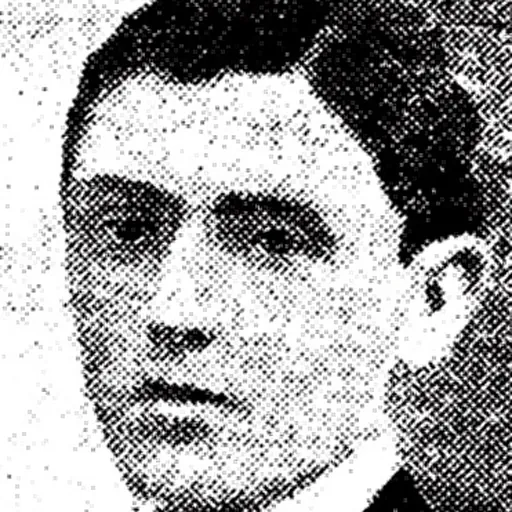
About D. Iacobescu
Lived 1893 – 1913 (aged 19–20). D. Iacobescu was a Romanian poet.
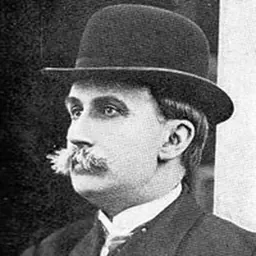
D. Iacobescu or Dumitru Iacobescu (; born Armand Iacobsohn; 1893 – October 9, 1913) was a Romanian Symbolist poet. His literary activity only lasted about two years, between his high school graduation and his death from tuberculosis, but made him a critically acclaimed presence inside Romania's Symbolist movement. Much of Iacobescu's work remained unpublished during his lifetime, and survived as autographed notebooks. Once rediscovered and published some twenty years after his death, it brought him posthumous recognition as a writer of talent, but one whose introversion and nostalgia ran contrary to the main currents in modernism.
Romanticizing his own physical suffering while adopting stylistic elements from French Symbolist classics such as Paul Verlaine, D. Iacobescu left lyric poetry that is either resigned or visionary in dealing with mortality. His other contributions display an interest in Decadent, pre-modernist, themes, as well as a taste for black comedy. The contrast between his approach and that of other, more avant-garde, Romanian Symbolists did not prevent Iacobescu's affiliation with the modernist circle at Ion Minulescu's Insula magazine.
Biography Born in Craiova as the son of physician Iacobsohn and his wife Doroteea, the future D. Iacobescu belonged to the Jewish-Romanian community, being one of several Jewish members of his early modernist generation to make an impact on Romanian literature.
D. Iacobescu had a short life, marked by his losing battle with tuberculosis. He was however active on the literary scene of Bucharest, just shortly after completing his high school studies. In spring 1912, Iacobescu became an affiliate of the literary circle formed by Minulescu around the short-lived review Insula (the existence of which marked a coming of age in Romanian Symbolism). At the time, Iacobescu met the modernist poet Ion Vinea, who later contributed his obituary in Facla magazine. According to this text, Iacobescu, who rallied with "the purifying and insect repelling" Insula, represented a "multicolored ray, vibrating far away from [...] the mediocre talents." In addition to lending his contribution to Insula, Iacobescu had his various poems published by several other literary magazines or newspapers: Flacăra, Noua Revistă Română, Ramuri, Ilustrația Națională, Arta, Biruința and Noi Pagini Literare.
D. Iacobescu died in Bucharest at age nineteen. He left behind several calligraphed manuscripts of his lifelong poetry (most of it previously unpublished), including a notebook carrying the title Quasi. In a memoir written during or shortly after World War I, literary historian Tudor Vianu, who noted having "read and admired" Iacobescu while he was still alive, reviewed these unpublished pieces, and argued that their title probably alluded to an "indecisive atmosphere" to be discerned in Iacobescu's creative process. The notebooks included Iacobescu's first mention of being bedridden, with Zile de vară ("Summer Days", dated August 6, 1913), as well as his last known work in verse, Capriccio-Fantazie (August 13).
Work
Generic traits D. Iacobescu's short career, overlapping with Symbolist mutations into the avant-garde, was still characterized by a focus on the mainstays of Symbolist aesthetics. In his obituary piece, Ion Vinea described the "dreamer's verse" contributed by Iacobescu as complementing "the fastidious and strange plangency" of Minulescu's work. In Tudor Vianu's opinion, Iacobescu was primarily a pre-modernist and "minor poet of great talent", whose work evidenced a stage in Romanian poetry that preceded the wartime effort.
A particular trait of Iacobescu's poetry, which placed him in line with the stylistic choices of many Romanian Symbolists, was its use of color-related epithets, particularly "synesthesic" ones (and, according to researcher Carmen Niculescu, with a personal palette of black, gray and blood red). Tudor Vianu argued that, in his more humorous works in particular, Iacobescu displays "the extraordinary precision of detail [Vianu's italics]", condensed into "dynamic evocations".
Poems about disease and death Călinescu believes the "personal note" of Iacobescu's literary contribution is to be found in lyric poems which deal with his sickness, with solitude and depression, detailing states such as "the strain of hearing to the vibrations of silence" or "the sensitivity in relation to rain". One such sample reads:
Black comedy Iacobescu's sad and meditative poetry was contrasted by his other works, where he turns to depicting the irony of life, often highlighted by his use of grotesque imagery. Focusing on the Symbolist contribution to Romanian humor, literary historian Ștefan Cazimir argues that, among Iacobescu's writings, such samples echo either Verlaine (in cases where Iacobescu discusses his "hypothetical love affairs" in self-mocking tones) or Jules Laforgue (in those pieces where his texts veer into black comedy). Cazimir suggests that the latter influence is to be found in the poem Prin ceață ("Through the Fog"), where Iacobescu likens streetlights to ghosts that have no choice but to play audience to tomcats in heat.
In his 1918 note on Iacobescu, Vianu also assessed: "I do believe I have managed to capture an especially original tone in his poetry [...]. I mean a certain sentimental grotesque [Italics in the original] where laughter merges into a flinch of pain." This trait, Vianu notes, is especially observable in settings such as Scenă de seară ("Evening Scene"), where patients in a mental institution marvel as one of them plays the ballerina, and where contentment suddenly becomes violence: Verse translation| After being reviewed by Vinea and Vianu, Iacobescu's work was revisited by critics of the interwar period, including Călinescu and the modernist critic Eugène Ionesco. The latter's articles, which center on the idea of radical cultural innovation, attacked the substance of Iacobescu's poems in terms deemed "full of hate" by cultural historian Marta Petreu. Being Jewish, Iacobescu was implicitly banned during the antisemitic regime of Ion Antonescu (1940–1944). In late 1941, when an anthology of Romanian poetry was supposed to be published in Italy, his name was crossed out by Alexandru Busuioceanu of the Romanian Propaganda Ministry.
In the 1970s, former Symbolist Barbu Solacolu was among those who suggested revisiting Iacobescu's work, calling him a "great poet". Iacobescu was again the object of critical interest only after 2008, when semiologist and critic Marin Mincu published the anthology Poezia română actuală ("Timely Romanian Poetry"). In what was equated with an actual recovery by literary reviewer Bogdan Crețu, it placed Iacobescu alongside other representatives of lyrical Romanian Symbolism. Mincu's work also placed Iacobescu's taste for the ballade poetic form in relation to the balladesque poetry of the 1940s, in particular with that produced by the modernist Sibiu Literary Circle.
In 2014, Ștefan Bolea republished Iacobescu's only volume, Quasi, along with literary references and personal commentary in a critical edition, praised by Oliviu Crâznic in Apostrof .
Don’t just read it —
keep it.
Full-length biographies made to live with: read them, listen on the way to work, watch them tonight.
- E-book
- Audio
- Video
Instant download · yours to keep · every purchase keeps this site free
Important facts
People in D. Iacobescu's life
Named in this biography and alive at the same time



Related people
Same field, nearest in time
Contemporaries
People whose lives overlapped D. Iacobescu's


Frequently asked questions
Who was D. Iacobescu?
poet
When was D. Iacobescu born?
D. Iacobescu was born in 1893 in Craiova.
When did D. Iacobescu die?
D. Iacobescu died on 9 October 1913 in Bucharest.
What was D. Iacobescu's occupation?
D. Iacobescu was a poet.
What nationality was D. Iacobescu?
D. Iacobescu was Romanian.
Sources & further reading
Cite this page
APA: Biography.guide. (2026). D. Iacobescu. https://biography.guide/d-iacobescu/
MLA: "D. Iacobescu." Biography.guide, https://biography.guide/d-iacobescu/.
Chicago: "D. Iacobescu." Biography.guide. https://biography.guide/d-iacobescu/.
Data last updated: 2026-09-24 · Spot an error? Report a correction.
Portrait: Wikimedia Commons · author & licence
Page generated 2026-09-27 05:08 UTC