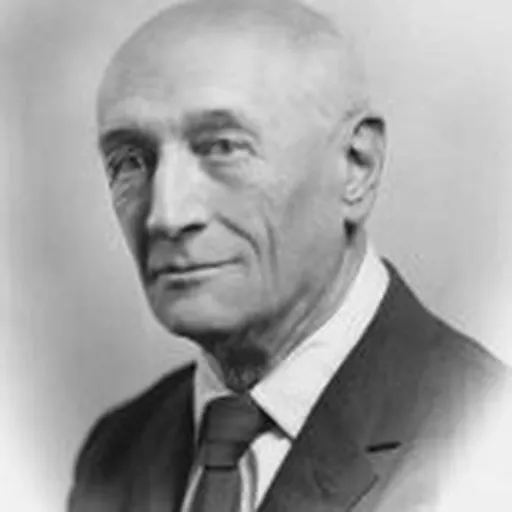
About Curt John Ducasse
Lived 1881 – 1969 (aged 88). Curt John Ducasse was a French and American philosopher.
Curt John Ducasse (; 7 July 1881 – 3 September 1969) was a French-born American philosopher who taught at the University of Washington and Brown University. He was known as an early champion of analytic philosophy inspired by the methods of the sciences, albeit with a mystical streak that included a noted interest in parapsychology and the possibilities of life before birth and life after death. He was a president of the American Philosophical Association (1939–1940) and a founder and the first president of the Association for Symbolic Logic (1936–1938).
Early life and education
Ducasse was born 7 July 1881 in Angoulême, France. He spent one year in England, emigrated to Mexico in 1900, then spent two years in Mexico before settling in the United States, where he soon joined the Theosophical Society. He obtained A.B. (1908) and A.M. (1909) degrees in philosophy from University of Washington. In 1912 he obtained his PhD from Harvard University under the mentorship of Josiah Royce. While there he met William James, who would remain a lasting influence on his work.
Career Ducasse taught at the University of Washington (1912–1926)
He is most notable for his work in philosophy of mind and aesthetics and for being an early champion of analytic philosophy. He was noted for championing analytic methods in philosophy and insisting on scientific rigor and precision in philosophy, particularly in his 1941 Philosophy as a Science. However, in Roderick Chisholm's recollection of his own words, he also had "a rather strong mystical bent." In his work in aesthetics, as in 1929's The Philosophy of Art and Art, the Critics, and You (1944), he applied his theories of causation and particularly an "adverbial theory of perception" to a participatory and relativist conception of art. Ducasse was influenced by William James, Josiah Royce, and Arthur Schopenhauer, and his own influence can be seen in the work of Roderick Chisholm and Wilfrid Sellars. His book A Critical Examination of the Belief in a Life After Death (1961) was a philosophical attempt to examine the idea of life after death, and in it he expressed his belief in survival. Further praise and criticism came from philosopher Corliss Lamont, who argued that some of the content was based on an implausible mind–body dualism, while at the same time he named it "one of the most powerful arguments I have encountered for post-mortem survival."
The September 1952 issue of Philosophy and Phenomenological Research was devoted to a symposium in Ducasse's honor, and he received a festschrift in 1966 titled Current Philosophical Issues: Essays in Honor of Curt John Ducasse.
Personal life and death Ducasse married Mable Lisle, a Seattle, Washington artist, in 1921. He died on 3 September 1969 in Providence, Rhode Island.
Books Causation and the Types of Necessity (1924). University of Washington Press. The Philosophy of Art (1929). The Dial Press. Philosophy as a Science (1941). O. Piest. Art, the Critics, and You (1944). O. Piest. Is a Life After Death Possible? (1948). University of California Press, Berkeley. Nature, Mind, and Death (1951). Open Court Publishing Company. A Philosophical Scrutiny of Religion (1953). Ronald Press Company. A Critical Examination of the Belief in a Life after Death (1961). Thomas. Truth, Knowledge, and Causation (1968). Routledge & K. Paul.
Don’t just read it —
keep it.
Full-length biographies made to live with: read them, listen on the way to work, watch them tonight.
- E-book
- Audio
- Video
Instant download · yours to keep · every purchase keeps this site free
Important facts
People in Curt John Ducasse's life
Named in this biography and alive at the same time






Related people
Same field, nearest in time



Contemporaries
People whose lives overlapped Curt John Ducasse's



Frequently asked questions
Who was Curt John Ducasse?
American philosopher (1881–1969)
When was Curt John Ducasse born?
Curt John Ducasse was born on 7 July 1881 in Angoulême.
When did Curt John Ducasse die?
Curt John Ducasse died on 3 September 1969 in Providence, Rhode Island, U.S..
What was Curt John Ducasse's occupation?
Curt John Ducasse was a philosopher.
What nationality was Curt John Ducasse?
Curt John Ducasse was French and American.
Sources & further reading
· Wikipedia: Curt John Ducasse
Cite this page
APA: Biography.guide. (2026). Curt John Ducasse. https://biography.guide/curt-john-ducasse/
MLA: "Curt John Ducasse." Biography.guide, https://biography.guide/curt-john-ducasse/.
Chicago: "Curt John Ducasse." Biography.guide. https://biography.guide/curt-john-ducasse/.
Data last updated: 2026-09-22 · Spot an error? Report a correction.
Portrait: Wikimedia Commons · author & licence
Page generated 2026-09-27 05:01 UTC