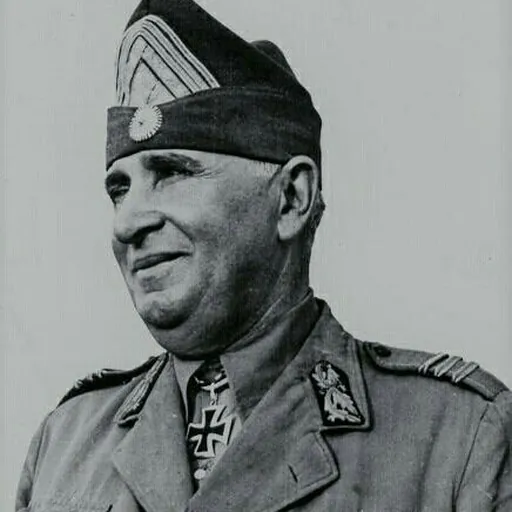
About Corneliu Dragalina
Lived 1887 – 1949 (aged 62). Corneliu Dragalina was a Romanian military personnel.
Corneliu Dragalina (5 February 1887 – 11 July 1949) was a Romanian lieutenant general during World War II.
Biography Early life and World War I He was born in the city of Karánsebes, Austria-Hungary, in what is now Caransebeș, Caraș-Severin County, Romania. His father, Ion Dragalina, was a general in World War I.
After attending the Artillery Military School in Bucharest (1905–1907), Corneliu Dragalina graduated with the rank of second lieutenant; he was promoted to lieutenant in 1910 and to captain in 1915. When Romania entered World War I in August 1916 on the side of the Allied powers, Dragalina fought with the Dobruja Army under the command of Russian General Andrei Zayonchkovski, and saw action against the Bulgarian forces. Wounded in battle, he was taken by barge on the Danube to a hospital in Galați, where he was operated upon. Shortly after that he went back to Bucharest to take leave of his father, who, at the command of the 1st Romanian Army, had been mortally wounded at the First Battle of the Jiu Valley. For his valor, Dragalina was decorated in November 1916 with the Order of Michael the Brave, 3rd class. In 1917 he was promoted to major.
The interwar period After the war, he pursued his military studies at the Higher War School (1919–1921). During that time (April 1920–February 1921), he also served (via a delegate) as prefect of Timiș-Torontal County. Dragalina was promoted to lieutenant colonel in 1920, colonel in 1928, and brigadier general in 1935. On 1 January 1940 he was named commander of the 6th Army Corps, stationed in Cluj, while on 6 June 1940 he was promoted to major general. In the aftermath of the Second Vienna Award (signed on 30 August 1940), Dragalina took a leading role in the evacuation of the Romanian troops from Northern Transylvania, and moved his headquarters to Brașov. During the Legionnaires' rebellion of January 1941, Dragalina with his troops restored order inside the city and secured the radio broadcast station at Bod. As a prelude to the invasion of Yugoslavia by the Axis powers in the spring of 1941, the 6th Army Corps was relocated to the Banat, but eventually the Serbian Banat was occupied by German troops.
World War II General Dragalina was still in command of the 6th Army Corps when Romania joined Operation Barbarossa on 22 June 1941 in order to reclaim the lost territories of Bessarabia and Bukovina, which had been annexed by the Soviet Union in June 1940. The 6th Corps was kept in reserve inside Romania and was sent to the Eastern Front only in October 1941, when it took part in the final phase of the Siege of Odessa. It then took part in the Crimean campaign, after which the 6th Corps moved in the spring of 1942 to the south of Izium, where it took under its command four Romanian infantry divisions (the 1st, 2nd, 4th, and 20th). In May 1942, Dragalina led his troops during the Second Battle of Kharkov. The 6th Corps lost 2,983 men during the battle, but took 26,432 Soviet POWs, and also captured a large number of T-60 light tanks, as well as the first T-34 and KV-1 tanks taken intact by the Romanian Army. For the 1942 German summer offensive, Dragalina was subordinated to the 1st Panzer Army. On 22 June, the 6th Corps forced the Donets River and continued the offensive towards the Don River, advancing 450 km in 20 days. On 18 July Dragalina was promoted to lieutenant general, after which he was subordinated to the 4th Panzer Army, helping it advance across the Don River.
At the beginning of September, the 6th Corps (consisting by then of the 1st, 2nd, 4th, and 18th Infantry Divisions) was assigned to the Romanian Fourth Army, commanded by General Constantin Constantinescu-Claps. The 4th Army had joined in the Battle of Stalingrad, helping to protect the southern flank of the German 6th Army as it tried to conquer the city of Stalingrad, defended by the Red Army. On 20 November 1942, the 4th Army was attacked by the Soviet 57th and 51st Armies, with the main blow in the sector of the 20th, 2nd, 18th and 1st Infantry Divisions. Overpowered and poorly equipped, Dragalina's 6th Corps troops received the brunt of the Soviet offensive (Operation Uranus) south of Stalingrad. On 23 November, the Deputy Chief of Staff of the Fourth Army demanded and received from the Romanian General Headquarters the authorization to make decisions independently from the 4th Panzer Army. Subsequently, the 6th Corps fell back to the Aksay River, but to no avail, as the Soviets were already in control of the communication center of Aksay. On 27 November, the Soviets managed to break through the line of the 6th Corps at the 18th Infantry Division, thus forcing it to retreat 25–30 km south of the river. The remnants of the 6th Corps tried to defend a line of villages backed up by Radu Korne's detachment, but the Soviets had an almost free hand as the Romanian forces disintegrated. when the Red Army occupied Bukovina during the Uman–Botoșani Offensive. He was then put at the disposal of the Ministry of Defense. He returned as General Inspector of the Mechanized Troops between November 1944 and March 1945, when he was definitively retired by order of the Petru Groza government.
After the war Dragalina later lost his house in Timișoara and was harassed by the Securitate, but, unlike many other military commanders who had fought on the Eastern Front, he was not arrested. He died from natural causes on 11 July 1949 in Bucharest, escaping persecution by the new Communist regime. He is buried at Bellu Military Cemetery in Bucharest.
Awards Order of Michael the Brave 3rd Class (11 November 1916) 2nd Class (1 September 1942) Iron Cross (1939) 2nd and 1st Class Knight's Cross of the Iron Cross (9 August 1942)
Legacy The National Military Museum in Bucharest houses a permanent exhibition that displays personal objects which belonged to top Romanian military leaders, including memorabilia of Corneliu Dragalina.
Don’t just read it —
keep it.
Full-length biographies made to live with: read them, listen on the way to work, watch them tonight.
- E-book
- Audio
- Video
Instant download · yours to keep · every purchase keeps this site free
Important facts
People in Corneliu Dragalina's life
Named in this biography and alive at the same time




Related people
Same field, nearest in time




Contemporaries
People whose lives overlapped Corneliu Dragalina's


Frequently asked questions
Who was Corneliu Dragalina?
Romanian general
When was Corneliu Dragalina born?
Corneliu Dragalina was born on 5 February 1887 in Caransebeș.
When did Corneliu Dragalina die?
Corneliu Dragalina died on 11 July 1949 in Bucharest.
What was Corneliu Dragalina's occupation?
Corneliu Dragalina was a military personnel.
What nationality was Corneliu Dragalina?
Corneliu Dragalina was Romanian.
Sources & further reading
· Wikipedia: Corneliu Dragalina
Cite this page
APA: Biography.guide. (2026). Corneliu Dragalina. https://biography.guide/corneliu-dragalina/
MLA: "Corneliu Dragalina." Biography.guide, https://biography.guide/corneliu-dragalina/.
Chicago: "Corneliu Dragalina." Biography.guide. https://biography.guide/corneliu-dragalina/.
Data last updated: 2026-09-20 · Spot an error? Report a correction.
Portrait: Wikimedia Commons · author & licence
Page generated 2026-09-27 04:58 UTC