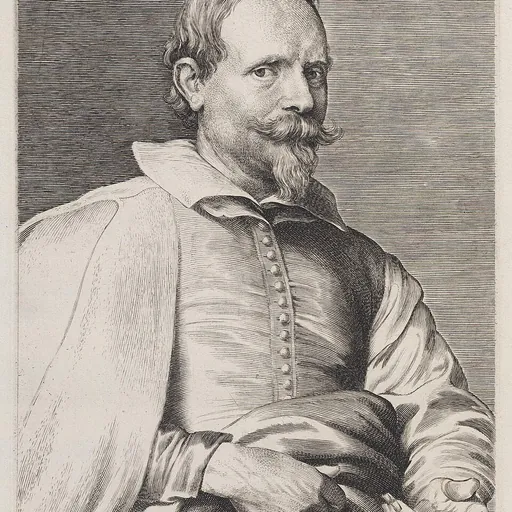
About Cornelis de Vos
Lived 1584 – 1651 (aged 66–67). Cornelis de Vos was a Belgian painter and draftsperson.
Cornelis de Vos (1584 - 9 May 1651) was a Flemish painter, draughtsman and art dealer. He was one of the leading portrait painters in Antwerp and is best known for his sensitive portraits, in particular of children and families. He was also successful in other genres including history, religious and genre painting. He was a regular collaborator with Rubens.
Life He was born in Hulst near Antwerp, now in the Dutch province of Zeeland. Little is known of his childhood. His father moved with his family to Antwerp in 1596. Cornelis and his younger brothers Paul and Jan (or Hans) studied under the little-known painter David Remeeus (1559–1626). In 1599 de Vos is mentioned as Remeeus' pupil while on 8 May 1604 he is referred to as the chief assistant of Remeeus. On 29 April 1604, de Vos petitioned the Antwerp City Council for a pass that would allow him to travel. This was a necessary procedure for artists who wished to be trained abroad. It is not known whether the young artist actually left the city to study abroad. De Vos joined the Guild of Saint Luke in 1608 at the age of 24. When he became a citizen of Antwerp in 1616 he listed his occupation as an art dealer.
Cornelis de Vos married the landscape painter Jan Wildens's half-sister Susanna Cock on 27 May 1617. The couple had 6 children. His sister Margaretha married the prominent animal painter Frans Snyders. These marriages confirmed and solidified de Vos' role in Antwerp's artistic life.
During this period of busy activity as a painter de Vos continued to operate an art dealership. He also created works specifically for export, primarily to Spain.
Cornelis de Vos was one of the artists working on the decorations for the Joyous Entry into Antwerp of the new governor of the Habsburg Netherlands Cardinal-Infante Ferdinand in 1635. Rubens was in overall charge of this project. De Vos made decorative paintings after designs by Rubens. One of the hewn-out images that crowned the triumphal arch on the Meir, above the Huidevettersstraat, has been preserved and is attributed to the studio of de Vos (Jupiter and Juno, Royal Museum of Fine Arts Antwerp).
In the period 1636-1638 Rubens' workshop received a large commission to make mythological decorations for the hunting pavilion Torre de la Parada of the Spanish king Philip IV near Madrid. For this project de Vos, together with a number of painters from Rubens' circle, painted decorations after oil sketches by Rubens. Important features of his personal style were the lucid plasticity of painted flesh and the bright tactility of highlights.
Portraits
De Vos was most successful as a painter of individual and group portraits, a genre in which he developed his own style. After the departure of Anthony van Dyck for England in 1621 and Rubens' absences from Antwerp on diplomatic and artistic missions, de Vos became the leading portraitist of the Antwerp haute-bourgeois and patrician society. In the portrait of his two eldest children Magdalena and Jan-Baptist, de Vos portrays them not from a distance but brought forward close to the viewer's space. Magdalena looks back at the viewer over her shoulder and seems to invite the viewer in while Jan-Baptist leans forward with tilted head and is also staring at the viewer. He has his feet stretched out and the soles of his shoes are visible. In many of his portraits, de Vos included fruit as symbolic attributes for his sitters. In the portrait of his two eldest children Magdalena holds cherries in her right hand and a peach in her left hand. Peaches and cherries are symbols of youth as well as fertility.
From 1624 onwards, Cornelis de Vos abandoned his thickly produced brush strokes for a lighter painting style and placed landscapes in the background. This change likely happened under the influence of Rubens. Starting from circa 1630, his compositions became less relief-like and his figures were placed more realistically in the space. The landscape also gradually got more attention while facial expressions became more intensive and the architecture in the background more developed. These changes followed contemporary developments in the Baroque style.
Another variation on the theme of players, Players and courtesans under a tent (Musée de Picardie), has been attributed to de Vos based on its similarity with the work in Stockholm. Previously it was attributed to the French follower of Caravaggio, Valentin de Boulogne.
Another genre composition involving backgammon players referred to as The game of backgammon (c. 1630, Musée Boucher-de-Perthes) is attributed to Cornelis de Vos.
Collaborations
Cornelis de Vos often collaborated with fellow artists as was common in Antwerp at the time. He painted the staffage in still lifes by his brother-in-law Frans Snyders and in return his brother Paul and Frans Snyders painted the fruit, animals, silver plate and armour in his own work. Jan Wildens, another brother-in-law, assisted with the landscapes in many of his works.
De Vos assisted Rubens with the large commissions of the Rubens workshop in the 1630s. He worked for Rubens on the Joyous Entry of the Cardinal-Infante Ferdinand, a project for which he painted twelve royal portraits after Rubens' designs. Between 1636 and 1638 he, along with his brother Paul and many other Antwerp artists, assisted Rubens in decorating the Torre de la Parada, a hunting lodge of Philip IV of Spain near Madrid. Cornelis contributed four paintings on mythological themes to the series made for the Torre de la Parada: The triumph of Bacchus, The birth of Venus, Apollo and the Python and Daphne chased by Apollo. These works are now in the collection of the Prado Museum. They were based on designs by Rubens which have also been preserved. This makes it possible to compare the designs by Rubens with the works completed by Cornelis de Vos. In The triumph of Bacchus de Vos' brush stroke is less energetic and free than that displayed in the Rubens sketch. De Vos' treatment of the faces also differs in that they are less expressive and dramatic than in the sketch.
While de Vos' collaborations with Rubens on projects in the 1630s appear not to have influenced his style, they did influence his technique.
Don’t just read it —
keep it.
Full-length biographies made to live with: read them, listen on the way to work, watch them tonight.
- E-book
- Audio
- Video
Instant download · yours to keep · every purchase keeps this site free
Important facts
more
cornelis de voss, De Vos, Cornelius Devos, Cors de Vos, Corneille de Voos, Corneille de Vos, Cornelius de Voss, C. de Vos, Corn. de Vosser, D. Vos, De Nos, corn. de vos, Cornil de Vos, cornelis vos, C. Devos, Vos, Cornelis de Vos the Elder, Jacobus Cornelis de VosPeople in Cornelis de Vos's life
Named in this biography and alive at the same time


Related people
Same field, nearest in time

Contemporaries
People whose lives overlapped Cornelis de Vos's



Frequently asked questions
Who was Cornelis de Vos?
Flemish painter
When was Cornelis de Vos born?
Cornelis de Vos was born in 1584 in Hulst.
When did Cornelis de Vos die?
Cornelis de Vos died on 9 May 1651 in Antwerp.
What was Cornelis de Vos's occupation?
Cornelis de Vos was a painter and draftsperson.
What nationality was Cornelis de Vos?
Cornelis de Vos was Belgian.
Sources & further reading
Cite this page
APA: Biography.guide. (2026). Cornelis de Vos. https://biography.guide/cornelis-de-vos/
MLA: "Cornelis de Vos." Biography.guide, https://biography.guide/cornelis-de-vos/.
Chicago: "Cornelis de Vos." Biography.guide. https://biography.guide/cornelis-de-vos/.
Data last updated: 2026-09-24 · Spot an error? Report a correction.
Portrait: Wikimedia Commons · author & licence
Page generated 2026-09-27 05:08 UTC