
About Constantino Brumidi
Lived 1805 – 1880 (aged 74). Constantino Brumidi was an Italian and American painter and interior designer.
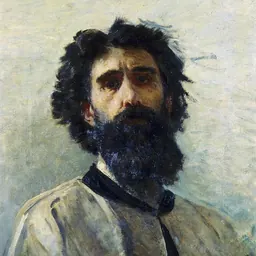
Constantino Brumidi (26 July 1805 – 19 February 1880) was an Italian-American painter, born in Italy to an Italian mother & Greek father, he was later naturalized an American citizen, best known and honored for his fresco work, Apotheosis of Washington, in the Capitol Building in Washington, D.C.
Parentage and early life Brumidi was born in Rome, his father a Greek from Filiatra in the province of Messenia, Greece, and his mother an Italian. He showed his talent for fresco painting at an early age and underwent training in the fields of sculpture and painting, under the tutelage of artists such as Bertel Thorvaldsen, Antonio Canova, and Baron Vincenzo Camuccini. Brumidi painted in several Roman palaces, among them being that of Prince Torlonia. Under Gregory XVI he worked for three years in the Vatican.
Immigration and following work Constantino Brumidi by Alexander Gardner, c. 1865, albumen print The occupation of Rome by French forces in 1849 apparently persuaded Brumidi to emigrate, having joined the short-lived risorgimental Roman Republic, and he sailed for the United States, where he became a naturalized citizen in 1852. Taking up his residence in New York City, the artist painted a number of portraits. Brumidi subsequently created several works for St. Stephen's Church in New York, including an altarpiece (1855) and murals (1866 and 1871–72). His work in the rotunda was left unfinished at his death, but he had decorated many other sections of the building, most notably hallways in the Senate side of the Capitol now known as the Brumidi Corridors. Filippo Costaggini continued painting the frieze over the next 8 years based on the sketches Brumidi left; however, there was no sketch left for the final panel, which remained empty until 1953, when Allyn Cox designed and painted it.
Brumidi's Liberty and Union paintings are mounted near the ceiling of the White House entrance hall.
In the Cathedral-Basilica of Sts. Peter and Paul in Philadelphia, Pennsylvania, he pictured St. Peter and St. Paul. Brumidi was a capable, if conventional painter, and his black and white modeling in the work at Washington, in imitation of bas-relief, is strikingly effective. He decorated the entrance hall of Saleaudo, located at Frederick, Maryland, and listed on the National Register of Historic Places in 1979.
A Brumidi painting of St. Ignatius Loyola's Vision at La Storta was installed on November 28, 1856 and now appears behind the altar in St. Ignatius Church in Baltimore, Maryland. Another, of Saint Aloysius Gonzaga receiving communion from Saint Charles Borromeo, hangs over the high altar of St Aloysius Church in Washington, D.C.thumb Grave of Constantino Brumidi, his wife, his son, and his in-laws at Glenwood Cemetery. Another Brumidi altarpiece was recently restored behind the marble high altar of the Shrine and Parish Church of the Holy Innocents in New York, New York. The fresco commissioned by the first pastor of Holy Innocents, John Larkin, portrays the Crucifixion of Jesus.
In memoriam Brumidi died in Washington, D.C., and was interred at Glenwood Cemetery. When he was buried, his grave was unmarked. The location of Brumidi's grave was lost for 72 years. It was rediscovered, and on 19 February 1952, a marker was finally placed above it.
Forgotten for many years, Brumidi's role was rescued from obscurity by Myrtle Cheney Murdock.
On 10 June 2008, Congress passed, and on 1 September 2008, President George W. Bush signed, Public Law 110–59 (122 Stat. 2430), which posthumously awarded the Congressional Gold Medal to Constantino Brumidi, to be displayed in the Capitol Visitor Center, as part of an exhibit honoring him.
A memorial statue of Constantino Brumidi stands near the central square of Filiatra, Greece, the birthplace of his father.
Gallery
Don’t just read it —
keep it.
Full-length biographies made to live with: read them, listen on the way to work, watch them tonight.
- E-book
- Audio
- Video
Instant download · yours to keep · every purchase keeps this site free
Important facts
more
Konstantinos MproumidesPeople in Constantino Brumidi's life
Named in this biography and alive at the same time




Related people
Same field, nearest in time

Contemporaries
People whose lives overlapped Constantino Brumidi's





Frequently asked questions
Who was Constantino Brumidi?
Italian-Greek-American historical painter (1805-1880)
When was Constantino Brumidi born?
Constantino Brumidi was born on 26 July 1805 in Rome.
When did Constantino Brumidi die?
Constantino Brumidi died on 19 February 1880 in Washington, D.C..
What was Constantino Brumidi's occupation?
Constantino Brumidi was a painter and interior designer.
What nationality was Constantino Brumidi?
Constantino Brumidi was Italian and American.
Sources & further reading
· Wikipedia: Constantino Brumidi
· DBpedia: Constantino Brumidi
Cite this page
APA: Biography.guide. (2026). Constantino Brumidi. https://biography.guide/constantino-brumidi/
MLA: "Constantino Brumidi." Biography.guide, https://biography.guide/constantino-brumidi/.
Chicago: "Constantino Brumidi." Biography.guide. https://biography.guide/constantino-brumidi/.
Data last updated: 2026-09-20 · Spot an error? Report a correction.
Page generated 2026-09-27 05:29 UTC