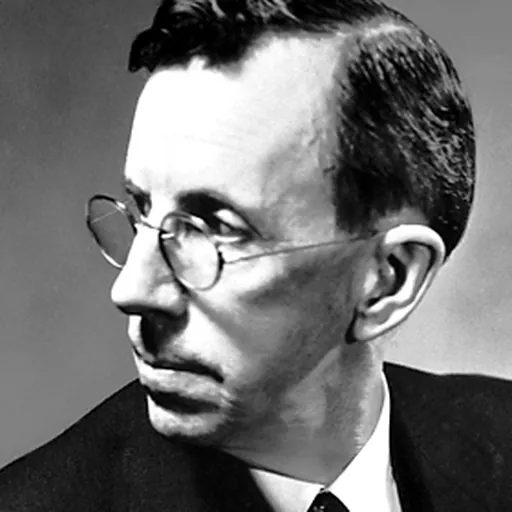
About Clinton Davisson
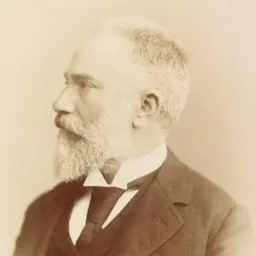
Lived 1881 – 1958 (aged 76). Clinton Davisson was an American physicist and university teacher, known for Electron diffraction.
Clinton Joseph Davisson (October 22, 1881 – February 1, 1958) was an American experimental physicist who shared the 1937 Nobel Prize in Physics with George Paget Thomson "for their experimental discovery of the diffraction of electrons by crystals."
Biography Clinton Joseph Davisson was born on October 22, 1881, in Bloomington, Illinois, the son of Joseph Davisson, an artisan from Ohio, and Mary Calvert, a schoolteacher from Pennsylvania.
Davisson graduated from Bloomington High School in 1902, and entered the University of Chicago on scholarship. Upon the recommendation of Robert Millikan, he was hired by Princeton University in 1905 as an instructor in physics. He completed the requirements for his B.S. from Chicago in 1908, mainly by working in the summers. While teaching at Princeton, he did doctoral research under Owen Richardson, receiving his Ph.D. in 1911 with a thesis titled On The Thermal Emission of Positive Ions From Alkaline Earth Salts.
Davisson died on February 1, 1958, in Charlottesville, Virginia, at the age of 76. Davisson crater on the far side of the Moon was named after him in 1970.
Davisson–Germer experiment
Diffraction is a characteristic effect when a wave is incident upon an aperture or a grating, and is closely associated with the meaning of wave motion itself. In the 19th century, diffraction was well-established for light and for ripples on the surfaces of fluids.
In 1927, Davisson and his Bell Labs colleague, Lester Germer, performed an experiment showing that electrons were diffracted at the surface of a crystal of nickel. This work confirmed the de Broglie hypothesis that particles of matter have a wave-like nature, which is a central tenet of quantum mechanics. In particular, their observation of diffraction allowed the first measurement of a wavelength for electrons. The measured wavelength agreed well with de Broglie's equation , where is the Planck constant and is the electron's momentum.
Family While doing his graduate work at Princeton, Davisson met his future wife, Charlotte Sara Richardson, who was visiting her brother (and his doctoral advisor), Professor Owen Richardson. Charlotte was the sister-in-law of Oswald Veblen, a prominent mathematician. Clinton and Charlotte (d. 1984) married in 1911 and had four children: Owen; James; Richard, who became a physicist; and Elizabeth.
Recognition Awards Year Organization Award Citation 1928 National Academy of Sciences Comstock Prize in Physics "In recognition of his experimental work demonstrating that under certain conditions, electrons behave as we would expect trains of waves to behave." 1931 Franklin Institute Elliott Cresson Medal "For the scattering and diffraction of electrons by crystals." 1935 Royal Society Hughes Medal "For his research that resulted in the discovery of the physical existence of electron waves through long-continued investigations on the reflection of electrons from the crystal planes of nickel and other metals." 1937 Royal Swedish Academy of Sciences Nobel Prize in Physics "For their experimental discovery of the diffraction of electrons by crystals." 1929 American Academy of Arts and Sciences Member 1929 National Academy of Sciences Member
Don’t just read it —
keep it.
Full-length biographies made to live with: read them, listen on the way to work, watch them tonight.
- E-book
- Audio
- Video
Instant download · yours to keep · every purchase keeps this site free
Important facts
People in Clinton Davisson's life
Named in this biography and alive at the same time

Related people
Same field, nearest in time


Contemporaries
People whose lives overlapped Clinton Davisson's


Frequently asked questions
Who was Clinton Davisson?
American physicist (1881-1958)
When was Clinton Davisson born?
Clinton Davisson was born on 22 October 1881 in Bloomington.
When did Clinton Davisson die?
Clinton Davisson died on 1 February 1958 in Charlottesville.
What was Clinton Davisson's occupation?
Clinton Davisson was a physicist and university teacher.
What was Clinton Davisson known for?
Clinton Davisson was known for Electron diffraction.
What nationality was Clinton Davisson?
Clinton Davisson was American.
Sources & further reading
Cite this page
APA: Biography.guide. (2026). Clinton Davisson. https://biography.guide/clinton-davisson/
MLA: "Clinton Davisson." Biography.guide, https://biography.guide/clinton-davisson/.
Chicago: "Clinton Davisson." Biography.guide. https://biography.guide/clinton-davisson/.
Data last updated: 2026-09-21 · Spot an error? Report a correction.
Portrait: Wikimedia Commons · author & licence
Page generated 2026-09-27 04:59 UTC