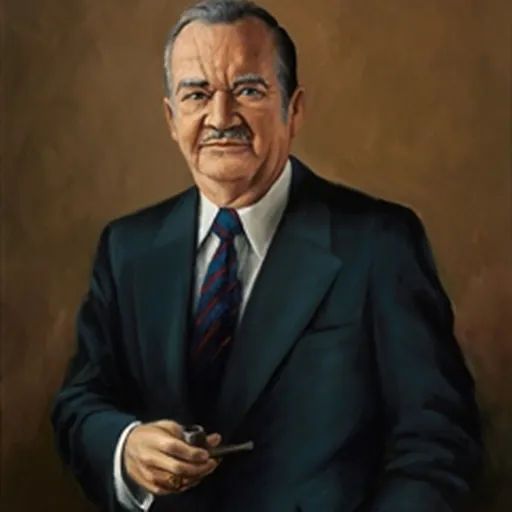
About Clement J. Zablocki
Lived 1912 – 1983 (aged 71). Clement J. Zablocki was an American politician, teacher, organist and choir director.
Clement John Zablocki (November 18, 1912 – December 3, 1983) was an American politician from Milwaukee, Wisconsin. He was one of Wisconsin's longest-serving members of the U.S. House of Representatives, representing Wisconsin's 4th congressional district for 18 terms, from 1949 until his death in 1983.
A liberal Democrat, he built his reputation in foreign policy by taking strong anti-communist positions and supporting the Vietnam War. He was a sponsor of the original Gulf of Tonkin Resolution which launched the American intervention, but near the end of the war he was a driving force for the War Powers Resolution, which sought to put restraints on the war-making powers of future presidents. He rose to become chair of the House Foreign Affairs Committee for the last seven years of his career.
Early life and education Clement Zablocki was born, raised, and lived most of his life in Milwaukee, Wisconsin. The son of Polish immigrants, he grew up speaking both Polish and English in Milwaukee's flourishing Polish American community. He attended St. Vincent's Catholic Parochial School and then graduated from Marquette University High School. He took lessons as an organist from age 10, and earned money for college by performing at church services and directing the church choir. He also worked as a department store clerk. As it does today, the 3rd Senate district spanned a swath of the south side of the city of Milwaukee, from Walker's Point to the Jackson Park neighborhood, comprising many of the Polish American neighborhoods of the city. In addition to Zablocki, however, six other Democrats also sought to challenge Zimny in 1938, significantly diluting the vote. Zimni won renomination, but Zablocki posted a surprisingly strong second-place finish in the primary, falling only 411 votes short.
Zimny did not run again in 1942, and Zablocki was immediately seen as a frontrunner to replace him. Nevertheless, he did still face a competitive Democratic primary against Richard F. Maruszewski. Zablocki prevailed with 53.6% of the vote.
In the state Senate, Zablocki championed common Democratic issues of the time, supporting Franklin D. Roosevelt's New Deal policies, labor unions, and veterans benefits, but was deep in the minority and held little influence in the crafting of legislation. In the Spring 1948 election, Zablocki sought election as Milwaukee city comptroller, but lost.
Congress
In 1946, Milwaukee's then-incumbent congressman Thaddeus Wasielewski lost the Democratic primary when seeking re-election, and then ran as an independent in the general election, splitting the Democratic vote and allowing Republican John C. Brophy to eke out a victory with 36% of the vote. When Wasielewski indicated he would not run again in 1948, Zablocki jumped into the race and quickly cleared the primary field. In the general election, however, Zablocki faced the danger of a split Democratic vote again, as the 1946 Democratic nominee Edmund V. Bobrowicz entered the race on the Progressive Party ticket. Zablocki and other prominent Milwaukee Democrats sought to head off this problem by denouncing Bobrowicz over past communist affiliations. The incumbent, Brophy, had only served on the Milwaukee City Council before his election to Congress and was regarded by the Wisconsin press as a weak campaigner relative to the gregarious Zablocki. At the general election, Zablocki won by a wide margin, taking nearly 56% of the vote.
He represented Wisconsin's 4th congressional district, which at that time comprised all of the southern half of Milwaukee County, including the south side of the city of Milwaukee, and also included the city and town of Wauwatosa. He was sworn in at the start of the 81st Congress and was reelected 17 times, serving from January 3, 1949, until his death on December 3, 1983. Zablocki faced several primary challenges during his career and nearly always faced a Republican opponent in the general election, but he never received less than 60% in another election after the 1948 general.
Early years in Congress Zablocki was assigned to the House Foreign Affairs Committee from his first term in Congress. He immediately struck a strong anti-communist line, insisting that the United States should not recognize the newly established People's Republic of China, and asserting that the people of China—and those of Eastern Europe—would eventually overthrow Communism. Controversially, he also then said that the U.S. should sooner recognize the Franco regime than Communist China. During his first term, he also hailed the establishment of the state of Israel on the first anniversary of its founding, praising it as a haven for refugees and displaced persons after the devastation of . Zablocki's continued support for rapprochement with Francoist Spain also led him into a public dispute with then-U.S. President Harry S. Truman in 1952. Zablocki also supported the Republican plan to invite General Douglas MacArthur to testify before Congress after his dismissal by President Truman.
Politically, Zablocki also clashed in these early years with the state Democratic Party leadership, particularly over patronage opportunities.
U.S. Senate special election (1957) Zablocki made only one attempt to run for higher office after being elected to the U.S. House of Representatives. That attempt occurred in the 1957 special election for U.S. Senate following the death of senator Joseph McCarthy. In the Democratic primary election, Zablocki was opposed by former state representative William Proxmire, who had been the Democratic nominee for Governor of Wisconsin in the previous three general elections. Proxmire was an enthusiastic campaigner, and was—by then—well known throughout the state. At the primary, Zablocki put up a large majority in Milwaukee County, but Proxmire won nearly every other county and took the nomination easily. After losing the primary, however, Zablocki campaigned in Catholic communities around the state for Proxmire, sometimes accompanied by Massachusetts U.S. Senator John F. Kennedy. Their combined efforts led to Proxmire winning a surprise upset in the election, and was then emulated by future Democratic statewide campaigns. Later that year, Kennedy attended a series of events in Wisconsin culminating in a Pulaski Day dinner which included a celebration of Zablocki's decade of service in Congress. Zablocki later took credit for introducing Kennedy to the Polish-American community, which became part of Kennedy's base in the 1960 election. Zablocki was ultimately elected as a delegate to the 1960 Democratic National Convention. Kennedy would, in 1962, refer to Zablocki as his campaign manager in Wisconsin. In the year after Tonkin, Zablocki warmed to the idea of direct American involvement in the war, and suggested that he would be comfortable with maintaining an American presence in South Vietnam for more than 15 years.
Although Zablocki's position on Vietnam became more politically unpopular within his party as the war dragged on, he easily survived several primary challenges. He served as chair of President Lyndon B. Johnson's doomed re-election effort in Wisconsin in 1968. Behind the scenes, however, Zablocki was souring on the war. In 1970, he began work on an early version of the War Powers Resolution. By 1971, Zablocki publicly supported a resolution from the House Foreign Affairs Committee calling for Nixon to set a date for a final American withdrawal from Vietnam as part of a broader effort to return American prisoners of war. And in 1972, Zablocki was a co-author of the Case-Zablocki Act, which required that executive agreements by the president be reported to Congress in 60 days. He ultimately helped push through the final version of the War Powers Resolution in 1973, over Nixon's veto.
Zablocki remained an advocate for the interests of Vietnam War prisoners of war and missing in action. During May 1973 hearings, Zablocki observed that returning prisoners uniformly had expressed their belief that there were no U.S. servicemen still alive in Vietnam.
Chair of House Foreign Affairs With the retirement of House Foreign Affairs Committee chairman Thomas E. Morgan in 1977, Zablocki—with 28 years of seniority in the House—was a strong candidate to succeed him in the 95th Congress. But Zablocki faced intense opposition, led by veteran New York congressman Benjamin Rosenthal. Rosenthal circulated a memo criticizing Zablocki's temperament, reputation, and policy positions, accusing him of being more like a conservative Republican on foreign policy issues. Among Rosenthal's policy charges, he faulted Zablocki for frequently siding with nationalist parties, such as the South Korean military dictatorship and the Kuomintang of Taiwan. He accused Zablocki of blocking human rights proposals and attempts to cut off or limit support to regimes that were committing human rights violations. He said Zablocki's stance on the middle east isolated him from all sides—where Zablocki had suggested withdrawing support from both Israel and Egypt. And he assailed Zablocki's continued vocal support for the war in Vietnam long after most of the party had turned against the conflict.
Zablocki reacted angrily and compared the memo to McCarthyism. He charged that Rosenthal's criticism was mostly motivated by his opinion that Zablocki was not sufficiently supportive of Israel. He further responded to some of Rosenthal's specific points, saying that cutting off aid to allies would not improve human rights, and that withdrawing from Vietnam harmed the United States reputation in Asia.
Ultimately, 72 Democrats voted against Zablocki becoming chair of the committee, but 182 voted in favor, giving him more than enough support to secure the seat.
Personal life and family Clement Zablocki was the fifth of nine children born to Mathias Zablocki and his wife Mary (née Jankowski). Both of Zablocki's parents were immigrants from the Poznań region, part of Poland that was controlled by the German Empire during their lifetime. The Zablockis were Catholics and were members of the Blessed Sacrament Catholic Church in Milwaukee.
Clement Zablocki married his childhood sweetheart, Blanche Janic, in 1937. They had no biological children, but adopted a son and daughter. Zablocki's mother and wife died within days of each other in July 1977.
Legacy
The Clement J. Zablocki Veterans Affairs Medical Center at in Milwaukee is named for him, as is the Zablocki Library and the Clement J. Zablocki Elementary School in Milwaukee.
Electoral history
Wisconsin Senate (1938, 1942, 1946)
Year Election Date Elected Defeated Total Plurality 1938 Primary Democratic 27,717 72.16% Dem. 10,692 27.84% 38,409 17,025 General Democratic 83,564 60.88% Rep. 53,702 39.12% 137,266 29,862 1952 Primary Democratic 43,710 77.84% Dem. 12,445 22.16% 56,155 31,265 General Democratic 131,098 64.27% Rep. 72,869 35.73% 203,967 58,229 1954 General Democratic 100,120 71.09% Rep. 40,723 28.91% 140,843 59,397 1956 General Democratic 128,213 65.66% Rep. 67,063 34.34% 195,276 61,150 1958 Primary Democratic 36,857 85.38% Dem. 6,311 14.62% 43,168 30,546 General Democratic 112,226 74.13% Rep. 39,167 25.87% 151,393 73,059 1960 Primary Democratic 47,718 88.00% Dem. 6,505 12.00% 54,223 41,213 General Democratic 155,789 71.71% Rep. 61,468 28.29% 217,257 94,321 1962 Primary Democratic 41,408 87.91% Dem. 5,694 12.09% 47,102 35,714 General Democratic 117,029 72.51% Rep. 44,368 27.49% 161,397 72,661 1964 Primary Democratic 48,887 89.28% Dem. 5,870 10.72% 54,757 43,017 General Democratic 125,683 74.17% Rep. 43,773 25.83% 169,456 81,910 1966 Primary Democratic 37,588 90.10% Dem. 4,129 9.90% 41,717 33,459 General Democratic 77,690 74.31% Rep. 26,863 25.69% 104,553 50,827 1968 Primary Democratic 32,121 86.04% Dem. 5,212 13.96% 37,333 26,909 General Democratic 118,203 72.62% Rep. 44,558 27.38% 162,761 73,645 1970 Primary Democratic 32,201 85.35% Dem. 5,529 14.65% 37,730 26,672 General Democratic 102,464 80.35% Rep. 23,081 18.10% 127,530 79,383 Amer. 1,985 1.56% 1972 Primary Democratic 32,087 75.78% Dem. 4,337 10.24% 42,340 27,750 Dem. 3,890 9.19% Dem. 2,026 4.79% General Democratic 149,078 75.66% Rep. 45,008 22.84% 197,032 104,070 Amer. 2,946 1.50% 1974 General Democratic 84,768 72.46% Rep. 27,818 23.78% 116,990 56,950 Amer. 4,404 3.76% 1976 Primary Democratic 29,540 83.50% Dem. 5,838 16.50% 35,378 23,702 General Democratic 172,166 100.0% 172,166 N/A 1978 General Democratic 101,575 66.09% Rep. 52,125 33.91% 153,700 49,450 1980 Primary Democratic 29,411 89.40% Dem. 3,489 10.60% 32,900 25,922 General Democratic 146,437 70.02% Rep. 61,027 29.18% 209,134 85,410 Ind. 1,670 0.80% 1982 Primary Democratic 56,047 60.82% Dem. 36,102 39.18% 92,149 19,945 General Democratic 129,557 94.58% Lib. 4,064 2.97% 136,988 125,493 Ind. 2,421 1.77% Cons. 946 0.69%
Don’t just read it —
keep it.
Full-length biographies made to live with: read them, listen on the way to work, watch them tonight.
- E-book
- Audio
- Video
Instant download · yours to keep · every purchase keeps this site free
Important facts
People in Clement J. Zablocki's life
Named in this biography and alive at the same time




Related people
Same field, nearest in time






Contemporaries
People whose lives overlapped Clement J. Zablocki's





Frequently asked questions
Who was Clement J. Zablocki?
Wisconsin politician (1912-1983)
When was Clement J. Zablocki born?
Clement J. Zablocki was born on 18 November 1912 in Milwaukee.
When did Clement J. Zablocki die?
Clement J. Zablocki died on 3 December 1983 in Washington, D.C..
What was Clement J. Zablocki's occupation?
Clement J. Zablocki was a politician, teacher, organist and choir director.
What nationality was Clement J. Zablocki?
Clement J. Zablocki was American.
Sources & further reading
· Wikipedia: Clement J. Zablocki
Cite this page
APA: Biography.guide. (2026). Clement J. Zablocki. https://biography.guide/clement-j-zablocki/
MLA: "Clement J. Zablocki." Biography.guide, https://biography.guide/clement-j-zablocki/.
Chicago: "Clement J. Zablocki." Biography.guide. https://biography.guide/clement-j-zablocki/.
Data last updated: 2026-09-21 · Spot an error? Report a correction.
Portrait: Wikimedia Commons · author & licence
Page generated 2026-09-27 04:59 UTC