
About Claude Hettier de Boislambert
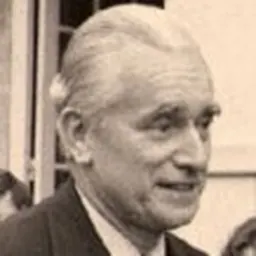
Lived 1906 – 1986 (aged 79). Claude Hettier de Boislambert was a French politician, beamter, french Resistance, national Assembly (France) and rheinland-Pfalz.
Claude Hettier de Boislambert (26 July 1906 - 22 February 1986) came to prominence during the German occupation of France in the 1940s as a Resistance leader, appointed by the Général a Companion of the Liberation in 1943. After the war, with Germany under military occupation, he served between 1946 and 1951 as governor of the region that during his period in office was reconfigured as Rheinland-Pfalz. Subsequently, he became a Gaullist member of parliament ("l'Assemblée Nationale"). From 1960 his contribution to public life was made, principally, as a member of the diplomatic service, notably in Africa.
Biography Provenance and early years Claude André Charles Antoine Marie Hettier de Boislambert was born at Hérouvillette (Calvados) just outside Caen into an upper-middle-class family with long roots in this part of Normandy.
War and resistance Before the German invasion The German army launched an invasion of Poland on 1 September 1939. The French and British governments reacted by declaring war on Germany on 3 September 1939, albeit without becoming militarily involved in Poland, even after the Soviet army launched its own invasion of Poland from the other side on 17 September 1939. The French army was more active closer to home, however, and Claude Hettier de Boislambert was called up in September 1939 as part of a generalised mobilisation: he was to serve as a cavalry lieutenant. Immediately he was sent to Lorraine to take part as leader of a horse-back platoon in a reconnaissance group.
On his appointment Hettier de Boislambert took up residence near Koblenz in Schloss Bassenheim: as his "hunting park" he used the "Forstamt Adenau" (now a nature reserve).
He quickly established close contacts with the venerable Bishop Bornewasser of Trier. Within in a couple of months the two of them had agreed denazification measures for those priests identified as being in need. He also teamed up with Bornewasser to promote the credentials of Trier as a university city. (The University of Trier had been closed in 1798, when - as between 1945 and 1951 - the city had been under French military control.) There were rival bids for university investment from Speyer and Mainz, but the bishop and Hettier de Boislambert were able to insist on the superior strategic position of Trier in relation to Cologne, Frankfurt am Main, Koblenz, Luxembourg and the economically (and politically) vital Saarland. In the end Trier lost out to Mainz, although a few decades later, in 1970, the University of Trier would indeed be re-established. In 1948 Hettier de Boislambert delivered the formal Catholics' Day greeting to General Kœnig, the French army commander in the occupation zone. Both men were close political allies of Général de Gaulle, and although he had by this time resigned the French presidency, The General remained a formidable focus of political power. Hettier de Boislambert took the opportunity of the greeting to General Kœnig, which took place in Mainz, to deliver a shamelessly Gaullist speech setting out a vision for a future Europe united in Christian faith.
He caused particular consternation among members of the Gaulliste old-guard at the time of the 1974 presidential election when he gave his support not to the Gaulliste candidate, Jacques Chaban-Delmas (who came a very distant third) but to the intellectually assertive young upstart Independent Republican candidate, Valéry Giscard d'Estaing (who - very narrowly - won).
Claude Hettier de Boislambert died in Paris in 1986. His body was buried at Sallenelles Calvados.
Don’t just read it —
keep it.
Full-length biographies made to live with: read them, listen on the way to work, watch them tonight.
- E-book
- Audio
- Video
Instant download · yours to keep · every purchase keeps this site free
Important facts
People in Claude Hettier de Boislambert's life
Named in this biography and alive at the same time

Related people
Same field, nearest in time






Contemporaries
People whose lives overlapped Claude Hettier de Boislambert's


Frequently asked questions
Who was Claude Hettier de Boislambert?
French politician (1906-1986)
When was Claude Hettier de Boislambert born?
Claude Hettier de Boislambert was born on 26 July 1906 in Hérouvillette.
When did Claude Hettier de Boislambert die?
Claude Hettier de Boislambert died on 22 February 1986 in 13th arrondissement of Paris.
What was Claude Hettier de Boislambert's occupation?
Claude Hettier de Boislambert was a politician, beamter, french Resistance, national Assembly (France) and rheinland-Pfalz.
What nationality was Claude Hettier de Boislambert?
Claude Hettier de Boislambert was French.
Sources & further reading
· Wikipedia: Claude Hettier de Boislambert
· DBpedia: Claude Hettier de Boislambert
Cite this page
APA: Biography.guide. (2026). Claude Hettier de Boislambert. https://biography.guide/claude-hettier-de-boislambert/
MLA: "Claude Hettier de Boislambert." Biography.guide, https://biography.guide/claude-hettier-de-boislambert/.
Chicago: "Claude Hettier de Boislambert." Biography.guide. https://biography.guide/claude-hettier-de-boislambert/.
Data last updated: 2026-09-22 · Spot an error? Report a correction.
Page generated 2026-09-27 05:19 UTC