
About Clark Warburton
Lived 1896 – 1979 (aged 83). Clark Warburton was an economist.
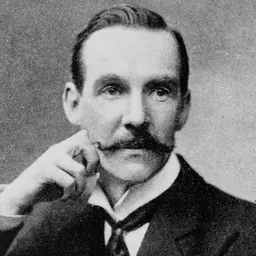
Clark Warburton (27 January 1896, near Buffalo, New York – 18 September 1979, Fairfax, Virginia) was an American economist. He was described as the "first monetarist of the post-World War II period," the most uncompromising upholder of a strictly monetary theory of business fluctuations, and reviver of classic monetary-disequilibrium theory and the quantity theory of money.
Life and works Warburton received bachelor's and master's degrees from Cornell University after military service overseas during World War I. From the 1920s to the early 1930s, he held teaching positions in India and the United States. He received a Ph.D. degree at Columbia University in 1932. There his interest had shifted from history to economics while attending lectures of Wesley C. Mitchell. His dissertation was published as The Economic Results of Prohibition. From 1932 to 1934, he worked at the Brookings Institution. In 1934 he joined the newly formed Federal Deposit Insurance Corporation. He subsequently became chief economist there, retiring from that position in 1965. He continued to publish research on substantive and historical monetary economics thereafter.
In the period from 1945, Warburton was a critic of Keynesian theory when the latter was "crowding out interest in money." He extended such results to 1965 some 20 years later.
In examining longer periods of time (decades) for 1799–1939 and annual data from 1909 to 1947, he found that velocity adjusted for trend and production capacity was relatively stable in peace time, despite extreme monetary volatility and that changes in the quantity of money were the "overwhelmingly dominant factor" responsible for changes in the price level, consistent with the quantity theory of money.
These findings supported Warburton's contentions that: instability of the money supply was a major source of business fluctuations, including the Great Depression, not merely an intensifying factor stability of monetary policy was key to macroeconomic stability. In 1966, a collection of 19 of his papers was published.
Warburton's Influence on Milton Friedman's Views on Money In the early 1950s, Warburton exerted an important impact on the development of Milton Friedman's views on money. At that time Warburton sharply criticized Friedman's then-existing monetary framework. In this connection, Warburton convinced Friedman that the Federal Reserve had caused the Great Depression and that a money supply growth rate rule would have averted the Depression had the Federal Reserve followed such a rule. During the next decade Friedman became the leading advocate of the view that the Federal Reserve caused the Great Depression and he adopted a money supply growth rate rule as his main monetary policy platform.
Don’t just read it —
keep it.
Full-length biographies made to live with: read them, listen on the way to work, watch them tonight.
- E-book
- Audio
- Video
Instant download · yours to keep · every purchase keeps this site free
Important facts
People in Clark Warburton's life
Named in this biography and alive at the same time

Related people
Same field, nearest in time






Contemporaries
People whose lives overlapped Clark Warburton's




Frequently asked questions
Who was Clark Warburton?
American economist (1896-1979)
When was Clark Warburton born?
Clark Warburton was born on 27 January 1896.
When did Clark Warburton die?
Clark Warburton died on 18 September 1979 in Fairfax.
What was Clark Warburton's occupation?
Clark Warburton was an economist.
Sources & further reading
Cite this page
APA: Biography.guide. (2026). Clark Warburton. https://biography.guide/clark-warburton/
MLA: "Clark Warburton." Biography.guide, https://biography.guide/clark-warburton/.
Chicago: "Clark Warburton." Biography.guide. https://biography.guide/clark-warburton/.
Data last updated: 2026-09-20 · Spot an error? Report a correction.
Page generated 2026-09-27 05:34 UTC