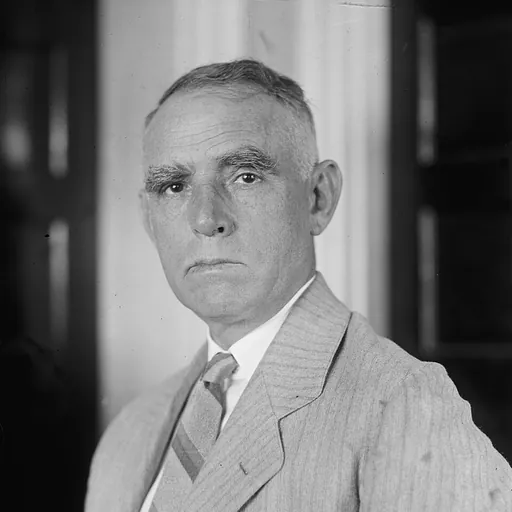
Clark Calvin Griffith
Major League Baseball player, manager, owner, executive
About Clark Calvin Griffith
Lived 1869 – 1955 (aged 85). Clark Calvin Griffith was an American baseball player.
Clark Calvin Griffith (November 20, 1869 – October 27, 1955), nicknamed "the Old Fox", was an American Major League Baseball (MLB) pitcher, manager and team owner. He began his MLB playing career with the St. Louis Browns, Boston Reds (1891), and Chicago Colts/Orphans (1893–1900). He then served as player-manager for the Chicago White Stockings (1901–1902) and New York Highlanders (1903–1907).
He retired as a player after the 1907 season, remaining manager of the Highlanders in 1908. He managed the Cincinnati Reds (1909–1911) and Washington Senators (1912–1920), making some appearances as a player with both teams. He owned the Senators from 1920 until his death in 1955. Sometimes known for being a thrifty executive, Griffith is also remembered for attracting talented players from the National League to play for the upstart American League when the Junior Circuit was in its infancy.
Griffith has the second-most ties by a manager in MLB history, with 59. He trails only Connie Mack, who has 76 ties and holds the record for managing the most games in MLB history, with a total of 7,755 games, 4,838 more than Griffith. Additionally, 25 managers have managed more games than Griffith’s 2,917, making the incidence of ties in his managerial career significantly higher than any other manager in Major League history.
Griffith was elected to the National Baseball Hall of Fame in 1946.
Early life Clark Calvin Griffith was born on November 20, 1869, in Clear Creek, Missouri, to Isaiah and Sarah Anne Griffith. His parents were of Welsh ancestry. They had lived in Illinois before Clark Griffith's birth. The family took a covered wagon west toward the Oklahoma Territory. Along the way, the family encountered hungry and disenchanted people returning from the Oklahoma Territory, so they decided to settle in Missouri. Griffith grew up with five siblings, four of them older.
When Griffith was a small child, his father was killed in a hunting accident when fellow hunters mistook him for a deer. Sarah Griffith struggled to raise her children as a widow, but Clark Griffith later said that his neighbors in Missouri had been very helpful to his mother, planting crops for her and the children. Fearing a malaria epidemic that was sweeping through the area, the Griffith family moved to Bloomington, Illinois.
A childhood incident taught him about the money side to baseball, Griffith recalled. When he was 13, he and a few other young boys had raised $1.25 to buy a baseball. They sent one of the boys 12 miles on horseback to make the purchase. The ball burst the second time that it was struck. Griffith later found out that the boy who purchased the ball only spent a quarter, keeping the leftover dollar. At the age of 17, Griffith had made $10 pitching in a local baseball game in Hoopeston, Illinois.
Professional career Minor leagues The 1889 Milwaukee Creams, Griffith is front row on the leftGriffith broke into organized baseball late in the 1887 with the local Bloomington club in the Central Interstate League. The following year, during an exhibition game against the Milwaukee Creams of the Western Association, Griffith so impressed Milwaukee manager Jim Hart that he offered the 18-year old a contract at $225 a month. Clark pitched for Milwaukee for three seasons before Charlie Comiskey convinced him to join the major leagues.
St. Louis Browns and Boston Reds (1891) Griffith entered the American Association in 1891, pitching innings and going 11-8 for Comiskey's St. Louis Browns. He was released in July of that year after developing a sore arm, and joined the Boston Reds later that season. After the 1891 season, the Association disbanded and he was left looking for new work. Cap Anson was the player-manager of the Colts during Griffith's tenure and he utilized a rotation of only three starting pitchers. Just before Griffith's arrival on the team, pitcher Bill Hutchison had thrown more than 600 innings in a single season for Anson, which may have contributed to a decline in Hutchison's career. Griffith tried a new pitch to increase his longevity. By modifying the grip of a curveball, he threw a pitch similar to the screwball that Christy Mathewson had developed. He also often scuffed balls with his spikes or rubbed them in the grass.
After a falling-out with the Highlanders' ownership, Griffith was fired during the 1908 season. The team had started strong, but the team's pitching faltered as the season progressed and Griffith was criticized for trading away Jimmy Williams in exchange for a disappointing prospect.
He made brief appearances as a player for the Reds (1909–1910) and Senators (1912, 1913 and 1914).
Cincinnati Reds (1909–1911) Griffith returned to the National League as manager of the Cincinnati Reds in . 250px
Washington Senators (1912–1920) Late in the season, the American League's Washington Senators needed to raise money to pay for the construction of their new park, National Park, which had been hurriedly built just days before the start of the season after its predecessor, Boundary Park, burned down. Principal owner Thomas C. Noyes had been friends with Griffith, and asked one of his minority partners, Ed Walsh, to come to Washington as manager in . At the same time, he also bought stock in the team as part of an effort to finance the construction of National Park. By selling the cattle on his Montana ranch, then mortgaging the ranch, Griffith was able to acquire a 10 percent stake in the Senators in two separate transactions totaling $27,000 ($ in dollars), making him the team's largest single shareholder. At the time, the franchise had little going for it other than star pitcher Walter Johnson. In the American League's first 12 years, the Senators had never had a winning record or finished higher than sixth.
To entertain the fans, Griffith hired Nick Altrock as a first base coach in his first season with Washington. Described as a "natural buffoon", Altrock engaged in lighthearted fun while coaching first base. He wrestled with himself, copied the motions of the pitcher and made the fans laugh with other antics. Griffith also engineered one of the biggest turnarounds in major league history, leading the Senators to second place. In nine years, his Washington teams only twice finished below fifth in the eight-team league.
Through this time, Griffith frequently clashed with the Senators executives, who were sometimes unwilling to spend the money he felt necessary to make the team a consistent winner. Noyes had died in the middle of the 1912 season and was succeeded as president by Benjamin Minor. Unlike Noyes, Minor insisted that Griffith clear all transactions with him. Griffith began an effort to increase his interest in the team. Along the way, he used his ties with Secretary of War Newton D. Baker to keep the baseball season going past July after the government issued a "work or fight" order requiring all able-bodied men to either serve in the military or work in an essential occupation. Griffith persuaded Baker to allow ballplayers to perform military drills on the field with bats rather than rifles, allowing the season to go on through Labor Day. Griffith boosted his holdings to 44 percent, while Richardson bought a 40.4 percent stake. Richardson and Griffith quickly came to an agreement that allowed Griffith to vote Richardson's shares as well, effectively giving Griffith a commanding 84 percent controlling interest. He also leaned heavily on Joe Cambria, a scout who frequently found talented Cuban players for Griffith. Additionally, he actively supported the St. Louis Browns' move to Baltimore, a mere 30 miles north, as the Baltimore Orioles, even though it would have almost certainly cut into the Senators' attendance.
National Baseball Hall of Fame
In 1939, sportswriter Bob Considine expressed disappointment that Griffith had not already been elected to the Baseball Hall of Fame. He referred to Griffith as "the real father of the American League", citing the fact that Griffith had been a key force in attracting National League players to join the American League teams in their initial years. He wrote that Griffith "belongs in any hall of fame where the elective body is composed of sports writers, for no other reason than that no sports writer ever came away from the old guy without a story. Some of them were even kindly stories."
Griffith had appeared on ballot for the second Baseball Hall of Fame election (1937), but he received 2% of the possible votes. In 1938, he received votes on only 3.8% of the submitted ballots. He received votes on 7.3% of ballots the next year. The Hall of Fame held only triennial elections for a few years. In 1942, 30.5% of voters submitted Griffith's name.
Griffith was elected to the Baseball Hall of Fame by the Old Timers Committee in 1946. He was honored at the induction ceremony the following year. According to author Dennis Corcoran, Griffith had attended the initial Hall of Fame induction ceremony in 1939 but that there is no evidence that Griffith came to the 1947 induction or any other ceremony.
Death and legacy
In October 1955, Griffith was in the hospital with neuritis when he suffered a stomach hemorrhage. Though he appeared to be improving, Griffith died a few days after he was hospitalized. He was nearing his 86th birthday. When the Baseball Hall of Fame was being built and was looking for baseball memorabilia, Griffith donated several photographs of these presidential first pitches.
League president Will Harridge called Griffith "one of the game's all-time great figures." Griffith was survived by his wife, who died of a heart attack two years later. He and his wife had no children, but they raised several relatives. One of those relatives was Calvin Griffith, who was informally adopted by Clark and Addie at the age of 11. Calvin took over the team after his uncle's death and led efforts to have the club moved to Minnesota and become the Twins. The younger Griffith held on to the team until 1984, when he sold it to Carl Pohlad, thus ending the Griffith family's 65-year ownership of the franchise. Another nephew, Sherry Robertson, played infield and outfield for the Senators and the Philadelphia Athletics in the 1940s and 1950s.
A monument was erected in honor of Griffith at Griffith Stadium. After the stadium was demolished in 1964, the obelisk was moved to Robert F. Kennedy Memorial Stadium, where the Washington Nationals played between 2005 and 2007. A collegiate baseball league, the National Capital City Junior League, was renamed in honor of Griffith after his death. The league suspended operations in 2010.
Gallery
Don’t just read it —
keep it.
Full-length biographies made to live with: read them, listen on the way to work, watch them tonight.
- E-book
- Audio
- Video
Instant download · yours to keep · every purchase keeps this site free
Important facts
People in Clark Calvin Griffith's life
Named in this biography and alive at the same time


Related people
Same field, nearest in time

Contemporaries
People whose lives overlapped Clark Calvin Griffith's






Frequently asked questions
Who was Clark Calvin Griffith?
Major League Baseball player, manager, owner, executive (1869–1955)
When was Clark Calvin Griffith born?
Clark Calvin Griffith was born on 20 November 1869 in Clear Creek Township.
When did Clark Calvin Griffith die?
Clark Calvin Griffith died on 27 October 1955 in Washington, D.C..
What was Clark Calvin Griffith's occupation?
Clark Calvin Griffith was a baseball player.
What nationality was Clark Calvin Griffith?
Clark Calvin Griffith was American.
Sources & further reading
· Wikipedia: Clark Calvin Griffith
Cite this page
APA: Biography.guide. (2026). Clark Calvin Griffith. https://biography.guide/clark-calvin-griffith/
MLA: "Clark Calvin Griffith." Biography.guide, https://biography.guide/clark-calvin-griffith/.
Chicago: "Clark Calvin Griffith." Biography.guide. https://biography.guide/clark-calvin-griffith/.
Data last updated: 2026-09-24 · Spot an error? Report a correction.
Portrait: Wikimedia Commons · author & licence
Page generated 2026-09-27 05:08 UTC