
About Cap Anson
Lived 1852 – 1922 (aged 69). Cap Anson was an American baseball player.
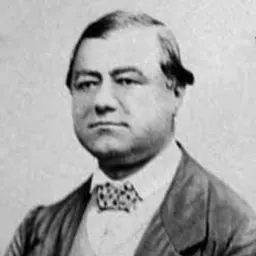
Adrian Constantine Anson (April 17, 1852 – April 14, 1922), nicknamed "Cap", "Pop", and, early in his career, "Baby" and "The Marshalltown Infant", was an American professional baseball player who played a record 27 consecutive major-league seasons. Anson was regarded as one of the greatest players of his era and one of the first superstars of the game. He spent most of his career with the National League's Chicago franchise, serving as the club's manager, first baseman and, later in his tenure, minority owner. He led the team to six pennants from 1876 to 1886. Anson was one of baseball's first great hitters, and probably the first to tally over 3,000 career hits. In addition to being a star player, he innovated managerial tactics such as signals between players and the rotation of pitchers.
Anson played a role in establishing the racial segregation in professional baseball that persisted until the late 1940s. On several occasions, Anson refused to take the field when the opposing roster included black players. His demands may have been cited as representative of player attitudes by team owners of the International League when they voted on July 14, 1887 to ban the signing of new contracts with black players.
After retiring as a player, Anson briefly managed the New York Giants. He ran several enterprises in Chicago, including opening a billiards and bowling hall and running a semi-professional baseball team he dubbed "Anson's Colts". Anson also toured extensively on the vaudeville circuit, performing monologues and songs. Many of his business ventures failed. As a result, Anson lost his ownership stake in the Chicago franchise and filed for bankruptcy. In 1939, Anson was inducted into the National Baseball Hall of Fame.
Early life Anson was born in Marshalltown, Iowa. His time away did little to discipline him. Soon after he returned home, his father sent him to the University of Iowa, where his bad behavior resulted in the school asking him to leave after one semester. While playing there, he gained the nickname "The Marshalltown Infant", because of his youth.
When the Rockford club folded at the end of the 1871 season, Anson signed with the Philadelphia Athletics. His numbers declined slightly in 1874 and 1875, but he was still good enough that Chicago White Stockings secretary-turned-president William Hulbert sought him to improve his club for the 1876 season. Hulbert broke league rules by negotiating with Anson and several other stars while the 1875 season was still in progress, and ultimately founded the new National League to forestall any disciplinary action.
Anson, who had become engaged to a Philadelphia native in the meantime, had second thoughts about going west, but Hulbert held Anson to his contract and he eventually warmed to the Windy City.
Chicago White Stockings/Colts
The White Stockings won the first league title, but fell off the pace the following two seasons. During this time, Anson was a solid hitter, but not quite a superstar. Both his fortunes and those of his team would change after Anson was named captain-manager of the club in 1879.
His new role led to the nickname "Cap", along with variants such as (Anson's) White Colts and (Anson's) Broncos. When Blue Stockings Manager Charlie Morton told Anson the White Stockings would forfeit the gate receipts if they refused to play, Anson backed down, but not before uttering the word nigger on the field and vowing that his team would not play in such a game again.
In 1884, Chicago again played an exhibition game at Toledo, which was then in the American Association, a major league. Walker sat it out, however, it is uncertain whether he did so to placate Chicago or due to injury; Jimmy McGuire instead did the catching. Both had sore hands, the Toledo Blade had said a few days earlier. Of the two catchers, Walker was seemingly the more injured, as he did not play in Toledo's second-most recent game. Among Anson's incidents, this one is unique in that private correspondence provides insight. Three months before the game, Chicago Treasurer-Secretary John A. Brown wrote Toledo manager Charlie Morton that "the management of the Chicago Ball Club have no personal feeling about the matter," while "the players do most decisively object and to preserve harmony in the club it is necessary that I have your assurance in writing that [Walker] will not play any position in your nine July 25. I have no doubt such is your meaning[;] only your letter does not express in full. I have no desire to replay the occurrence of last season and must have your guarantee to that effort."
Walker and his brother Welday were released from Toledo later that year. On July 14, 1887, the Chicago White Stockings played an exhibition game against the Newark Little Giants. African American George Stovey was listed in the Newark News as the scheduled Newark starting pitcher. Anson objected, and Stovey did not pitch. Moreover, International League owners had voted 6-to-4 at a 10 a.m. to 1 p.m. meeting in Buffalo on the morning of the game to exclude African-American players from future contracts.
Personal character
Anson was authoritarian as a manager, marching his players onto the field in military formation and banning alcohol consumption during the playing season.
On corruption in sports, he said the following in 1891: "The time may have been, and probably was, when base-ball was as rotten as horse racing, but that time has gone by. The men in control of base-ball matters are of the highest personal character, and no one will say anything against them. As to the charges against any individual player, I will believe them when they have been proved. Every thing [sic] possible has been done to protect the patrons of the National game, and efforts in that direction will never be abated. I don’t know of any crookedness in the ball field. If I did I’d undoubtedly say something about it."
A chronological review of 162 reports of bets on regular season baseball by players, managers or club officials, from 1876 to 1900, tallied the sport's top bettors in that era as follows:
1. Anson (57), Chicago's captain-manager; Hall of Famer 2. (tie) Jim Mutrie (9), mainly as manager of the New York Giants, and his bets were mostly with Anson 2. Edward Talcott (9), millionaire stockbroker as treasurer of the New York Giants 4. (tie) King Kelly (7), mainly as Boston's captain; Hall of Famer 4. Frank Robison (7), Cleveland Spiders owner
Albert Spalding and James Hart Anson first met Albert Spalding while both were players; Spalding was a pitcher for the Rockford Forest Citys, Anson played for the Marshalltown, Iowa, team. Neither the Macmillan Encyclopedia editions nor a 1969 special baseball rules committee recognized the National Association as being a major league. This places Anson 30th on MLB.com's all-time list.
Other sources credit Anson with a different number of hits, largely because scoring and record keeping was haphazard in baseball until well into the 20th century.
Beginning with the publication of the Baseball Encyclopedia, statisticians have continually found errors and have adjusted career totals accordingly. According to the Sporting News baseball record book, which does not take National Association statistics into account, Anson had 3,012 hits over his career. Baseball Reference also credits Anson with 3,012 hits during his National League career; including his time in the NA, Anson is credited with 3,435 hits. This figure disregards games played in the NA, but includes the walks earned during 1887 as hits.
Retirement Anson briefly made a return to baseball managing the New York Giants in June and July 1898.
After a number of failed business attempts, including a handball arena and bottled ginger beer that exploded on store shelves, Despite the traction issue being the predominant issue of the day in the city's politics, Anson instead centered his campaign on the nativist and racist assertion that "race suicide" was occurring with demographic shifts in the United States due to an increased number of Catholic immigrants from places such as Ireland and Italy. As a candidate, Anson benefited from strong name recognition owing to his sports celebrity. During his tenure, one of Anson's billiards hall generated controversy for Anson's failure to pay license fees on pool tables. Anson would appear before the Chicago City Council to unsuccessfully lobby them to reduce such fees. After serving one term as city clerk, he failed in the Democratic primary to become Cook County sheriff in 1907.
In 1907, Anson made another attempt to come back to baseball, acquiring a semi-pro team in the Chicago City League, which he would call "Anson's Colts". He also played himself in an 1895 Broadway play called The Runaway Colt, written to take advantage of his fame.
Anson retired from vaudeville in 1921, and continued to refuse a pension from the National League, despite having no other income. He was interred at Oak Woods Cemetery in Chicago.
Legacy Anson was inducted into the Baseball Hall of Fame in 1939, one of the first 19th century players selected. Over 100 years after his retirement, he still holds several Cubs franchise records, including most career runs batted in, runs, hits, singles, and doubles. Defensively, he also holds the franchise record for putouts, but also is second in franchise history for errors. Anson still holds the major-league record for most seasons played (27), although Nolan Ryan equaled it in 1993.
Anson won 1,282 games with Chicago as a manager and remains the franchise's all-time leader in wins. He was the second manager to reach 1,000 wins, after Harry Wright. Just 24 other major-league managers have won 1,000 games with one team.
In a 1992 episode of The Simpsons, "Homer at the Bat", Anson was suggested by Mr. Burns as one of the ringers for his softball team, before being informed that he was long since deceased.
Personal life In 1872, the 20-year-old Anson met 13-year-old Virginia Fiegel, the daughter of a Philadelphia bar and restaurant owner. The couple got married on November 21, 1876; the marriage lasted until her death in 1916. For the first seven years of their marriage, the couple lived in Chicago during the baseball season and Philadelphia during the off-season, but eventually moved to Chicago on a year-round basis.
The Ansons had seven children, three of whom died in infancy. Daughter Grace was born in October 1877; son Adrian Hulbert was born in 1882 and died four days later; daughter Adele was born in April 1884; son Adrian Constantine, Jr. was born in 1887 and died four months later; daughter Dorothy was born in 1889; son John Henry was born in 1892 and died four days later; and daughter Virginia Jeanette was born in 1899.
Don’t just read it —
keep it.
Full-length biographies made to live with: read them, listen on the way to work, watch them tonight.
- E-book
- Audio
- Video
Instant download · yours to keep · every purchase keeps this site free
Important facts
People in Cap Anson's life
Named in this biography and alive at the same time





Related people
Same field, nearest in time

Contemporaries
People whose lives overlapped Cap Anson's

Frequently asked questions
Who was Cap Anson?
American baseball player (1852–1922)
When was Cap Anson born?
Cap Anson was born on 17 April 1852 in Marshalltown.
When did Cap Anson die?
Cap Anson died on 14 April 1922 in Chicago.
What was Cap Anson's occupation?
Cap Anson was a baseball player.
What nationality was Cap Anson?
Cap Anson was American.
Sources & further reading
Cite this page
APA: Biography.guide. (2026). Cap Anson. https://biography.guide/cap-anson/
MLA: "Cap Anson." Biography.guide, https://biography.guide/cap-anson/.
Chicago: "Cap Anson." Biography.guide. https://biography.guide/cap-anson/.
Data last updated: 2026-09-20 · Spot an error? Report a correction.
Page generated 2026-09-27 05:24 UTC