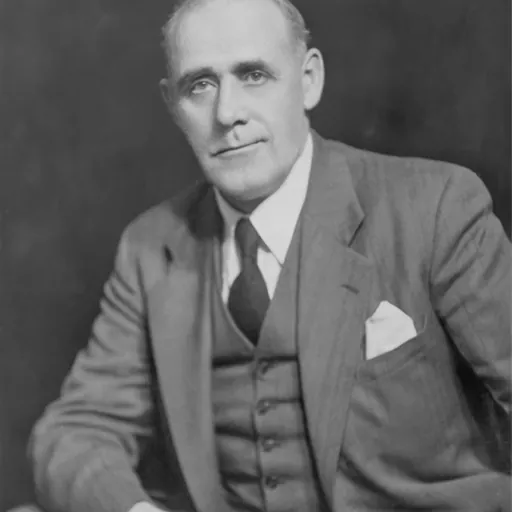
About Clarence Gillis
Lived 1895 – 1960 (aged 65). Clarence Gillis was a Canadian politician, miner and labor leader.
Clarence (Clarie) Gillis (October 3, 1895 – December 17, 1960) was a Canadian social democratic politician and trade unionist from Cape Breton Island, Nova Scotia. He was born on Nova Scotia's mainland but grew up in Cape Breton. He worked in the island's underground coal mines operated by the British Empire Steel and Coal Company (BESCO). He also served as a member of the infantry in the Canadian Corps in Flanders during the First World War. After the war, he returned to the coal mines and became an official with the mine's United Mine Workers of America (UMW) union. In 1938, he helped bring UMW Local 26 into the Co-operative Commonwealth Federation (CCF), becoming the first labour local to affiliate with the party. In 1940, he became the first CCF member elected to the House of Commons of Canada, east of Manitoba. While serving in the House, he was known as its leading voice championing labour issues. He was also a main voice for social rights during his 17 years in Parliament. His most notable achievement was securing the funding that allowed the building of a fixed link between Nova Scotia's mainland and Cape Breton Island at the Strait of Canso: the Canso Causeway. After winning four straight elections, he was defeated in 1957 and died three years later in Glace Bay, Nova Scotia.
Early life and World War I service Clarence Gillis was born on the Nova Scotia mainland, in the town of Londonderry, in 1895. His father, J.H. Gillis, relocated the family to the Industrial Cape Breton region in 1904. J.H. Gillis was employed in the coal mines and was an associate of union leader J. B. McLachlan. The following year, he enlisted in the Canadian Corps and progressed from private to acting lieutenant. He sustained a head injury from shrapnel during the Battle of Flanders. As Gillis pointed out in the House of Commons, Cape Breton miners had amongst the highest enlistment rates in Canada, and their families were needy, not just for butter, but just about every kind of basic food-stuff. Parliamentarians started attacking the American Congress of Industrial Organizations (CIO), which the CCL was affiliated with, and claiming that its union members were hurting the war effort. Federal Co-operative Commonwealth Federation (CCF) delegation attending the September 1944 Conference of Commonwealth Labour Parties in London, England. Pictured from Left to right: Clarie Gillis, MP for Cape Breton South; David Lewis, National Secretary; M.J. Coldwell, National Leader, MP for Rosetown—Biggar; Percy E. Wright, MP for Melfort; and Frank Scott, National Chairman. His defence of Japanese Canadians arose out of the July 1944 debate on whether to allow them to vote. After questioning from prime minister William Lyon Mackenzie King, Gillis pointed out that the CCF's official position is that all Canadians, especially those born in Canada, should have the full rights of that citizenship and have the franchise to vote. In the end, the Liberal government ignored the CCF's pleas and passed a law to restrict voting for Japanese Canadians.
One of his most notable achievements while in Parliament, was getting federal government funding to build the Canso Causeway to bridge mainland Nova Scotia to Cape Breton Island. The causeway was opened on August 13, 1955, and Gillis was part of the opening ceremonies, though his part was downplayed in the media at the time, as recently deceased former Nova Scotia premier Angus L. MacDonald was given most of the credit.
Personal life and death He failed to get re-elected in the general election of 1957. He ran for parliament for the last time in 1958, the year of the Diefenbaker-Sweep, and lost the election. He retired from politics after this defeat. His first wife, Maime Gillis, née Stewart, died in 1953. He married his second wife, Theresa Sargeant in 1958. He died of pleurisy, in the Glace Bay Hospital, on December 17, 1960, in Cape Breton.
Election results
Don’t just read it —
keep it.
Full-length biographies made to live with: read them, listen on the way to work, watch them tonight.
- E-book
- Audio
- Video
Instant download · yours to keep · every purchase keeps this site free
Important facts
People in Clarence Gillis's life
Named in this biography and alive at the same time

Related people
Same field, nearest in time






Contemporaries
People whose lives overlapped Clarence Gillis's

Frequently asked questions
Who was Clarence Gillis?
former Canadian Politician
When was Clarence Gillis born?
Clarence Gillis was born on 3 October 1895 in Londonderry.
When did Clarence Gillis die?
Clarence Gillis died on 17 December 1960 in Glace Bay.
What was Clarence Gillis's occupation?
Clarence Gillis was a politician, miner and labor leader.
What nationality was Clarence Gillis?
Clarence Gillis was Canadian.
Sources & further reading
Cite this page
APA: Biography.guide. (2026). Clarence Gillis. https://biography.guide/clarence-gillis/
MLA: "Clarence Gillis." Biography.guide, https://biography.guide/clarence-gillis/.
Chicago: "Clarence Gillis." Biography.guide. https://biography.guide/clarence-gillis/.
Data last updated: 2026-09-21 · Spot an error? Report a correction.
Portrait: Wikimedia Commons · author & licence
Page generated 2026-09-27 04:59 UTC