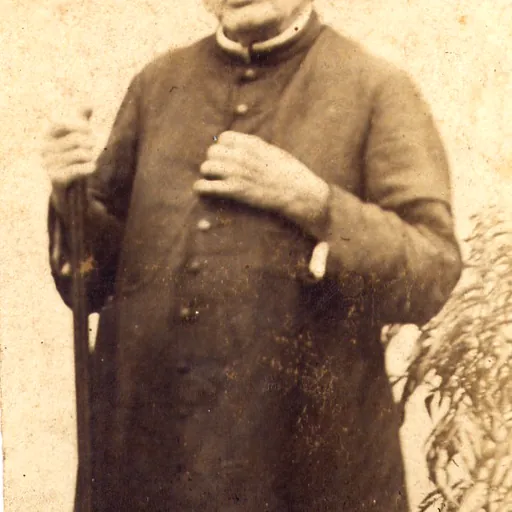
About Cícero Romão Batista
Lived 1844 – 1934 (aged 90). Cícero Romão Batista was a Brazilian catholic priest, teacher and politician.
Cícero Romão Batista (24 March 1844 – 20 July 1934), also known as Padre Cícero (Father Cícero), was a Brazilian Catholic priest who became a spiritual leader to the people of Northeastern Brazil.
Batista has been declared a saint by the Brazilian Catholic Apostolic Church. He placed 32nd in The Greatest Brazilian of All Time, a nationwide public poll conducted in 2012.
Despite many conflicts with the Church hierarchy during his life, official reconciliation with the Catholic Church occurred in December 2015. The beatification process was opened on August 20, 2022 after the Dicastery for the Causes of Saints issued the official "nihil obstat" (no objections to the cause) edict and titled him as a servant of God.
Career Batista was actively involved in the politics of his time and was a member of the Conservative Republican Party of Brazil. When Juazeiro was raised to the status of a municipality in 1911, he was appointed its first mayor. He governed the city in this capacity for most of the next twenty years. In 1926 he was elected federal deputy, but he did not take office. On October 4, 1911, he and sixteen other political leaders from the region met in Juazeiro and signed a mutual cooperation agreement, as well as a commitment to support Governor Antônio Pinto Nogueira Accioli. The meeting was nicknamed the Pact of Colonels, being considered an important passage in the history of Brazilian coronelismo.
In 1913, he was removed from office by Governor Marcos Franco Rabelo, returning to power in 1914, when Franco Rabelo was deposed in the event that became known as the Juazeiro Sedition. He was also elected vice-governor of Ceará, in the Government of General Benjamin Liberato Barroso.
At the end of the 1920s, Batista to lose his political strength, which practically ended after the Revolution of 1930. His prestige as a miracle worker however, would increase even more.
Despite some attempts to relate Batista to communism and, much later, to liberation theology, he was deeply anti-communist. In an interview given in 1931, he stated: "Communism was started by the Devil. Lucifer is his name and the dissemination of his doctrine is the war of the Devil against God. I know communism and I know that it's evil. It's the continuation of the war of the fallen angels against the Creator and His children."
In the course of his ministry, he was accused of heresy by Catholic Church officials, eventually becoming suspended but not formally excommunicated.
Legacy Statue of Padre Cícero, erected in the city of Juazeiro do Norte, the motto of which is "The Land of Padre Cícero" Today, a large statue of Batista stands in Juazeiro do Norte, where he is considered to be the patron saint of the city. A pilgrimage to this statue takes place in his honour every November, attracting hundreds of thousands of followers.
Batista was canonized by the Brazilian Catholic Apostolic Church, an Independent Catholic church. He is not recognized as a saint by the Catholic Church, though Pope Benedict XVI proposed a study on Batista as a candidate for canonization.
On 13 December 2015, as part of the opening ceremonies of the Holy Year proclaimed by Pope Francis, the Bishop of Crato, Fernando Panico, declared the rehabilitation of Batista's status with the Catholic Church. He further declared Batista to have been a man of extraordinary virtues, formally reconciling him with the church.
Beatification process On August 20, 2022, during a Mass held in Largo da Capela do Socorro, in Juazeiro do Norte, the bishop of the Diocese of Crato, , announced that he had received a letter from the Dicastery for the Causes of Saints, the Vatican body responsible for beatification and canonization processes, informing about the authorization of Pope Francis for the opening of the beatification process of Batista.
Don’t just read it —
keep it.
Full-length biographies made to live with: read them, listen on the way to work, watch them tonight.
- E-book
- Audio
- Video
Instant download · yours to keep · every purchase keeps this site free
Important facts
Related people
Same field, nearest in time

Contemporaries
People whose lives overlapped Cícero Romão Batista's

Frequently asked questions
Who was Cícero Romão Batista?
Brazilian saint (1844-1934)
When was Cícero Romão Batista born?
Cícero Romão Batista was born on 24 March 1844 in Crato.
When did Cícero Romão Batista die?
Cícero Romão Batista died on 20 July 1934 in Juazeiro do Norte.
What was Cícero Romão Batista's occupation?
Cícero Romão Batista was a catholic priest, teacher and politician.
What nationality was Cícero Romão Batista?
Cícero Romão Batista was Brazilian.
Sources & further reading
· Wikipedia: Cícero Romão Batista
Cite this page
APA: Biography.guide. (2026). Cícero Romão Batista. https://biography.guide/cicero-romao-batista/
MLA: "Cícero Romão Batista." Biography.guide, https://biography.guide/cicero-romao-batista/.
Chicago: "Cícero Romão Batista." Biography.guide. https://biography.guide/cicero-romao-batista/.
Data last updated: 2026-09-22 · Spot an error? Report a correction.
Portrait: Wikimedia Commons · author & licence
Page generated 2026-09-27 05:04 UTC