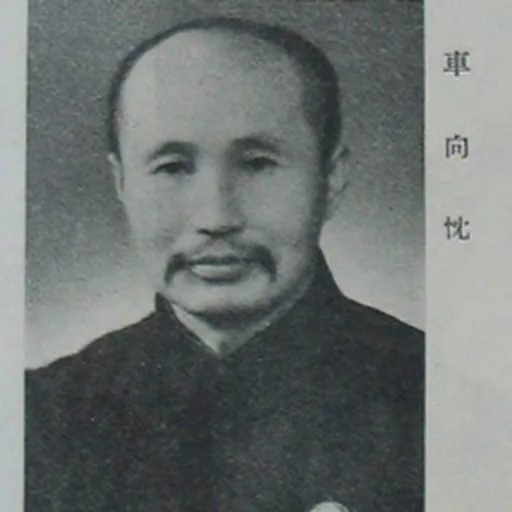
About Che Xiangchen
Lived 1898 – 1971 (aged 72). Che Xiangchen was a Chinese politician.
Che Xiangchen (; 7 May 1898 – 8 January 1971), courtesy name Xiangchen and originally named Che Qinghe , was a Chinese educator and social activist from Faku County, Liaoning. He was widely recognized for his contributions to popular education and his involvement in anti-Japanese resistance movements in Northeast China.
Biography Che Xiangchen was born on 7 May 1898, into a relatively well-off and progressive family in Faku County, Liaoning. His early life was shaped by his father's public-minded efforts, including the sale of family property to fund the construction of dikes along the Liao River to prevent flooding, an act that earned local admiration. He received a traditional education in private schools before enrolling in Faku County Middle School and later studying at a preparatory program of Peking University. He was initially admitted to the law program at China University but soon transferred to the philosophy department, driven by his belief in saving the nation through education.
During the May Fourth Movement in 1919, Che participated in student protests and was arrested for his involvement in the burning of the Zhao family residence, though he was later released following public pressure. While studying, he began organizing night schools for workers, marking the start of his lifelong commitment to popular education. In 1923, he published Breaking Superstition, advocating democracy and science.
After graduating in 1925, Che returned to Shenyang, where he taught at institutions including the affiliated middle school of Northeastern University and Fengtian Provincial First High School. At the same time, he established schools for underprivileged children and expanded popular education initiatives, founding organizations such as the Fengtian Student Popular Service Corps and the Fengtian Association for the Promotion of Popular Education. With support from Zhang Xueliang, these efforts led to the establishment of numerous schools across Liaoning Province, serving thousands of students.
In the late 1920s, Che became active in anti-Japanese movements, organizing civic groups that promoted the use of domestic goods and opposed Japanese economic and political influence. Following the Mukden Incident in 1931, he moved to Beijing and co-founded the Northeast National Salvation Association, where he took on leadership roles in propaganda and organization. He undertook multiple missions into Japanese-occupied territories, establishing contact with resistance leaders such as Ma Zhanshan and Yang Jingyu, delivering communications, and coordinating anti-Japanese activities.
Throughout the 1930s, Che remained engaged in resistance and educational work. He supported the formation of the Second United Front and helped establish schools for displaced youth in Xi'an. During this period, he worked closely with figures such as Zhang Xueliang and Yang Hucheng, advocating cooperation against Japanese aggression. He was briefly arrested by Nationalist authorities but was released after intervention from various parties.
After 1945, Che returned to Northeast China and assumed leadership roles in education under the new political order. He served as Vice Chairman of the Nenjiang Provincial People's Government and later held positions including head of the Education Committee of the Northeast Administrative Commission and president of Harbin University. He joined the Chinese Communist Party in 1946 and played a key role in restructuring education in the region.
Following the establishment of the People's Republic of China in 1949, Che held several important positions, including vice governor of Liaoning Province and Vice Chairman of the Liaoning Provincial Committee of the Chinese People's Political Consultative Conference. He also served as a member of the Standing Committee of the National Committee of the Chinese People's Political Consultative Conference and as Vice Chairman of the China Association for Promoting Democracy. In addition, he was elected as a deputy to the first three National People's Congresses.
During the Cultural Revolution, Che Xiangchen was persecuted and died under unjust circumstances on 8 January 1971, in Panjin at the age of 73. He was posthumously rehabilitated in 1978, and his membership in the Chinese Communist Party was publicly confirmed in 1979.
Che devoted his life to education, advocating democratic, scientific, and mass-oriented educational principles. He emphasized the integration of education with practical work, production, and social development. His book How to Educate the New Generation (1959) outlined his educational philosophy, stressing persuasion, moral education, and cooperation among schools, families, and society. He also played a significant role in establishing regional branches of the China Association for Promoting Democracy in Northeast China.
Don’t just read it —
keep it.
Full-length biographies made to live with: read them, listen on the way to work, watch them tonight.
- E-book
- Audio
- Video
Instant download · yours to keep · every purchase keeps this site free
Important facts
People in Che Xiangchen's life
Named in this biography and alive at the same time



Related people
Same field, nearest in time






Contemporaries
People whose lives overlapped Che Xiangchen's





Frequently asked questions
Who was Che Xiangchen?
Chinese politician
When was Che Xiangchen born?
Che Xiangchen was born on 7 May 1898.
When did Che Xiangchen die?
Che Xiangchen died on 8 January 1971.
What was Che Xiangchen's occupation?
Che Xiangchen was a politician.
What nationality was Che Xiangchen?
Che Xiangchen was Chinese.
Sources & further reading
Cite this page
APA: Biography.guide. (2026). Che Xiangchen. https://biography.guide/che-xiangchen/
MLA: "Che Xiangchen." Biography.guide, https://biography.guide/che-xiangchen/.
Chicago: "Che Xiangchen." Biography.guide. https://biography.guide/che-xiangchen/.
Data last updated: 2026-09-20 · Spot an error? Report a correction.
Portrait: Wikimedia Commons · author & licence
Page generated 2026-09-27 04:58 UTC