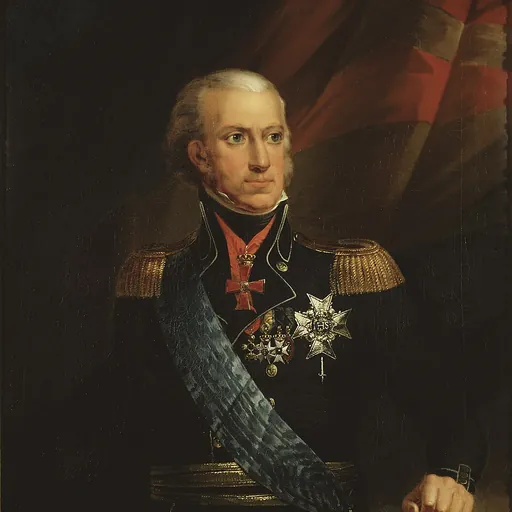
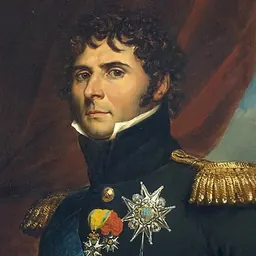
About Charles XIII of Sweden
Lived 1748 – 1818 (aged 69). Charles XIII of Sweden was a Swedish monarch.
Charles XIII or Carl XIII (; 7 October 1748 – 5 February 1818) was King of Sweden from 1809 and King of Norway from 1814 to his death. In Norway, he is known as Charles II. He was the second son (and younger brother to King Gustav III) of King Adolf Frederick of Sweden and Louisa Ulrika of Prussia, sister of Frederick the Great.
Early life
Prince Charles was placed under the tutelage of Hedvig Elisabet Strömfelt and then Ulrica Schönström. He was appointed grand admiral when he was but few days old. He was described as a good dancer at the amateur theatre of the royal court. Reportedly he was not very close to his mother. The Queen preferred her youngest children, Sophie Albertine and Frederick Adolf.
Charles was, however, his father's favorite, and similar to him in personality. He was also described as close to his brother Gustav during their childhood. His numerous affairs gave him the reputation of being a libertine.
Prince Charles in his princely attire for his brother Gustav III's coronation in 1772. His coronet can be seen on the left.thumb Medal issued when Charles married his cousin Hedwig Elizabeth Charlotte of Holstein-Gottorp in 1774.The Duke was known for his interest in the supernatural and mysticism, and he was engaged in several secret societies. He was a member of the Freemasons. He was reportedly a client of the fortune teller Ulrica Arfvidsson, and he also favored the medium Henrik Gustaf Ulfvenklou. In 1811, he founded the Order of Charles XIII, a Swedish order of chivalry awarded only to a maximum number of 33 knights, on the condition of confessing the Lutheran Evangelic Religion and being Freemasons. All Princes and Kings of the Bernadotte dynasty, the royal house of Sweden are from baptism, incorporate parts of the royal order of knights and freemasons. In addition are the order of merit granted to members of foreign Grand Lodges affiliated to the so-called Swedish System, such as the Grande Loge Nationale Française, if of royal rank. When the Swedish order of Freemason's states that "Freemasonry in Sweden has continued to develop under leadership of their Grand Masters, all of them belonging to the Royal House since more than 200 years", the origin of which arrives in large from King Charles II of Norway, XIII of Sweden.
Duke Charles was given several political tasks during his tenure as a duke. In 1777, he served as regent during Gustav III's stay in Russia. In 1780, he served as formal chief commander during the king's stay in Spa. The same year, Gustav III named him regent for his son should he succeed him while still a minor. This however never materialized. Duke Charles as admiral of the Swedish fleet, by Giovanni Battista Lampi the Elder, 1799. On the outbreak of the Russo-Swedish War of 1788 he served with distinction as admiral of the fleet, especially at the battles of Hogland (7 June 1788) and Öland (26 July 1789). On the latter occasion he would have won a signal victory but for the remissness of his second-in-command, Admiral Liljehorn.
The autumn of 1789, Duchess Hedvig Elisabeth Charlotte wished to depose Gustav III and place her husband Duke Charles upon the throne. Her ideal was the Swedish Constitution of 1772, which she saw as a good tool for an enlightened aristocracy, and the war and the Union and Security Act had made her a leading part of the opposition. She cooperated with Prince Frederick Adolf of Sweden and Gustaf Adolf Reuterholm.
Reign of Gustav IV Adolf On the assassination of Gustav III in 1792, Charles acted as regent of Sweden until 1796 on behalf of his nephew, King Gustav IV, who was a minor when his father was shot in the Stockholm opera. Gustav III had designated him regent in his earlier will. When he was dying, he altered the will, and while still appointing Charles regent of his minor son, he was no longer to rule absolute, but restricted by a government consisted of the supporters of Gustav III. In 1808, Charles was again chief commander during Gustav IV Adolf's stay in Finland. He is presumed to have been, if not involved, aware of the plans to depose Gustav IV Adolf in 1809.
Charles was the 872nd Knight of the Order of the Golden Fleece in Spain.
Family He married his 15-year-old cousin, Princess Hedwig Elizabeth Charlotte of Holstein-Gottorp (1759–1818), on 7 July 1774 in Stockholm. They had two children who died in infancy:
Stillborn daughter (2 July 1797) Carl Adolf, Duke of Värmland (Stockholm, 4 July 1798 – Stockholm, 10 July 1798). Lived six days; buried at Riddarholm Church.
With Augusta von Fersen, he had an extramarital son:
Carl Axel Löwenhielm (1772–1861)
Adopted sons: Charles August, Crown Prince of Sweden Charles XIV John of Sweden
Honours and arms Honours Sweden: Knight of the Order of the Seraphim, 7 October 1748 Commander Grand Cross of the Order of the Sword, 7 October 1748; Grand Cross, 1st Class, 27 July 1788 Commander Grand Cross of the Order of the Polar Star, 7 October 1748 Commander Grand Cross of the Order of Vasa, 7 October 1748 Founder of the Order of Charles XIII, 27 May 1811 Kingdom of Prussia: Knight of the Order of the Black Eagle, 18 October 1770 Knight of the Order of St. Andrew, 28 August 1796 Knight of the Order of St. Alexander Nevsky, 28 August 1796 Knight of the Order of the Elephant, 10 February 1810 Spain: Knight of the Order of the Golden Fleece, 23 September 1814
Arms
Ancestors
Don’t just read it —
keep it.
Full-length biographies made to live with: read them, listen on the way to work, watch them tonight.
- E-book
- Audio
- Video
Instant download · yours to keep · every purchase keeps this site free
Important facts
Family & relationships
People in Charles XIII of Sweden's life
Named in this biography and alive at the same time



Related people
Same field, nearest in time



Contemporaries
People whose lives overlapped Charles XIII of Sweden's





Frequently asked questions
Who was Charles XIII of Sweden?
King of Sweden (1809-1818) and King of Norway (1814-1818)
When was Charles XIII of Sweden born?
Charles XIII of Sweden was born on 7 October 1748 in Stockholm.
When did Charles XIII of Sweden die?
Charles XIII of Sweden died on 5 February 1818 in Stockholm, The Royal Court Parish.
What was Charles XIII of Sweden's occupation?
Charles XIII of Sweden was a monarch.
What nationality was Charles XIII of Sweden?
Charles XIII of Sweden was Swedish.
Sources & further reading
· Wikipedia: Charles XIII of Sweden
Cite this page
APA: Biography.guide. (2026). Charles XIII of Sweden. https://biography.guide/charles-xiii-of-sweden/
MLA: "Charles XIII of Sweden." Biography.guide, https://biography.guide/charles-xiii-of-sweden/.
Chicago: "Charles XIII of Sweden." Biography.guide. https://biography.guide/charles-xiii-of-sweden/.
Data last updated: 2026-09-20 · Spot an error? Report a correction.
Portrait: Wikimedia Commons · author & licence
Page generated 2026-09-27 05:19 UTC