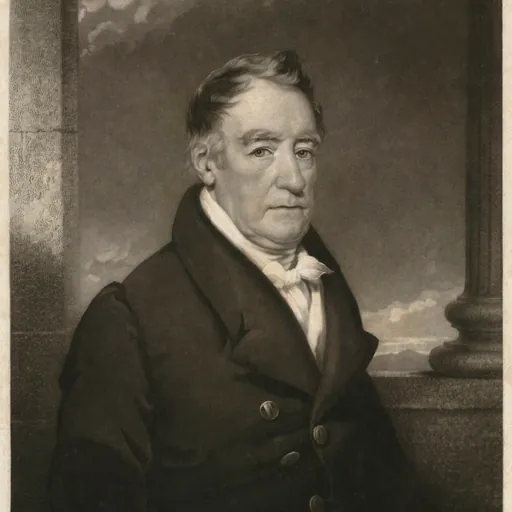
About Charles Wilkins
Lived 1749 – 1836 (aged 86–87). Charles Wilkins was a British translator, orientalist, writer, literary scholar and oriental studies.
Sir Charles Wilkins (1749 – 13 May 1836) was an English typographer and scholar who co-founded The Asiatic Society. He is notable as the first translator of the Bhagavad Gita into English. He supervised Panchanan Karmakar to create one of the first Bengali typefaces. In 1788, Wilkins was elected a member of the Royal Society.
Birth and childhood He was born at Frome in Somerset in 1749. He trained as a printer. In 1770, he went to India as a printer and writer in the East India Company's service. His facility with language allowed him to quickly learn Persian and Bengali. He created with his own hands the first type for printing Bengali. He published the first typeset book in the language, earning himself the name "the Caxton of India". He also designed type for publications of books in Persian. In 1781, he was appointed as translator of Persian and Bengali to the Commissioner of Revenue and as superintendent of the company's press. He successfully translated a Royal inscription in Kutila characters, which were thitherto indecipherable.
In 1784, Wilkins helped William Jones establish the Asiatic Society of Bengal.
Work Wilkins moved to Benares (Varanasi), where he studied Sanskrit under Kalinatha, a Brahmin pandit. At this period he began work on his translation of the Mahabharata, securing strong support for his activities from the governor of British India, Warren Hastings. Though he never completed the translation, portions were later published. The most important was his version of the Gita, published in 1785 as 'Bhagvat-geeta', or Dialogues of Krishna and Arjun (London: Nourse, 1785). In his preface Wilkins argued that the Gita was written to encourage a form of monotheist "unitarianism" and to draw Hinduism away from the polytheism he ascribed to the Vedas. He had a hobby to learn about other religions. He was also a scholar of Islam. He stayed in India for 16 years (1770–1786). He also made visits to holy shrines of other religions to learn about their customs. During a visit to Varanasi, he made a stop at Patna, and visited Patna Sahib Gurudwara, the birthplace of Guru Gobind Singh Ji. He wrote his account of this visit titled as 'Sikhs and their College at Patna'. He writes about Dasam Granth there and notes in this article. Meanwhile, inscriptions of the 6th century CE in late Brahmi script were deciphered in 1785 by Charles Wilkins, who published an essentially correct translation of the Gopika Cave Inscription written by the Maukhari king Anantavarman. In 1801 he became librarian to the East India Company, He was named examiner at Haileybury when a college was established there in 1805. During these years he devoted himself to the creation of a font for Devanagari, the "divine script". In 1808 he published his Grammar of the Sanskrita Language. King George IV gave him the badge of the Royal Guelphic Order and he was knighted in recognition of his services to Oriental scholarship in 1833. He also published a catalogue of the manuscripts collected by Sir William Jones, who acknowledged his indebtedness to Wilkins.
Publications
The Seeks and their College at Patna (1781) by Charles Wilkins, published within: Asiatic Researches: Or, Transactions of the Society Instituted in Bengal, for Enquiry Into the History and Antiquities, the Arts and Sciences, and Literature of Asia (Calcutta, India: Asiatick Society, Vol. I, 1788, pp. 288–294)
Don’t just read it —
keep it.
Full-length biographies made to live with: read them, listen on the way to work, watch them tonight.
- E-book
- Audio
- Video
Instant download · yours to keep · every purchase keeps this site free
Important facts
People in Charles Wilkins's life
Named in this biography and alive at the same time

Related people
Same field, nearest in time



Contemporaries
People whose lives overlapped Charles Wilkins's




Frequently asked questions
Who was Charles Wilkins?
British orientalist and typographer
When was Charles Wilkins born?
Charles Wilkins was born in 1749 in Frome.
When did Charles Wilkins die?
Charles Wilkins died on 13 May 1836 in Greater London.
What was Charles Wilkins's occupation?
Charles Wilkins was a translator, orientalist, writer, literary scholar and oriental studies.
What nationality was Charles Wilkins?
Charles Wilkins was British.
Sources & further reading
Cite this page
APA: Biography.guide. (2026). Charles Wilkins. https://biography.guide/charles-wilkins-translator/
MLA: "Charles Wilkins." Biography.guide, https://biography.guide/charles-wilkins-translator/.
Chicago: "Charles Wilkins." Biography.guide. https://biography.guide/charles-wilkins-translator/.
Data last updated: 2026-09-22 · Spot an error? Report a correction.
Page generated 2026-09-27 05:10 UTC