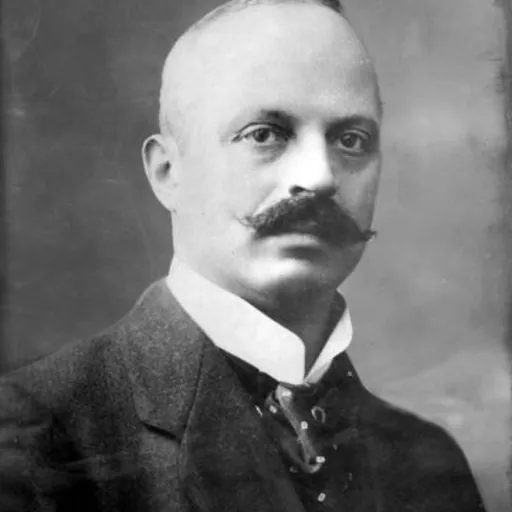
About Charles Ruijs de Beerenbrouck
Lived 1873 – 1936 (aged 62). Charles Ruijs de Beerenbrouck was a Dutch lawyer and politician.
Charles Joseph Marie Ruijs de Beerenbrouck (1 December 1873 – 17 April 1936) was a Dutch politician of the Roman Catholic State Party (RKSP). He served as Chairman of the Council of Ministers from 9 September 1918 until 4 August 1925 and from 10 August 1929 until 26 May 1933.
Early life Charles Joseph Maria Ruijs de Beerenbrouck was born on 1 December 1873 in Roermond, a town with a Bishop's see in the province of Limburg, in the very south of the Netherlands. Born into an aristocratic family, he grew up in a predominantly Catholic community and went to school in Maastricht and in The Hague. He attended the Utrecht University and in 1895, he obtained his master's degree in law at the Leiden University.
He was the son of Gustave Ruijs de Beerenbrouck (1842–1926), Minister of Justice in the Mackay cabinet (founder of the labour and social laws first) and later governor of Limburg (1918).
Career He started his career in 1896 as a lawyer in Maastricht. In 1899 Ruijs de Beerenbrouck became a member of the Maastricht municipal council and in 1905 he was elected to the House of Representatives. Ruijs de Beerenbrouck remained a councillor and a member of parliament until 16 May 1918, when he became Queen's Commissioner of the province of Limburg (in the province of Limburg usually called Gouverneur, or Governor).
Ruijs de Beerenbrouck did not stay in office as Queen's Commissioner for long, as on 9 September 1918 he was appointed as minister of the Interior and "temporary" Chairman of the Council of Ministers.
As Chairman of the Council of Ministers he had to deal with the aftermath of World War I. Although the Netherlands had remained neutral during the conflict, Ruijs de Beerenbrouck nevertheless faced several problems, particularly the return of German troops through the province of Limburg and the exile of the German emperor Wilhelm II.
In November 1918 the leader of the Social Democratic Workers' Party (SDAP), Pieter Jelles Troelstra, inspired by the Russian Revolution and the German Revolution of 1918–1919, called for a socialist revolution among the working class. However, the revolution attempt of Troelstra met with little enthusiasm. Despite this, the Ruijs de Beerenbrouck cabinet enacted several social reforms in order to satisfy the working class.
The Labour Act of November 1919, for example, introduced an eight-hour day, limited night work and provided for (as noted by one study) “establishment of a department of labor inspection.” Laws were passed in 1919 and 1921 that extended workmen’s compensation to additional groups, while in 1919 an Invalidity Act was passed which provided (as noted by one study) “life pensions for widows and pensions for orphans to their majority.” That same year, a Health Act was passed which set up a separate inspectorate for child health. The Old Age Pensions Act of November 1919 established voluntary old age insurance for self-employed persons, while the Pensions Act of May 1922 provided pensions for public servants, together with their widows and orphans.
In 1919, a High Council of Labour was set up that advised on issues related to workers and social security. The Unemployment Insurance Emergency Act of 1919 provided temporary support to municipal unemployment funds, while the Meat Inspection Act of 1919 sought to prevent the sale of meat and meat products that posed a risk to public health. In 1920, the coverage of family allowances was extended to the entire civil service, while a subsidy scheme was set up that same year to encourage the homebuilding by private individuals and institutions.
From 1925 to 1929 Ruijs de Beerenbrouck was Speaker of the House of Representatives.
During his third cabinet Ruijs de Beerenbrouck had to deal with the worldwide Great Depression of 1929 and the early 1930s, which had crippling effects on the Dutch economy, effects which lasted longer than they did in most European countries. The depression led to high unemployment and poverty, as well as increasing social unrest. Ruijs de Beerenbrouck was forced to cut government expenses and to devalue the national currency, the Guilder, but these measures only worsened the effects of the economic crisis.
In February 1933 the third Ruijs de Beerenbrouck cabinet ordered the bombing of the navy cruiser De Zeven Provinciën, when sailors aboard the cruiser, cruising near Sumatra, mutinied because of the cutting of their wages. Twenty three mutineers were killed, resulting in a prolonged controversy and recriminations.
In 1933 Ruijs de Beerenbrouck became Speaker of the House of Representatives again. He remained in office until his death.
Personal life On 15 April 1902, Ruijs de Beerenbrouck married Maria van der Heyden (19 August 1877 – 17 January 1948). Ruijs de Beerenbrouck died on 17 April 1936 at the age of 62 in Utrecht.
Decorations
Don’t just read it —
keep it.
Full-length biographies made to live with: read them, listen on the way to work, watch them tonight.
- E-book
- Audio
- Video
Instant download · yours to keep · every purchase keeps this site free
Important facts
more
Jhr. Mr. Charles Ruijs de Beerenbrouck, Heer van BeerenbrouckPeople in Charles Ruijs de Beerenbrouck's life
Named in this biography and alive at the same time
Related people
Same field, nearest in time

Contemporaries
People whose lives overlapped Charles Ruijs de Beerenbrouck's


Frequently asked questions
Who was Charles Ruijs de Beerenbrouck?
Dutch politician (1873-1936)
When was Charles Ruijs de Beerenbrouck born?
Charles Ruijs de Beerenbrouck was born on 1 December 1873 in Roermond.
When did Charles Ruijs de Beerenbrouck die?
Charles Ruijs de Beerenbrouck died on 17 April 1936 in Utrecht.
What was Charles Ruijs de Beerenbrouck's occupation?
Charles Ruijs de Beerenbrouck was a lawyer and politician.
What nationality was Charles Ruijs de Beerenbrouck?
Charles Ruijs de Beerenbrouck was Dutch.
Sources & further reading
· Wikipedia: Charles Ruijs de Beerenbrouck
· DBpedia: Charles Ruijs de Beerenbrouck
Cite this page
APA: Biography.guide. (2026). Charles Ruijs de Beerenbrouck. https://biography.guide/charles-ruijs-de-beerenbrouck/
MLA: "Charles Ruijs de Beerenbrouck." Biography.guide, https://biography.guide/charles-ruijs-de-beerenbrouck/.
Chicago: "Charles Ruijs de Beerenbrouck." Biography.guide. https://biography.guide/charles-ruijs-de-beerenbrouck/.
Data last updated: 2026-09-23 · Spot an error? Report a correction.
Portrait: Wikimedia Commons · author & licence
Page generated 2026-09-27 05:06 UTC