
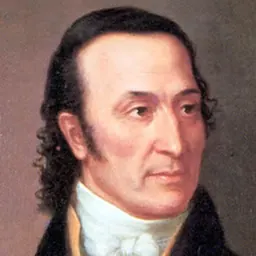
Charles Rinaldo Floyd
American military leader
About Charles Rinaldo Floyd
Lived 1797 – 1845 (aged 47).
Charles Rinaldo Floyd (October 14, 1797 – March 22, 1845) was an American planter, politician and military leader most famous for his leading the Trail of Tears out of Georgia and for his Okefenokee Campaign during the Second Seminole War. He wrote one of the first published accounts of the Okefenokee Swamp. His diary portrays elite planter life on the Georgia frontier.
Early and family life
Charles Rinaldo Floyd was born October 14, 1797, at "The Thickets" near Darien in McIntosh County, Georgia, to General John Floyd and Isabella Maria Hazzard. His grandfather, Captain Charles Floyd, served in the American Revolutionary War. His father, General John Floyd, served during the War of 1812 and the Creek Indian War.
When he was three years old the family moved to Camden County where they purchased large tracts of land located south of the Satilla River, north of the Crooked River and west of the marshes and the Cumberland River to what is now I-95. This area, farmed using enslaved labor, became known as "Floyd's Neck." General John Floyd built Bellevue Plantation within view of the marshes leading to Todd's Creek for his father, Charles. That manor house has an anchor-shaped footprint, to symbolize their fortunes provided by the sea. One mile distant, he built Fairfield Plantation overlooking Floyd's Basin and Floyd's Creek for himself. Charles Rinaldo Floyd spent his early childhood years in Camden County. He was educated at home by tutors and later went to boarding school in Beaufort, South Carolina. He attended Sunbury Academy in Sunbury, Georgia.
As discussed below, at age sixteen, Charles Rinaldo Floyd left Sunbury Academy to serve as a military aide to his father, General John Floyd, whose army at that time was entrenched at Fort Mitchell.
Early military, plantation and political careers At age sixteen, Charles Rinaldo Floyd left Sunbury Academy to serve as a military aide to his father, General John Floyd, whose army at that time was entrenched at Fort Mitchell. Autossee was an Indian town of the Creek Nation on the Tallapoosa River. The Georgia militia cut off escape routes, then completely destroyed and burned the town and slaughtered more than 200 Indians, including women and children. According to his Journal, in the frenzy of his first battle, a rifle ball grazed Charles' forehead and another passed through his coat sleeve.
In 1837, an altercation arose over cattle. A neighbor, Edward Stevens Hopkins, allowed his slaves to capture and kill Floyd's cows that had roamed onto his property and trampled his patches of peas. In his Journal, Charles Rinaldo Floyd labeled Hopkins as "the cow-thief" and "the enemy". The true reason for the confrontation was that Edward S. Hopkins announced his name for election as Major of the 8th Battalion, First Regiment, Georgia Militia. Floyd felt, that as Brigadier-General, he alone had the right to order such an election and he challenged Hopkins to a duel. Hopkins accepted under the Code Duello.
Second Seminole War and Okefenokee Campaign
Floyd was appointed brigadier general of the Georgia militia in October 1838 and ordered to meet five companies and chase a party of Seminoles out of the Okefenokee Swamp. The Indian refugees had been forced north during the Second Seminole Wars, and their presence caused anxiety and conflict in the south Georgia.
He wrote letters detailing his Okefenokee campaign to regional newspapers. The Savannah Georgian printed his first letter, and multiple newspapers reprinted it. He wrote that it was “a satisfaction to me to have performed what all other men have deemed impossible; to cross the Okefenokee with an army.”
However, Floyd was deeply disappointed the following year when the Georgia legislature appointed Peter Cone rather than himself as Major General of the state militia.
Retirement In April 1843 he sold 2,000 acres of land to fund his hobbies. He founded of the Camden County Hunting Club, and his racing boats were famous in the area. Canoes especially were a travel and sporting boat of choice in the area and they were manned by crews of strong slaves in races. He was a secretary of the Aquatic Club of Georgia, and in 1837 challenged New York boating clubs to a race. Floyd was also an avid collector of rare and antique weapons, and sometimes hunted with a medieval-style lance. thumb
Death and legacy Charles Rinaldo Floyd died on March 22, 1845, at his beloved Fairfield Plantation. It is now the only structure on Fairfield plantation.
During the American Civil War and First World War, the Macon Volunteers renamed themselves the "Floyd rifles" to honor this Floyd.
Don’t just read it —
keep it.
Full-length biographies made to live with: read them, listen on the way to work, watch them tonight.
- E-book
- Audio
- Video
Instant download · yours to keep · every purchase keeps this site free
Important facts
People in Charles Rinaldo Floyd's life
Named in this biography and alive at the same time


Contemporaries
People whose lives overlapped Charles Rinaldo Floyd's






Frequently asked questions
Who was Charles Rinaldo Floyd?
American military leader
When was Charles Rinaldo Floyd born?
Charles Rinaldo Floyd was born on 14 October 1797 in Darien.
When did Charles Rinaldo Floyd die?
Charles Rinaldo Floyd died on 22 March 1845 in Camden County, Georgia.
Sources & further reading
· Wikipedia: Charles Rinaldo Floyd
· DBpedia: Charles Rinaldo Floyd
Cite this page
APA: Biography.guide. (2026). Charles Rinaldo Floyd. https://biography.guide/charles-rinaldo-floyd/
MLA: "Charles Rinaldo Floyd." Biography.guide, https://biography.guide/charles-rinaldo-floyd/.
Chicago: "Charles Rinaldo Floyd." Biography.guide. https://biography.guide/charles-rinaldo-floyd/.
Data last updated: 2026-09-20 · Spot an error? Report a correction.
Page generated 2026-09-27 05:05 UTC