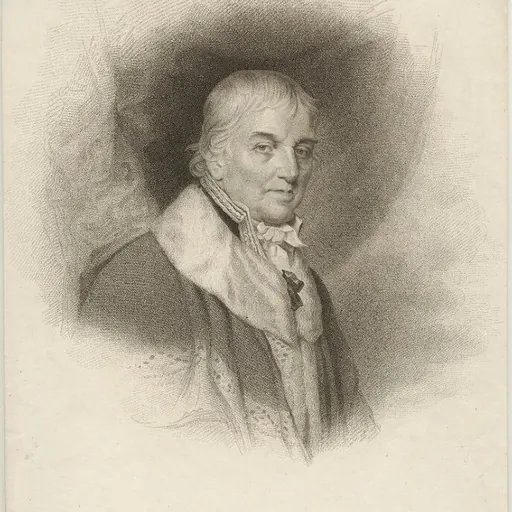
Charles Middleton, 1st Baron Barham
British admiral, politician and abolitionist
About Charles Middleton, 1st Baron Barham
Lived 1726 – 1813 (aged 86). Charles Middleton, 1st Baron Barham was a British naval officer, politician and soldier.
Admiral of the Red Charles Middleton, 1st Baron Barham, PC (14 October 172617 June 1813 ) was a Royal Navy officer and politician. As a junior officer he saw action during the Seven Years' War. Middleton was given command of a guardship at the Nore, a Royal Navy anchorage in the Thames Estuary, at the start of the American War of Independence, and was subsequently appointed Comptroller of the Navy. He went on to be First Naval Lord and then First Lord of the Admiralty.
Early life Charles Middleton was born at Leith, Midlothian to Robert, a customs collector of Bo'ness, Linlithgowshire, and Helen, daughter of Captain Charles Dundas RN and granddaughter of Sir James Dundas of Arniston. He was a nephew of Brigadier-General John Middleton (1678–1739), a grandson of George Middleton DD, and a great-grandson of Alexander Middleton (younger brother of John Middleton, 1st Earl of Middleton), the last two having served as Principal of King's College, Aberdeen.
Marriage and family On 21 December 1761, Charles married Margaret Gambier (c.1731 – 10 October 1792), daughter of James Gambier and Margaret Mead, at St Martin-in-the-Fields, Westminster, London. Margaret was the sister of Vice-Admiral James Gambier (1723–1789) and a niece of Captain Mead, captain of the Sandwich. Margaret's first encounter with Charles was aboard the Sandwich some twenty years earlier. Margaret later moved to Teston in Kent, to be close to her friend Elizabeth Bouverie. After their marriage, Charles and Margaret made their home at Barham Court in Teston where they lived until their respective deaths. Charles and Margaret had one daughter, Diana, later Diana Noel, 2nd Baroness Barham, born 18 September 1762.
In 1786, Charles and Margaret adopted Charles's nephew Robert Gambier Middleton (November 1774 – 21 August 1882), the eldest son of Charles's elder brother Captain George Middleton (1724–1794) and Elizabeth Wilson. Robert Gambier Middleton attained the rank of Rear-Admiral on 9 June 1832.
Naval career
Middleton entered the Royal Navy in 1741 as captain's servant aboard and HMS Duke, and later served aboard HMS Flamborough as midshipman and master's mate. He became lieutenant in 1745, serving aboard the frigate HMS Chesterfield, after 1748 on the west Africa station.
In 1784, Middleton was elected as a Tory Member of Parliament (MP) for Rochester, a seat he held for six years, and on 24 September 1787 he was promoted rear admiral. By 1786 he had become disillusioned with his role as Comptroller of the Navy, seeing it as beset by internal politics between the Admiralty and the Navy Board. In 1786 he prepared a letter to the First Lord of the Admiralty indicating he would "contend no more for the public," and urging the appointment of a successor who could "have more weight than I have had, and influence ministers to correct these evils." and again to Vice-Admiral of the Red on 12 April 1794; in May 1794, Middleton was appointed to the Board of Admiralty. and dying seven years later at the age 86 at his estate of Barham Court.
Abolitionist
In addition to his service in the Royal Navy, Middleton played a crucial role in the abolition of British involvement in the Atlantic slave trade. He had been influenced by a pamphlet written by James Ramsay, who served as a surgeon under Middleton aboard Arundel in the West Indies before taking holy orders and serving on the Caribbean island of Saint Kitts, where he observed first-hand the brutal mistreatment of enslaved people. In 1777, exhausted by the continuing conflict with influential planters and businessmen, Ramsay returned to Britain and briefly lived with Middleton and his wife at Teston. He later became vicar of Teston and rector of Nettlestead, Kent, the livings being in the gift of Middleton.
Ramsay's 1784 pamphlet Essay on the Treatment and Conversion of African Slaves in the British Sugar Colonies especially affected Middleton's wife. Feeling inadequate to take up the issue of the slave trade in Parliament himself, and knowing that it would be a long, hard battle, Middleton suggested the young MP William Wilberforce as the one who might be persuaded to take up the cause. (Whether this was the first time that the issue had been suggested to Wilberforce is debatable). In 1787 Wilberforce was introduced to Ramsay and Thomas Clarkson at Teston, as well as meeting the Testonites, a growing group of supporters of abolition which also included Edward James Eliot, Hannah More and Beilby Porteus.
Clarkson had first made public his desire to spend his life fighting for emancipation at Middleton's home, Barham Court, overlooking the River Medway at Teston, Kent. In order to make a case for abolishing the slave trade, Clarkson did much research over many years, gathering evidence by interviewing thousands of sailors who had been involved in the trade.
Legacy A key leader in the Royal Navy (1778–1807), he was an austere but politically liberal public official. As Comptroller of the Navy, First Lord of the Admiralty, and Commissioner, his success in handling the problems of supply, construction, inefficiency, and insubordination made a critical contribution to Britain's naval victories in the Napoleonic wars, according to Bernard Pool.
Three warships of the Royal Navy have been named Barham in honour of Middleton including the battleship Barham launched in 1914. A fourth was planned but never completed. Barham Building at HMS Nelson, Portsmouth (HMNB Portsmouth), is also named after Middleton.
Fictional portrayals Barham is a character in Treason's Tide by Robert Wilton, set during the summer of 1805. He is also portrayed by the simple moniker of Admiral Barham in Naomi Novik's alternative history fiction series, Temeraire, in the second novel, Throne of Jade, (published with Del Rey in 2006) in which he is depicted as arbitrating a dispute between the Chinese delegation and the British government over the possible return of Captain William Laurence's dragon Temeraire to China. His political relationship with William Wilberforce and the Abolitionist movement in Britain is also referenced in the work. He is also a minor character in the second book "Post Captain" in the Patrick O'Brian series of Aubrey-Maturin books.
Don’t just read it —
keep it.
Full-length biographies made to live with: read them, listen on the way to work, watch them tonight.
- E-book
- Audio
- Video
Instant download · yours to keep · every purchase keeps this site free
Important facts
People in Charles Middleton, 1st Baron Barham's life
Named in this biography and alive at the same time



Related people
Same field, nearest in time



Contemporaries
People whose lives overlapped Charles Middleton, 1st Baron Barham's





Frequently asked questions
Who was Charles Middleton, 1st Baron Barham?
British admiral, politician and abolitionist (1726-1813)
When was Charles Middleton, 1st Baron Barham born?
Charles Middleton, 1st Baron Barham was born on 14 October 1726 in Leith.
When did Charles Middleton, 1st Baron Barham die?
Charles Middleton, 1st Baron Barham died on 17 June 1813 in Teston.
What was Charles Middleton, 1st Baron Barham's occupation?
Charles Middleton, 1st Baron Barham was a naval officer, politician and soldier.
What nationality was Charles Middleton, 1st Baron Barham?
Charles Middleton, 1st Baron Barham was British.
Sources & further reading
· Wikipedia: Charles Middleton, 1st Baron Barham
· DBpedia: Charles Middleton, 1st Baron Barham
Cite this page
APA: Biography.guide. (2026). Charles Middleton, 1st Baron Barham. https://biography.guide/charles-middleton-1st-baron-barham/
MLA: "Charles Middleton, 1st Baron Barham." Biography.guide, https://biography.guide/charles-middleton-1st-baron-barham/.
Chicago: "Charles Middleton, 1st Baron Barham." Biography.guide. https://biography.guide/charles-middleton-1st-baron-barham/.
Data last updated: 2026-09-20 · Spot an error? Report a correction.
Portrait: Wikimedia Commons · author & licence
Page generated 2026-09-27 04:58 UTC