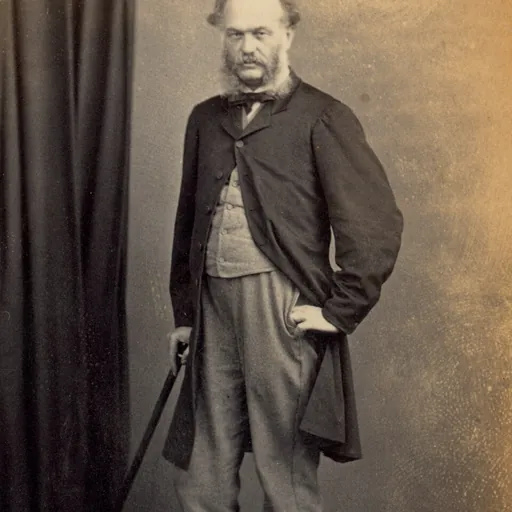
About Charles Johnston
Lived 1812 – 1872 (aged 60). Charles Johnston was a writer, physician and politician.
Charles Johnston MRCS (12 March 1812 – 16 July 1872) was a British surgeon, travel writer of Africa and founder of the Durban Botanic Gardens.
Johnston visited the Ethiopian Empire (then known as Abyssinia) in 1842 – 1843 and recorded his experience in a book titled Travels in Southern Abyssinia, Through the Country of Adal to the Kingdom of Shoa. His book forms an important historical account of the customs and culture of the region in the 1840s. He befriended the King of the Ethiopian kingdom of Shewa, Sahle Selassie, publishing in his book their conversations from various meetings. After his travels in Ethiopia he returned to England where he became assistant editor of the Lady's Newspaper. Some years later Johnston returned to Africa to settle in Durban, Colony of Natal (now part of South Africa), where he founded the Durban Botanic Gardens, which is now the oldest surviving botanic gardens in Africa. Johnston returned to England in 1861 and eventually settled in Barnstaple, Devon.
Early life and education Charles Johnston was the son of Thomas Johnston (1785–1866) and Elizabeth Johnston (1789–1867 née Woodiwis). Thomas Johnston was a successful silk and linen merchant who had emigrated from Scotland to England. Thomas settled for a time in Manchester where Charles Johnston was born. Thomas eventually settled in Birmingham becoming chairman of the Birmingham Water Works.
Charles Johnston had nine siblings who survived into adulthood: five sisters and four brothers. Johnston was the second eldest child and the eldest son. Three of Johnston's brothers followed him into the medical profession.
Johnston wrote that since boyhood he had wished for a "life of novel and wild adventure".
Visit to the Ethiopian Empire (1842–1843) Preparation and journey to the East African coast In 1841 Johnston resigned a commission with the East India Company, with whom he was employed as a ship's surgeon, so that he could take an opportunity to explore East Africa. Johnston obtained letters of introduction from the British Indian government to Captain Haines the colonial administrator of Aden and to Captain Harris the British ambassador to the Kingdom of Shewa, within the Ethiopian Empire. Johnston stayed in Aden for several weeks before he received an offer from Captain Haines to be put in charge of a mission to take supplies to the British Embassy in Shewa. Johnston began his journey into East Africa by sailing from Aden to Tadjoura in February 1842 aboard the brig-of-war Euphrates captained by John Young. From there he intended to take the supplies to the embassy in Shewa. Whilst in Tadjoura he met with the local ruler, described as a sultan. Johnston was however unable to travel further on this occasion upon the advice of Captain Young, who felt that the local inhabitants of Tadjoura were unwilling to assist the mission. He therefore returned on the ship Euphrates to Aden.
Captain Haines believed that it was the presence of a war ship which had made the inhabitants of Tadjoura unwilling to assist the mission. It was therefore arranged that Johnston would approach Tadjoura on a local vessel from the city of Berbera. In Berbera Johnston met with Sharmarke Ali Saleh, the most powerful man in the region. Saleh loaned Johnston a local vessel for his onward journey to Tadjoura. Johnston returned to Tadjoura aboard the vessel on 6 March 1842.
In the same year as his first arrival in Durban, Johnston founded the Durban Botanic Gardens. However, the death of his first wife in 1850 caused him to resign his position of managing the gardens.
Johnston entered local politics in Durban and became one of the first councillors in Durban to be elected in the first local election on 2 August 1854. Johnston was later elected to the Natal Legislative Council in the 1857 Natal parliamentary election.
On 19 November 1851 Johnston obtained a licence to practise medicine in Natal. During 1857 he published by subscription his Observations Upon Disease in Natal and in 1860, towards the end of Johnston's residence in Durban, he published a book titled Observations on Health and Disease, and on the Physical Economy of Human Life, in Natal. Johnston left Durban in 1861 and returned to England.
Publications
Engravings from drawings by Johnston of Ethiopia
Don’t just read it —
keep it.
Full-length biographies made to live with: read them, listen on the way to work, watch them tonight.
- E-book
- Audio
- Video
Instant download · yours to keep · every purchase keeps this site free
Important facts
People in Charles Johnston's life
Named in this biography and alive at the same time


Related people
Same field, nearest in time


Contemporaries
People whose lives overlapped Charles Johnston's





Frequently asked questions
Who was Charles Johnston?
author (1812-1872)
When was Charles Johnston born?
Charles Johnston was born on 12 March 1812 in Manchester.
When did Charles Johnston die?
Charles Johnston died on 16 July 1872 in Barnstaple.
What was Charles Johnston's occupation?
Charles Johnston was a writer, physician and politician.
Sources & further reading
· DBpedia: Charles Johnston (travel writer)
Cite this page
APA: Biography.guide. (2026). Charles Johnston. https://biography.guide/charles-johnston-writer/
MLA: "Charles Johnston." Biography.guide, https://biography.guide/charles-johnston-writer/.
Chicago: "Charles Johnston." Biography.guide. https://biography.guide/charles-johnston-writer/.
Data last updated: 2026-09-22 · Spot an error? Report a correction.
Portrait: Wikimedia Commons · author & licence
Page generated 2026-09-27 05:02 UTC