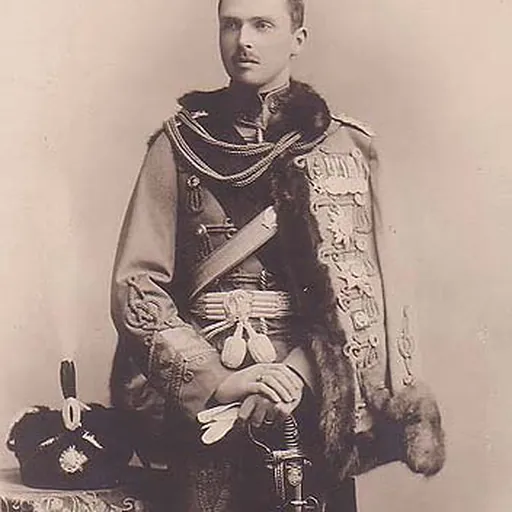
Charles Edward, Duke of Saxe-Coburg and Gotha
Last Duke of Saxe-Coburg and Gotha from 1900 to 1918, British prince and royal duke, Nazi politician
About Charles Edward, Duke of Saxe-Coburg and Gotha
Lived 1884 – 1954 (aged 69). Charles Edward, Duke of Saxe-Coburg and Gotha was a British politician.
Charles Edward (Leopold Charles Edward George Albert; 19 July 18846 March 1954) was at various points in his life a British prince and royal duke, a German duke, and a Nazi politician. He was the last ruling Duke of Saxe-Coburg and Gotha, a state of the German Empire, from 30 July 1900 to 14 November 1918. He later held multiple positions in the Nazi regime, including leader of the German Red Cross, and acted as an unofficial diplomat for the German government.
Charles Edward's parents were Prince Leopold, Duke of Albany, and Princess Helen of Waldeck and Pyrmont. His paternal grandparents were Queen Victoria of the United Kingdom and Prince Albert of Saxe-Coburg and Gotha. Prince Leopold died before his son's birth. Charles Edward was born in Surrey, England, and brought up as a British prince. He was a sickly child who developed a close relationship with his grandmother and his only sibling, Alice. He was privately educated, including at Eton College. In 1899, Charles Edward was selected to succeed to the throne of Saxe-Coburg and Gotha because he was deemed young enough to be re-educated as a German. He moved to Germany at the age of 15. Between 1899 and 1905, he was put through various forms of education, guided by his cousin, German Emperor Wilhelm II.
Charles Edward ascended the ducal throne in 1900 but reigned through a regency until 1905. In 1905, he married Princess Victoria Adelaide of Schleswig-Holstein. The couple had five children, including Sibylla, the mother of King Carl XVI Gustaf of Sweden. The Duke was a conservative ruler with an interest in art and technology. He tried to emphasise his loyalty to his adopted country through various symbolic gestures. Still, his continued close association with the United Kingdom was off-putting both to his subjects and to the German elite. He chose to support the German Empire during the First World War. He was deposed during the German revolution like the other German princes. He also lost his British titles as a result of his decision to side against the British Empire.
During the 1920s, Charles Edward became a moral and financial supporter of violent far-right paramilitary groups in Germany. By the early 1930s, he was supporting the Nazi Party and joined it in 1933. He helped to promote eugenicist ideas which provided a basis for the murder of many disabled people. He was involved in attempting to shift opinion among the British upper class in a more pro-German direction. His attitudes became more pro-Nazi during the Second World War, though it is unclear how much of a political role he played. After the war, he was interned for a period and was given a minor conviction by a denazification court. He died of cancer in 1954.
Early life in Britain Birth and family Charles Edward's father was Prince Leopold, Duke of Albany, the youngest son of the reigning British monarch, Queen Victoria. Historian Karina Urbach described Leopold as "the most intellectual of Queen Victoria's children". His mother, Princess Helen, Duchess of Albany, was the daughter of the ruling prince of Waldeck and Pyrmont, George Victor, and the sister of Queen Emma of the Netherlands. Royal biographer Theo Aronson described her as a "capable, conscientious" woman, and a devout Christian. Leopold, who suffered from haemophilia, died after slipping and hitting his head, several months before Charles Edward was born. The unborn child was not at risk of haemophilia, as the condition cannot be passed from father to son. He succeeded to his deceased father's titles at birth and was styled His Royal Highness the Duke of Albany. In addition to being the Duke of Albany, he was also the Earl of Clarence and Baron Arklow.
Leopold Charles Edward George Albert was born on 19 July 1884 at Claremont House near Esher, Surrey. He used the name Charles Edward. Leopold had wanted his firstborn son to be named after Charles Edward Stuart, an 18th-century claimant to the British throne. The infant was privately baptised at Claremont on 4 August after he fell ill. His baptism was publicly certified at St George's Church, Esher, on 4 December. Charles Edward was brought up as a prince of the United Kingdom for the first 15 years of his life. He had a sister, Alice, who was a year and a half older. Being an intensely anxious child, he often looked to Alice for support, a habit that continued throughout his adulthood. The siblings were nicknamed "Siamese twins".
Throughout the 18th and 19th centuries, the British royal family had developed close familial relationships with continental Protestant, and particularly German, reigning families. Queen Victoria's immediate family belonged to the House of Saxe-Coburg and Gotha; her deceased husband, Prince Albert, was the younger brother of the childless Duke Ernest II. Ernest governed the Duchy of Saxe-Coburg and Gotha, one of the states in the German Empire, which had a federal system of government . Victoria and Albert's eldest daughter, Victoria, German Empress, was the mother of German Emperor Wilhelm II. Victoria and Albert's eldest son, Prince Albert Edward, was the heir apparent to the British throne. Thus it was their second son, Prince Alfred, who succeeded his uncle Ernest II in 1893. Aronson commented on a painting of the family commissioned to commemorate Queen Victoria's Golden Jubilee in 1887:
Charles Edward, his mother, and his sister were surrounded by members of the wider royal family in proximity to Queen Victoria. They frequently spent time with the Queen at her various estates. Charles Edward was described as Victoria's favourite grandchild. The boy and his sister often visited Balmoral Castle where they prepared for their future positions. Victoria enjoyed her grandchildren acting out dramatic scenes which reflected the religious values she wanted to inculcate in them. Lewis Carroll, a family friend, described Charles Edward as a "perfect little prince" who was well-trained in court etiquette and ceremony. Princess Helen also took her children on visits to her relatives in Germany and the Netherlands.
Upbringing and education
Theo Aronson described the Albany household at Claremont House as "cosy, comfortable, well-ordered". After her husband's death, the British Parliament had given Helen an annual grant from the civil list of 6,000 pound sterling. This did not make her as wealthy as she was during her marriage, but did allow her to employ several domestic servants, including a number responsible for the children. One of Charles Edward's childhood nannies referred to him as "delicate and sensitive, nervous and tiring". Medical experts consulted by the royal family believed that he had been permanently harmed by the grief which his widowed mother had suffered from during her pregnancy. No record of Charles Edward's own childhood memories exists, but Alice fondly recalled this period of their lives. Aronson commented that the environment where the two children were looked after was a "typical, late nineteenth-century nursery". He described it as:... a small, self-contained world of early-to-rise, porridge for breakfast, vigorous hair-brushings, buttoned boots, holland pinafores, pick-a-back rides, stories, squabbles, tears, treats and punishments, bland nursery meals, walks to the lake to feed the wild ducks with squares of dry bread ... , little covered baskets holding soup or jelly or junket for the sick, pony rides in the park, baths filled with hot water from highly polished copper cans, firelight, lamplight, warming-pans, good-night prayers, nightlights.Caring for the children was mainly the responsibility of their nannies, but they spent time with their mother for set periods each day. She taught the children practical skills, such as knitting, and gave them their Sunday school lessons. Helen read them literature by various well-known English and Scottish authors of the 19th century. She was an affectionate mother but also a strict oneinsisting her children were brought up with stern discipline and encouraged to develop a sense of duty. Her son did not react well to this, becoming afraid of his mother and authority more generally.
Public duties, such as attending public events and providing patronage to charities, were a part of the royal family's functions. Aronson suggests that while they possessed "a highly developed sense of duty and responsibility", they were naïve about the deeply unpleasant conditions in which much of the British population lived. Charles Edward's mother wasunusually for a German aristocratespecially interested in social issues and, according to Alice, the children were encouraged to sympathise with others and engage in charitable work. Alice felt that "discipline at home and familiarity with the troubles of others ... cultivated in us [children] a sense of responsibility, poise and self-control."
Historian Hubertus Büschel indicates that the British royal family had high expectations for their young members' education. Charles Edward's first teacher was a governess called "Mrs Potts" who taught him together with his sister. The siblings developed a lifelong interest in history from her lessons where they were allowed to play-act historical scenes. He was then sent to school without his sister, studying in the privately funded public school system. Charles Edward attended two prep schools, firstly Sandroyd School in Surrey, and later Park Hill School in Lyndhurst. In a 1896 diary entry, Queen Victoria mentioned meeting the headmaster of the latter school "Mr Rawnsley" and his wife. She commented that: "All they said was most satisfactory. He seems to be very careful & kind."
Charles Edward developed an interest in military and royal occasions at a young age. He was given his first ceremonial position in the Seaforth Highlanders regiment of the British Army as a child. Victoria mentioned the five-year-old Prince wearing the "full uniform of the Seaforth Highlanders" in her diary. Shortly before his 13th birthday, Charles Edward participated in a parade for the Diamond Jubilee of Queen Victoria. The boy climbed on the roof of Buckingham Palace to see the assembled crowds before the event. He was described in contemporary press reports as being the most well-received participant.
In 1898 the prince enrolled at Eton College and his mother hoped he would eventually go on to Oxford University. Press reports sometimes accused the boy of behaving self-importantly at school, refusing to complete mandatory chores as he considered them a "degradation". He was happy at Eton and looked back nostalgically at his time at that school throughout his life. Aronson described the prince in his early teens as "small, blue-eyed, exceptionally handsome and highly strung". He was not expected to grow up to be a particularly prominent person.
First years in Germany Selection as heir
Duke Alfred's only son, Prince Alfred, died in 1899. The Duke was in poor health and the question of who would be his successor became an issue for the family. Alfred was seen as an inadequate foreigner by many members of the German governing elite, and a number of German princes wanted to split up the duchy among themselves. Prince Arthur, Duke of Connaught and Strathearn, Victoria and Albert's third son, was initially heir presumptive. The German press objected to a foreigner taking the throne, for instance, the (Berlin Daily) commented;The highest value that three bloody wars have given the German people is a newly awakened national consciousness. The first Chancellor [ the German Revolution , Carl Eduard was regarded as a mere footnote in history; a harmless, potty old aristocrat, washed up by the seismic upheavals of the early 20th century. However, that benign interpretation has been recently revised. We now know that Carl Eduard was a member of the Nazi Party, a sponsor of paramilitary terrorism andas Urbach's excellent book demonstratesan important 'go-between' for Hitler.Büschel suggested in his 2016 biography of Charles Edward that the various pressures placed on the nobleman from childhood until the outcome of the First World War may have led to him developing split personality disorder and narcissism. The writer argues that the Nazi regime allowed the former duke to regain much of the status he had lost after the First World War. He commented that Charles Edward was influenced by "coercion, fear, indoctrination, the effort to "stay on top", and probably also inner homelessness and loneliness". He suggests this was similar to many of the Duke's German contemporaries. However, Büschel believed that Charles Edward freely chose to support the Nazi regime when the option of leaving Germany would have been fairly easy for him. He wrote that the former duke was the most active and enthusiastic of the regime's aristocratic supporters. He describes Charles Edward as a "second-tier perpetrator": someone who was not a central figure in the regime, but who helped to conceal policies that would lead to the deaths of millions of people.
Rushton, in his 2018 book about the former duke's relationship to the murder of disabled people, described Charles Edward's life as "the story of a man born to royalty who became ensnared in the politics of human destruction. It is a tragic story." Rushton suggested there would have been risks to Charles Edward and his family if he had chosen to object to any actions of the regime, giving examples of other former nobles who were persecuted. Rushton noted that Charles Edward had already lost his status as a British prince and German duke, making his new identity as a Nazi party leader deeply emotionally important to him. Rushton argued that the factors affecting Charles Edward's behaviour were similar to many Germans. However, the historian also noted that the former duke had a close friendship with Hitler, and argued that he could have encouraged Hitler to stop certain atrocities. The writer felt that Charles Edward's failure to respond to the murder of a member of his extended family indicated that he was "weak-willed". He argued that this "... reflects a moral character defect... low self-esteem and little self-respect ... [lack of action is often due to] fear of others' opinions in the community and the risk to one's comfortable and secure lifestyle".
In 2015, a local dispute took place in Coburg about whether a street should be named after Max Brose, a businessman who had links to the Nazi regime. In response to this, the Coburg town council commissioned a group of historians to investigate why support for the Nazis had developed unusually quickly in Coburg and events in the town during the period. The commission, which reported its findings in 2024, noted that Charles Edward was an influential figure in the town, and that his support for organisations contributed to the growth of far-right politics.
Don’t just read it —
keep it.
Full-length biographies made to live with: read them, listen on the way to work, watch them tonight.
- E-book
- Audio
- Video
Instant download · yours to keep · every purchase keeps this site free
Important facts
Family & relationships
People in Charles Edward, Duke of Saxe-Coburg and Gotha's life
Named in this biography and alive at the same time




Related people
Same field, nearest in time

Contemporaries
People whose lives overlapped Charles Edward, Duke of Saxe-Coburg and Gotha's
Frequently asked questions
Who was Charles Edward, Duke of Saxe-Coburg and Gotha?
last Duke of Saxe-Coburg and Gotha from 1900 to 1918, British prince and royal duke, Nazi politician (1884–1954)
When was Charles Edward, Duke of Saxe-Coburg and Gotha born?
Charles Edward, Duke of Saxe-Coburg and Gotha was born on 19 July 1884 in Claremont.
When did Charles Edward, Duke of Saxe-Coburg and Gotha die?
Charles Edward, Duke of Saxe-Coburg and Gotha died on 6 March 1954 in Coburg.
What was Charles Edward, Duke of Saxe-Coburg and Gotha's occupation?
Charles Edward, Duke of Saxe-Coburg and Gotha was a politician.
What nationality was Charles Edward, Duke of Saxe-Coburg and Gotha?
Charles Edward, Duke of Saxe-Coburg and Gotha was British.
Sources & further reading
· Wikipedia: Charles Edward, Duke of Saxe-Coburg and Gotha
· DBpedia: Charles Edward, Duke of Saxe-Coburg and Gotha
Cite this page
APA: Biography.guide. (2026). Charles Edward, Duke of Saxe-Coburg and Gotha. https://biography.guide/charles-edward-duke-of-saxe-coburg-and-gotha/
MLA: "Charles Edward, Duke of Saxe-Coburg and Gotha." Biography.guide, https://biography.guide/charles-edward-duke-of-saxe-coburg-and-gotha/.
Chicago: "Charles Edward, Duke of Saxe-Coburg and Gotha." Biography.guide. https://biography.guide/charles-edward-duke-of-saxe-coburg-and-gotha/.
Data last updated: 2026-10-01 · Spot an error? Report a correction.
Portrait: Wikimedia Commons · author & licence
Page generated 2026-10-04 14:34 UTC