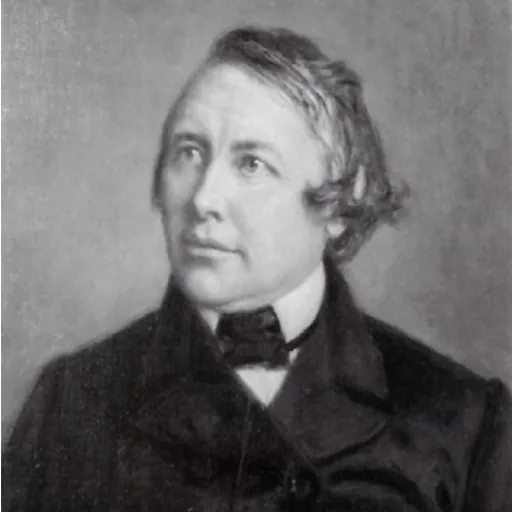
Charles de Montalembert
French publicist, historian and Count of Montalembert, Deux-Sèvres
About Charles de Montalembert
Lived 1810 – 1870 (aged 59). Charles de Montalembert was a French politician, historian, journalist, writer, count and opinion journalist.
Charles-Forbes-René, comte de Montalembert (; 15 April 1810 – 13 March 1870
Career Montalembert's early years were spent in England, where he was largely raised by his grandfather, who, although a Protestant, encouraged him to follow the religion of his father. In 1819 he attended the Lycée Bourbon and at the Collège Sainte-Barbe in Paris. In 1829 he was a contributor to the review Le Correspondant. In September and October 1830, he travelled in Ireland, where he met Daniel O'Connell; he was thinking of assisting the cause for which O'Connell was struggling by writing a history of Ireland, when he learned that the House of Commons had passed the Irish Emancipation Act. He clung to his early liberalism, and in 1848 saw the end of a government towards which he had always been hostile. In 1848 he was elected to the Chamber of Deputies. He was at first inclined to support Napoleon III, but was soon alienated by his policy.
He took great interest in the débuts of the Liberal empire. He severed his connection with Père Hyacinthe Loyson as he had with Lamennais and made the submission expected of him to the council. It was his last fall. Montalembert became increasingly isolated, politically, for his support of religious freedom in education; and by the Church for his liberal views.
Charles de Montalembert died in 1870.
Marriage Montalembert married Mlle de Merode, daughter of Félix de Mérode. His daughter married the vicomte de Meaux, a Roman Catholic statesman and distinguished writer. He was thus the brother-in-law of Belgian prelate and papal statesman Xavier de Mérode.
Montalembert was a close friend of Edwin Wyndham-Quin, 3rd Earl of Dunraven and Mount-Earl with whom he toured Scotland in 1862, staying at Dunraven Castle on his return journey. The viscount travelled with Montalembert to Switzerland the following year and stayed at Maîche, Doubs (Montalembert's country property) on his return.
Writing and works (selection) In addition to being an eloquent orator, Montalembert wrote in a style at once picturesque, fiery and polished. He was an ardent student of the Middle Ages, but his medieval enthusiasm was strongly tinctured with religious sentiments. His first historical work, La Vie de Ste Elisabeth de Hongrie (1836), is not so much a history as a religious manifesto, which did much to restore the position of hagiography. It met with great success, but Montalembert was not elected a member of the until 1851, after the fall of the July Monarchy.
From this time he gave much of his attention to a great work on monasticism in the West. He was at first attracted by the figure of St. Bernard and devoted one volume to him. He later withdrew it on the advice of his friend Dupanloup, and the entire printing was destroyed. He then enlarged his original plan and published the first volumes of his Moines d'occident (1860), an eloquent work which was received with much admiration in those circles where language was more appreciated than learning. The work, unfinished at the time of the author's death, was completed later from some long fragments found among his papers. Volumes VI and VII appeared in 1877.
Like Chateaubriand he kept a close (now published) record of acquaintances, invitations, necrology.
Défense de l'école libre devant la Chambre des Pairs (1831) Histoire de sainte Élisabeth, reine de Hongrie (1836) Monuments de l'histoire de sainte Élisabeth (1838) Du vandalisme et du catholicisme dans l'art (1839) The Obligation of Catholics in the Matter of Freedom of Teaching (1843) Catholic Interests in the Nineteenth Century (1852) Political Future of England (1855) Illustrations of West American oaks. From drawings by Albert Kellog; the text by Edward L. Greene. Published from funds provided by James M. McDonald (1856) Pius IX and France in 1849 and 1859 (1860) Memoir of the Abbe Lacordaire. Authorized translation. (London, Richard Bentley, 1863) Les moines d'Occident depuis saint Benoît jusqu'à saint Bernard ("The Monks of the West from St. Benedict to St. Bernard," Paris: J. Lecoffre Fils et Cie., 1877) Saint Columban, English ed., with introduction, notes and critical studies by Rev. E.J. McCarthy, S.S.C (1927) Emmanuel Mounier, ed., Montalembert (Paris, 1945), an anthology of his writing
Tributes
Don’t just read it —
keep it.
Full-length biographies made to live with: read them, listen on the way to work, watch them tonight.
- E-book
- Audio
- Video
Instant download · yours to keep · every purchase keeps this site free
Important facts
People in Charles de Montalembert's life
Named in this biography and alive at the same time


Related people
Same field, nearest in time




Contemporaries
People whose lives overlapped Charles de Montalembert's




Frequently asked questions
Who was Charles de Montalembert?
French publicist, historian and Count of Montalembert, Deux-Sèvres (1810-1870)
When was Charles de Montalembert born?
Charles de Montalembert was born on 15 April 1810 in London.
When did Charles de Montalembert die?
Charles de Montalembert died on 13 March 1870 in Paris.
What was Charles de Montalembert's occupation?
Charles de Montalembert was a politician, historian, journalist, writer, count and opinion journalist.
What nationality was Charles de Montalembert?
Charles de Montalembert was French.
Sources & further reading
· Wikipedia: Charles de Montalembert
· DBpedia: Charles Forbes René de Montalembert
Cite this page
APA: Biography.guide. (2026). Charles de Montalembert. https://biography.guide/charles-de-montalembert/
MLA: "Charles de Montalembert." Biography.guide, https://biography.guide/charles-de-montalembert/.
Chicago: "Charles de Montalembert." Biography.guide. https://biography.guide/charles-de-montalembert/.
Data last updated: 2026-09-23 · Spot an error? Report a correction.
Portrait: Wikimedia Commons · author & licence
Page generated 2026-09-27 05:06 UTC