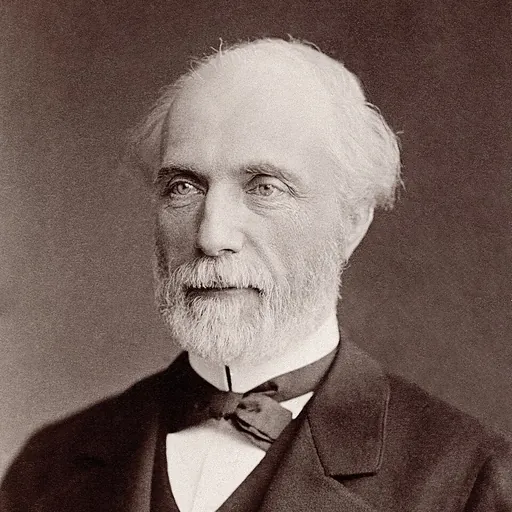
Charles de Freycinet
Politician of the French Third Republic
About Charles de Freycinet
Lived 1828 – 1923 (aged 94). Charles de Freycinet was a French politician, engineer, official and writer.
Charles Louis de Saulces de Freycinet (; 14 November 1828 – 14 May 1923) was a French statesman who served four times as Prime Minister during the Third Republic. He also served an important term as Minister of War (1888–1893). He belonged to the Moderate Republican faction.
He was elected a member of the Academy of Sciences, and in 1890, the fourteenth member to occupy a seat in the .
Biography
Early years Freycinet was born at Foix (Ariège) of a Protestant family and was the nephew of Louis de Freycinet, a French navigator and the grandson of Élisabeth-Antoinette-Catherine Armand, a French pastellist. Charles Freycinet was educated at the École Polytechnique. He entered government service as a mining engineer (see X-Mines). In 1858 he was appointed traffic manager to the Compagnie de chemins de fer du Midi, a post in which he showed a remarkable talent for organization, and in 1862 returned to the engineering service, attaining in 1886 the rank of inspector-general. He was sent on several special scientific missions, including one to the United Kingdom, on which he wrote (1867).
Franco-Prussian War In July 1870 the Franco-Prussian War started, which led to the fall of the Second French Empire of Napoleon III. On the establishment of the Third Republic in September 1870, he offered his services to Léon Gambetta, was appointed prefect of the department of Tarn-et-Garonne, and in October became chief of the military cabinet. It was mainly Freycinet's powers of organization which enabled Gambetta to raise army after army to oppose the invading Germans. He revealed himself to be a competent strategist, but the policy of dictating operations to the generals in the field was not accompanied by happy results. The friction between him and General d'Aurelle de Paladines resulted in the loss of the advantage temporarily gained at Coulmiers and Orléans, and he was responsible for the campaign in the east, which ended in the destruction of the Armée de l'Est of Charles Denis Bourbaki. He attempted to compromise by occupying the Isthmus of Suez, but the vote of credit was rejected in the Chamber by 417 votes to 75, and the ministry resigned. He returned to office in April 1885 as Foreign Minister in Henri Brisson's cabinet, and retained that post when, in January 1886, he succeeded to the premiership. A law was introduced in July 1890 that regulated the semi-monthly inspection of mines with the object (as noted by one study) “of examining the conditions of security for the employees.” A law of July 1890 allowed for elected miners to inspect mines, and a law of December 1890 allowed workers to demand damages from employers who dismissed them due to their belonging to a union. In addition, the ‘livret,’ a long-established document that placed arbitrary restrictions on laborers, was abolished on July the 22nd 1890, and a law of July the 20th 1891 set up a bureau of labor which was given the duty (as noted by one study) “to collect, systematize, and publish all information relating to labor, particularly as regards the state and development of production, the organization and renumeration of labor, its relations with capital, the condition of the working people, and the comparative situation of labor in France and in foreign countries.”
Minister of War In April 1888 he became Minister of War in Charles Floquet's cabinet – the first civilian since 1848 to hold that office. His services to France in this capacity were the crowning achievement of his life, and he enjoyed the conspicuous honour of holding his office without a break for five years through as many successive administrations – those of Floquet and Pierre Tirard, his own fourth ministry (March 1890 – February 1892), and the Émile Loubet and Alexandre Ribot ministries. The introduction of the three-years' service and the establishment of a general staff, a supreme council of war, and the army commands were all due to him. His premiership was marked by heated debates on the clerical question, and it was a hostile vote on his bill against the religious associations that caused the fall of his cabinet. He failed to clear himself entirely of complicity in the Panama scandals, and in January 1893 resigned the Ministry of War.
In November 1898 he once again became Minister of War in the Charles Dupuy cabinet, but resigned office on 6 May 1899.
Prime Minister of France
1st Ministry Charles de Freycinet – President of the Council and Minister of Foreign Affairs Jean Joseph Frédéric Farre – Minister of War Charles Lepère – Minister of the Interior and Worship Pierre Magnin – Minister of Finance Jules Cazot – Minister of Justice Jean Bernard Jauréguiberry – Minister of Marine and Colonies Jules Ferry – Minister of Public Instruction and Fine Arts Henri Varroy – Minister of Public Works Adolphe Cochery – Minister of Posts and Telegraphs Pierre Tirard – Minister of Agriculture and Commerce
Changes 17 May 1880 – Ernest Constans succeeds Lepère as Minister of the Interior and Worship.
2nd Ministry Charles de Freycinet – President of the Council and Minister of Foreign Affairs Jean-Baptiste Billot – Minister of War René Goblet – Minister of the Interior Léon Say – Minister of Finance Gustave Humbert – Minister of Justice and Worship Jean Bernard Jauréguiberry – Minister of Marine and Colonies Jules Ferry – Minister of Public Instruction and Fine Arts François de Mahy – Minister of Agriculture Henri Varroy – Minister of Public Works Adolphe Cochery – Minister of Posts and Telegraphs Pierre Tirard – Minister of Commerce
3rd Ministry Charles de Freycinet – President of the Council and Minister of Foreign Affairs Georges Boulanger – Minister of War Ferdinand Sarrien – Minister of the Interior Marie François Sadi Carnot – Minister of Finance Charles Demôle – Minister of Justice Théophile Aube – Minister of Marine and Colonies René Goblet – Minister of Public Instruction, Fine Arts, and Worship Jules Develle – Minister of Agriculture Charles Baïhaut – Minister of Public Works Félix Granet – Minister of Posts and Telegraphs Édouard Locroy – Minister of Commerce and Industry
Changes 4 November 1886 – Édouard Millaud succeeds Baïhaut as Minister of Public Works
4th Ministry Charles de Freycinet – President of the Council and Minister of War Alexandre Ribot – Minister of Foreign Affairs Ernest Constans – Minister of the Interior Maurice Rouvier – Minister of Finance Armand Fallières – Minister of Justice and Worship Jules Roche – Minister of the Colonies and of Commerce and Industry Édouard Barbey – Minister of Marine Léon Bourgeois – Minister of Public Instruction and Fine Arts Jules Develle – Minister of Agriculture Yves Guyot – Minister of Public Works
Publications (1858) (1860, revised ed., 1881) (1861) (1869) (1870) (1870) (1896) (1905) Contemporain: Pensées contributed under the pseudonym of Alceste"
Don’t just read it —
keep it.
Full-length biographies made to live with: read them, listen on the way to work, watch them tonight.
- E-book
- Audio
- Video
Instant download · yours to keep · every purchase keeps this site free
Important facts
People in Charles de Freycinet's life
Named in this biography and alive at the same time





Related people
Same field, nearest in time


Contemporaries
People whose lives overlapped Charles de Freycinet's




Frequently asked questions
Who was Charles de Freycinet?
politician of the French Third Republic (1828-1923)
When was Charles de Freycinet born?
Charles de Freycinet was born on 14 November 1828 in Foix.
When did Charles de Freycinet die?
Charles de Freycinet died on 14 May 1923 in Paris.
What was Charles de Freycinet's occupation?
Charles de Freycinet was a politician, engineer, official and writer.
What nationality was Charles de Freycinet?
Charles de Freycinet was French.
Sources & further reading
· Wikipedia: Charles de Freycinet
· DBpedia: Charles de Freycinet
Cite this page
APA: Biography.guide. (2026). Charles de Freycinet. https://biography.guide/charles-de-freycinet/
MLA: "Charles de Freycinet." Biography.guide, https://biography.guide/charles-de-freycinet/.
Chicago: "Charles de Freycinet." Biography.guide. https://biography.guide/charles-de-freycinet/.
Data last updated: 2026-09-22 · Spot an error? Report a correction.
Portrait: Wikimedia Commons · author & licence
Page generated 2026-09-27 05:01 UTC