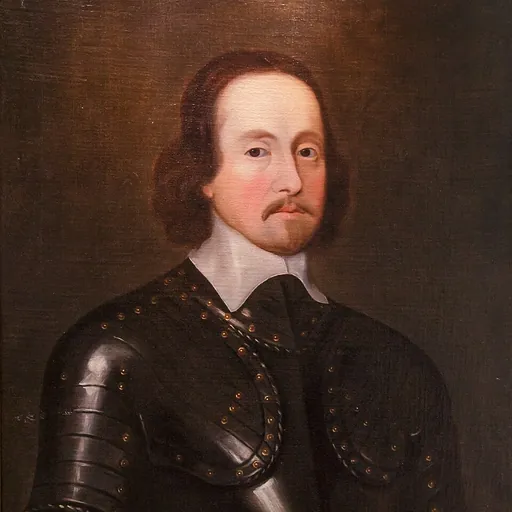
About Charles Coote, 1st Earl of Mountrath
Lived 1610 – 1661 (aged 50–51). Charles Coote, 1st Earl of Mountrath was a politician.
Charles Coote, 1st Earl of Mountrath ( 1609 – 18 December 1661) was an Anglo-Irish soldier and politician from County Roscommon. A strong advocate of the Protestant Ascendancy in Ireland, he fought for Parliament and the Commonwealth in the 1641 to 1652 Irish Confederate Wars. Coote also sat as an MP, and held various senior administrative posts, including Lord President of Connaught.
Personal details Charles Coote was born 1609, eldest son of Sir Charles Coote (died 1642), and his wife Dorothea. One of five surviving children, he had three brothers, Chidley (1608–1668), Richard (1620–1683), and Thomas (1621–1671), and a sister, Letitia.
Prior to 1630, Coote married Mary Rushe, with whom he had a son, another Charles (1630–1672). Mary died before 1645, when Coote married again, this time to Jane Hannay (died 1684). They had four children together, Richard, Chidley, Dorothy (1652–1677), Hannah, and Jane.
Irish Confederate Wars Relatively little is known of Coote's career prior to 1641. He entered Trinity College, Dublin in 1622, was knighted in 1626, and was elected Member of Parliament for County Leitrim in the Irish House of Commons in 1640.
After the death of his father in action defending Trim in May 1642, Charles Coote led some of the King's forces under Ormonde against the Confederate army, but was captured defending a stronghold in the Curragh of Kildare by an Irish army led by Castlehaven. He was released during the 1643 cessation of arms.
At this time Coote traveled to England with a number of Protestants to agitate for harsh anti-Catholic measures and an end to the cessation. In Dublin Archbishop Ussher condemned the extremism of Coote and his fellows, but Coote was unbending. The King, however, ignored these demands and so Coote joined the Parliamentarians. Coote was appointed commander of Connacht by the Parliamentarians in 1645. Operating from west Ulster, he temporarily overran the northwest of the province over the next two years.
The Cromwellian Conquest The execution of Charles I in 1649 led local Protestant and Scottish forces in Ulster to join the Duke of Ormond's royalist coalition, thus isolating Coote. He defended Derry against a protracted siege (March–August 1649), with the unlikely assistance of the Irish Confederate Ulster army under Owen Roe O'Neill.
After the New Model Army under Cromwell captured Drogheda, a detachment under Robert Venables headed north into Ulster, where Coote joined Venables to destroy the Scottish Ulster Royalists at the Battle of Lisnagarvey. By early 1650, however, the Irish Ulster army (now under Heber MacMahon, as O'Neill had died a few months earlier) became active once more, and Coote was again forced onto the defensive. After being reinforced, he advanced on the Irish army at Scarrifholis and routed them, killing over 2,000 soldiers and taking no prisoners. After this, Coote's army attempted to take the formidable fortress of Charlemont, which was defended by the remnants of the Ulster army, but his soldiers suffered heavy casualties before the stronghold surrendered.
With Ulster largely cleared, in June 1651, Coote advanced on Athlone from the north-west, evading a blocking force. Through this movement the town was gained; the town contained a stone bridge over the Shannon and this action thus opened up Connacht to the Parliamentarian army for the first time.
Having entered Connacht, Coote laid siege to Galey Castle, the seat of the Ó Ceallaigh clan. The Ó Ceallaighs resisted, and for their defiance, they were taken to An Creagán (a local stoney, stepped hill), and were hanged. The hill thereafter came to be known as 'Cnoc an Chrochaire', 'the Hill of the Hanging', and gave its name to the adjacent village, now Anglicised as ‘Knockcroghery’.
Coote continued westwards and besieged Galway in the winter of 1652. Galway surrendered in April 1652.
Coote inherited the substantial plantation lands of his father in the midlands of Ireland.
Restoration After Cromwell's death, Coote took part in December 1659 in a coup d'etat against The Protectorate, seizing Dublin Castle. In February 1660 he sent a representative to King Charles II, inviting him to make an attempt on Ireland. Coote was a central figure in the Convention Parliament. Following the Restoration, Charles II ennobled him Earl of Mountrath in 1660 as a reward for his support.
In the remaining months of his life, he was one of the three most powerful men in Ireland, as the King appointed him Lord Justice of Ireland, together with Roger Boyle, 1st Earl of Orrery and Sir Maurice Eustace. Pending the appointment of the Duke of Ormond as Lord Lieutenant of Ireland, the Lords Justices acted as the interim government. However, deep divisions among the three men, particularly on the question of whether dispossessed Roman Catholics should be allowed to recover their lands, seriously weakened the effectiveness of the regime.
He built Rush Hall near Mountrath, which was the family's main residence for several generations.
Coote died of smallpox in 1661 and was buried in Christchurch Cathedral, Dublin.
Don’t just read it —
keep it.
Full-length biographies made to live with: read them, listen on the way to work, watch them tonight.
- E-book
- Audio
- Video
Instant download · yours to keep · every purchase keeps this site free
Important facts
People in Charles Coote, 1st Earl of Mountrath's life
Named in this biography and alive at the same time



Related people
Same field, nearest in time
Contemporaries
People whose lives overlapped Charles Coote, 1st Earl of Mountrath's


Frequently asked questions
Who was Charles Coote, 1st Earl of Mountrath?
Irish peer
When was Charles Coote, 1st Earl of Mountrath born?
Charles Coote, 1st Earl of Mountrath was born in 1610.
When did Charles Coote, 1st Earl of Mountrath die?
Charles Coote, 1st Earl of Mountrath died in 1661.
What was Charles Coote, 1st Earl of Mountrath's occupation?
Charles Coote, 1st Earl of Mountrath was a politician.
Sources & further reading
· Wikipedia: Charles Coote, 1st Earl of Mountrath
· DBpedia: Charles Coote, 1st Earl of Mountrath
Cite this page
APA: Biography.guide. (2026). Charles Coote, 1st Earl of Mountrath. https://biography.guide/charles-coote-1st-earl-of-mountrath/
MLA: "Charles Coote, 1st Earl of Mountrath." Biography.guide, https://biography.guide/charles-coote-1st-earl-of-mountrath/.
Chicago: "Charles Coote, 1st Earl of Mountrath." Biography.guide. https://biography.guide/charles-coote-1st-earl-of-mountrath/.
Data last updated: 2026-09-25 · Spot an error? Report a correction.
Portrait: Wikimedia Commons · author & licence
Page generated 2026-10-04 09:46 UTC