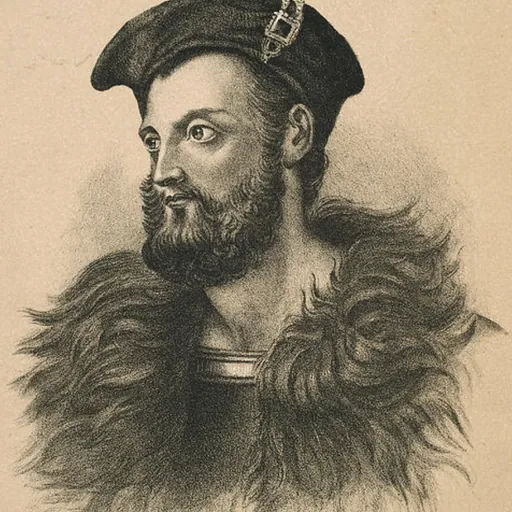
About Owen Roe O'Neill
Lived 1590 – 1649 (aged 58–59). Owen Roe O'Neill was an Irish military personnel, soldier and mercenary.
Owen Roe O'Neill (Irish: Eoghan Ruadh Ó Néill; – 6 November 1649) was a Gaelic Irish soldier and one of the most famous of the O'Neill dynasty of Ulster. O'Neill left Ireland at a young age and spent most of his life as a mercenary in the Spanish Army serving against the Dutch in Flanders during the Eighty Years' War. After the Irish Rebellion of 1641, O'Neill returned and took command of the Irish Confederate Ulster Army. He is known for his victory at the Battle of Benburb in 1646.
O'Neill's later years were marked by infighting amongst the Confederates, and in 1647 he led his army to seize power in the capital of Kilkenny. His troops clashed with rival forces of the Confederacy, leading to O'Neill forming a temporary alliance with Charles Coote's English Parliamentary forces in Ulster. He initially rejected a treaty of alliance between the Confederates and the Irish Royalists, but faced with the Cromwellian invasion he changed his mind. O'Neill died shortly after agreeing to an alliance with the 1st Marquess of Ormond, the Lord Lieutenant of Ireland. The agreement included the promise of an Earldom, but O'Neill died on Tuesday, 6 November 1649.
Early life O'Neill was the illegitimate son of Art MacBaron O'Neill, a son of Matthew O'Neill, 1st Baron Dungannon and younger half-brother of Hugh O'Neill, Earl of Tyrone, who held lands in County Armagh. His alleged great-grandfather was Conn O'Neill, 1st Earl of Tyrone, the most powerful figure in Ulster and the first O'Neill to take a title from the Crown as part of the surrender and regrant policy of the Tudor era. Through Conn, he was descended from Thomas FitzGerald, 7th Earl of Kildare, the leading Anglo-Irish noble of the era, member of the Earls of Kildare, who more or less ruled Ireland in the 15th and early 16th centuries.
His year of birth is unknown but was likely to have been around 1585. It is also not known exactly where he was born, but it was probably near Loughgall in County Armagh where his father's estates were and where O'Neill spent much of his youth. His mother was the daughter of Hugh Connolly O'Reilly, lord of Breifne O'Reilly in County Cavan.
O'Neill was educated by Franciscan monks who not only taught him Latin but also the art of war. He later fought against the English in the Nine Years' War, with the Irish war effort led by his great-uncle Hugh O'Neill. He would have been only a teen at the time and it is unknown what his role would have been, but it may have fueled his deep hatred for the English later in his life.
Several of his elder brothers also took part in the rebellion, some of whom died fighting. Another, Brian MacArt O'Neill, was hanged for manslaughter in 1607. One of his nephews was Daniel O'Neill, a Protestant who became a noted cavalier in England during the 1640s. Another of his nephews, Hugh Dubh O'Neill fought in the Confederate Wars and famously inflicted heavy casualties on Oliver Cromwell's New Model Army during the Siege of Clonmel in 1650.
In Spanish Service As a young man, O'Neill left Ireland (likely in 1607 during the Flight of the Earls). He grew up in the Spanish Netherlands and served for 40 years in the Irish regiment of the Spanish army. Most of his combat was in the Eighty Years' War against the Dutch Republic in Flanders and against the French in the Franco-Spanish War. He distinguished himself notably at the Siege of Arras in 1640, where he commanded the Spanish garrison and held out for 48 days with 2,000 men (many of whom were fellow Irishmen), against a French army of 35,000. Throughout his career O'Neill was known to be an expert in defensive warfare.
Like many Irish officers in Spanish service, O'Neill was deeply opposed to English rule in Ireland. In 1627, he was involved in petitioning the Spanish monarchy to invade Ireland using the Irish Spanish regiments. O'Neill proposed that Ireland be made a republic under Spanish protection to avoid in-fighting between Irish Catholic landed families over which of them would provide a prince or king of Ireland. This plan came to nothing.
However, in 1642, O'Neill planned to return to Ireland with 300 veterans to aid the Irish Rebellion of 1641, apparently at the invitation of one of the organizers of the rebellion Rory O'Moore. He was given money by the Pope, with which he bought a frigate, the St. Francis, and also purchased weapons and cannons to arm the ships. The ship, often described as the flagship of the Confederate naval forces during the war, was the first to fly the Confederate flag. He was joined by several of his countrymen and his sons. They managed to evade several Royal Navy vessels, which were specially deployed to intercept O'Neill. Upon landing in Ulster he was met by Sir Felim O'Neill who escorted him to the Irish-held fort of Charlemont.
Twelve more ships from continental Europe carrying experienced Irish officers along with weapons and supplies for the Irish war effort would land in Ireland later, reviving the rebellion, and adding considerable knowledge and experience to the Catholic ranks, which would prove extremely valuable.
Return to Ireland The rebellion had broken out in autumn 1641, with the rebel leaders issuing the Proclamation of Dungannon declaring their aim of enhancing Catholic rights while declaring their continued loyalty to King Charles I. Despite a failed attempt to seize Dublin Castle, the rebels enjoyed success across Ulster, and the uprising spread to other parts of the country. However, the rebels then suffered several defeats to the Royal Irish Army and the Scottish Covenanter Army in Ireland and by the time Eoghan Rua arrived, the rising was increasingly in trouble.
The subsequent war, known as the Irish Confederate Wars, was part of the Wars of the Three Kingdoms—civil wars throughout Britain and Ireland. Because of his military experience, O'Neill was recognised on his return to Ireland, at Doe Castle in County Donegal on 8 July 1642, as the leading representative of the O'Neills and head of the Ulster Irish. Sir Phelim O'Neill resigned the northern command of the Irish rebellion in Eoghan Rua's favour and escorted him from Lough Swilly to Charlemont.
Upon arrival in Ireland, he received a letter from an English parliamentarian general by the name of Leslie, telling O'Neill that he was sad O'Neill, as an experienced officer, was committing himself to such a cause and that he should return to Spain. O'Neill responded that his cause in Ireland was far more honourable than an English general fighting against his own King.
But distrust between the kinsmen was complicated by differences between Owen Roe O'Neill and the Catholic Confederation which met at Kilkenny in October 1642. Phelim professed to be acting in the interest of Charles I; O'Neill's aim was complete independence of Ireland as a Catholic country, while the Old English Catholics represented by the council desired to secure religious liberty and an Irish constitution under English rule.
O'Neill, who was still in northern Leinster, was again called to Preston's aid when the Leinster army was almost destroyed by Jones at the Battle of Dungans Hill. As the remainder of Preston's army retreated, O'Neill arrived just in time to mount a successful rearguard action and annihilated the Parliamentarian advanced guard pursuing Preston. However, with the Leinster army now severely damaged, Leinster was in a precarious position. Afterwards, O'Neill returned to southern Ulster.
Death and legacy O'Neill died on 6 November 1649 at the O'Reilly stronghold of Cloughoughter Castle on an island in Lough Oughter in County Cavan. One belief was that he was poisoned by a priest who was working for the English, another that he died from an illness resulting from an old wound. However, it is now widely believed that he died from complications related to gout, which he had complained about several days before his death.
Given O'Neill's well-known excellent defensive abilities and immense experience in siege warfare, he could have been a serious threat to Cromwell's invasion, and that would be reason enough to assassinate O'Neill. However, there is no evidence to support this, and it is generally accepted now that he died of gout. Under the cover of night, he was said to have been brought to the Franciscan abbey in Cavan town for burial. Local tradition is that he was buried at Trinity Abbey, on an island in Lough Oughter. His death was a major blow to the Irish of Ulster and was kept secret for some time.
After his death, the command of the Ulster army fell to his son, Henry Roe, until a replacement was found. Catholic nobles and gentry met in Ulster in March to appoint a commander to succeed O'Neill. Their choice was Heber MacMahon, Bishop of Clogher. The Ulster army was unable to prevent the Cromwellian conquest of Ireland, despite a successful defence of Clonmel by O'Neill's nephew Hugh Duff O'Neill and was destroyed at the Battle of Scarrifholis in Donegal in 1650. Its remnants continued guerrilla warfare until 1653 when they surrendered at Cloughoughter Castle in County Cavan. Most of the survivors were transported to serve in the Spanish Army.
In the 19th century, O'Neill was celebrated by the Irish nationalist revolutionaries, the Young Irelanders, as a patriot. Thomas Davis wrote a song about O'Neill, "The Lament for Owen Roe", first published in the Young Ireland newspaper The Nation. Drawing on an older melody composed by the harp player Turlough Carolan, it portrays his death as an assassination and the main cause of the subsequent defeat of Cromwell's English Republican forces. Its first verse is:
"Did they dare, did they dare, to slay Owen Roe O’Neill?” "Yes, they slew with poison him they feared to meet with steel". "May God wither up their hearts! May their blood cease to flow, May they walk in living death, who poisoned Owen Roe".
Tommy Makem composed a song, "The Battle of Benburb", which commemorates O'Neill's 1646 victory over the Scottish Covenanters.
Commemoration O'Neill is commemorated in the names of several Gaelic Athletic Association clubs in Northern Ireland, including (in Armagh) Eoghan Ruadh Middletown; (in Derry) CLG Eoghan Rua, Coleraine; (in Dublin) St Oliver Plunketts/Eoghan Ruadh GAA, and (in Tyrone) Brackaville Owen Roes GFC; Owen Roe O'Neill's GAC, Leckpatrick; Eoghan Ruadh, Dungannon GAA, in Down, Kilcoo Owen Roes GAC and the defunct Benburb Eoghan Ruadh GAC
The Irish Army opened a new barracks in 1990, to replace the old military post in Cavan Town since 1707?, and named it "Dún Uí Néill" (O'Neill's Fort or Fort of O'Neill). A & Sp companies of the 29th Infantry Battalion conducted border patrols and Aid To Civil Power operations from here. It was subsequently closed in 2012 during Irish Defence Forces restructuring.
Don’t just read it —
keep it.
Full-length biographies made to live with: read them, listen on the way to work, watch them tonight.
- E-book
- Audio
- Video
Instant download · yours to keep · every purchase keeps this site free
Important facts
Family & relationships
People in Owen Roe O'Neill's life
Named in this biography and alive at the same time



Related people
Same field, nearest in time



Contemporaries
People whose lives overlapped Owen Roe O'Neill's



Frequently asked questions
Who was Owen Roe O'Neill?
Irish miltary commander
When was Owen Roe O'Neill born?
Owen Roe O'Neill was born in 1590 in County Armagh.
When did Owen Roe O'Neill die?
Owen Roe O'Neill died on 6 November 1649 in Cavan.
What was Owen Roe O'Neill's occupation?
Owen Roe O'Neill was a military personnel, soldier and mercenary.
What nationality was Owen Roe O'Neill?
Owen Roe O'Neill was Irish.
Sources & further reading
Cite this page
APA: Biography.guide. (2026). Owen Roe O'Neill. https://biography.guide/owen-roe-o-neill/
MLA: "Owen Roe O'Neill." Biography.guide, https://biography.guide/owen-roe-o-neill/.
Chicago: "Owen Roe O'Neill." Biography.guide. https://biography.guide/owen-roe-o-neill/.
Data last updated: 2026-09-23 · Spot an error? Report a correction.
Portrait: Wikimedia Commons · author & licence
Page generated 2026-09-27 05:05 UTC